Day 3: starting to recover from an abusive relationship, emotional abuse
audhd
This morning I experienced something, which is a good example of sensory issues not being a minor inconvenience for autistic people, but a major aspect of making autism a disability for many of us. They can have a huge impact on our everyday life, restrict our mobility and ability to work and can sometimes put us in danger.
At the end of my morning walk with Lumi, I couldn't cross the street at the pedestrian crosswalk like I usually do, because there were landscape gardeners with very loud machines working close by and they already made me feel overwhelmed and disorientated from the distance.
When I wanted to cross the street at another point of the road, while still disoriented by the noise, I stumbled and fell down at the middle of the street. I didn't hurt myself much, because I was wearing a lot of clothes and I made it to keep hold of Lumis leash, but I felt kind of shocked and couldn't move for some seconds, looking paralyzed at an SUV coming closer. Luckily the driver saw me too and stopped and I was able to get up and walk home.
Edited 344d ago
Still one of my favourite songs for dancing and to listen to on repeat (rich brain food). It took me quite a long time to recognise that this song isn't actually about dancing 🙈
https://youtu.be/2wzXQ8Mbrhs?si=6UWOfp7RX7z6nhEl
(Slow - Chemical Brothers remix)
Edited 343d ago
As some of you may know. I have a chronic lower back issue, which normally ranges from, just wishes to let me know that it's still there, to, oh, I think you over did that a bit dear boy, have an extra dose of pain for your effort. But, ever so now and again, normally as a result of doing something really stupid, I'll enrage it completely. Somehow, and this time I'm not entirely sure how, I did this last Monday and since then I have been suffering from a level of pain, that I haven't managed to reach before. To the extent that, even I had to contact the Doctor's (and if you know me, I only do this as a pretty much life or death choice).
Now, this post isn't really about that. It's slowly getting better and I am managed to at least function enough (when you live alone, you don't really have a choice). It's about my sneaky autistic/Audhd brain that has latched onto this and seems to be demanding that I pay back some of the massive sleep debt that I almost always live with. Now, I suppose it could be the industrial strength painkillers the doctor has put me on, but, I'm pretty sure, may cause you to be drowsy, doesn't mean, will put you to sleep if you are stupid enough to close your eyes for even a couple of seconds.
No. I'm pretty sure it's the sleep debt and the fact that my brain sees this as a perfect opportunity to demand pay back. After all, I doubt if sleep debt is unknown to most of us, in one form or another. We either don't realise that we are building it, or have become very adept at ignoring it. Either through hyper-focus, or sheer bloody mindedness. In part, it's often something we've trained ourselves to do. The days are never long enough to fit everything we want to into them and, I suspect, many of us have a trauma related and perfectionist fear of not doing enough, or basically, not justifying ourselves enough. We're also not beyond taking on far more than we should, simply because we don't like to, or know how to say no and often, simply, because we like to help people.
What, I suspect for many of us, all this means is that adequate rest can be somewhat of a foreign concept and sleep debt builds up. Which is why I think our sneaky autistic brains take every opportunity they can to impose it on us. How many times, when you are finally on holiday, are the first few days a wasteland of barely staying awake? How many weekends, when you really want to get things done, do you just not have the energy? It's like every time your mind relaxes, or we can't really resist, the bill for the sleep debt that we've built up, will get presented, with all the subtlety of a hammer between the eyes.
In other words, our autistic/audhd brains may be weird, but they are not stupid.
#ActuallyAutistic
#Autism
#Audhd

okay so, i want to knit some wool socks for charity this month. i also want to make dragons.
so to keep my AuDHD attention spam, PDA and brain stimulated enough but not too hard i made a plan.
1. knit socks down to the heel.
2. finish a tiny dragon.
3. knit sock until narrowing for toes starts (or half way there, these are some big ass socks).
4. work on tiny dragon.
5. finish the socks.
6. dragon.
7. new socks.


Edited 341d ago
What being pansexual means for me (as an autistic person)
Edited 343d ago
"Autism should not be seen as single condition with one cause, say scientists"

#ActuallyAutistic #Autism #Autistic #AuDHD #AI #GenerativeAI #ClimateChange #Environment #GlobalWarming
!["They despise your kind because you understand the machine, while they have to turn jungles into fuel and enslave thousands of computers just to pretend that the machine speaks to them too."
[Colorful art of a CRT headed robot lecturing a humanoid being]](/proxy/post_attachment/869660/785143bc65.png "\"They despise your kind because you understand the machine, while they have to turn jungles into fuel and enslave thousands of computers just to pretend that the machine speaks to them too.\"
[Colorful art of a CRT headed robot lecturing a humanoid being]")
Edited 340d ago

Hey #ADHD and #AuDHD friends, as I sit down to finish a project I wanted to share that "brown noise" has really helped me focus when it comes to doing college tasks/homework.
I tend to listen to this one most of all:
Had some outing with colleagues.
“You - autistic? No way, you’re so talkative!”
Spent first half(the one outside) of the event wandering away from the group taking photos of nature and when insisted on talking and interacting by others - repeatedly trying to show them the place with colchicums or brambleberries, or blackthorns, or pointing out a booted eagle(?) in the skies and making jokes over its name.
Spend the second half(the one in a tavern) talking to everyone more or less willing to interact, almost not shutting up, ending up oversharing(and instantly regretting that A LOT) and letting go a few tears because of not being able to fully control the emotions.
Now at home fully exhausted, drained out, feeling physically bad, not wanting to see people for a week, horrified by a sheer thought of the need to go to work on Monday and regretting agreeing to go on that outing and promising myself to never go at any event again and not interact with people again
That’s what #AuDHD is like.
Subject: Autistic ‘black and white’ thinking.
It's framed as a deficit often seen in autism, but... is it that simple? 
Autistic people are traditionally criticized for our inflexibility, or cognitive rigidity.
But I think this isn’t the whole picture.
To start with what we know, here are ten things we autistic people generally have in common (refs at the end of the thread):
⬇️
#Autism #Neurodivergent #ActuallyAutistic #AuDHD #Neurodiversity
Just spent a couple hours in a coworking call with friends and managed to get my whole big desk tidied and big chunks of my office organized. Whoah.
I'm IN AWE of the power of body doubling. No matter how many times it happens, every time it still feels incredible, like why aren't all us neurodivergent people doing this more.
I wanted to make explicit why I am so deeply opposed to even someone as incompetent and unscientific as RFK Jr' investigating autism for its "cause".
It is because in my reading of history, no one has ever looked for a "cause" of some human condition without at least considering the possibility of finding an off switch.
Now when we're talking cancer, that's good and appropriate. It kills people. Greed, too, should be carefully fought. It kills way more people.
But autism doesn't generally kill. Not directtly, certainly. It's just a different way of thinking and perceiving and being present in the world. It's not a disease, and autistic people don't need to be "cured".
And more importantly, humanity needs not to look for, let alone find or develop, that off switch.
It's flat out eugenics. The elimination of undesirables. Doing it before we're born doesn't make it okay. Doesn't make it morally right. We contribute to the world in many ways. To society. Even if we don't always understand it.
But we uphold the social contract. Well, unless someone figures out that it's all based on BS, then it gets trickier, but as a rule, we do uphold the social contract.
So yes. If someone says they're looking for the "cause" of something that doesn't actually harm anyone, like transgender identity, or nonbinaryness, or asexuality, or autism, or anything else that's frankly harming almost no one, start asking them *why* they want to find that cause. What do they want to do once they find it?
Cause you turn over enough rocks, sometimes you get the bugs with the swastikas on them.
In that discussion about learning languages, I asked the opponent why wouldn’t the approach with throwing into the language one is learning not work for most people if that’s the exact way the kids learn to talk: kids don’t have any language to translate to - and they told me that we’re not kids and that adults learn differently.
And I was thinking: do we really? Maybe that’s exactly why #autism and #ADHD are considered neurodevelopment disorders: we just partially stay kids forever? Like, a lot of things which are symptoms are considered normal for kids of certain age. Like, most of what makes others consider my behavior weird in my forties is something that would have been seen as totally natural to a seven-years-old, no?
#neurodivergent
#AuDHD
@autistics
Was talking with someone recently about learning languages, and they were complaining how in a new country the language classes for the newcomers who supposedly don’t know the language or know very little(A0) are made in a language which they are learning. The person complaining was saying that this shouldn’t be the case because it’s impossible to learn this way.
I was very surprised to hear that, because I also passed through the similar classes - and this actually is THE MOST efficient way to learn a language for me. I need to be thrown into it and don’t have any way to slack, don’t have any way to express myself in another language. Giving me vocabulary and rules per se is not going to help me talk. But having no other way to interact does help me understand the language kinda intuitively, to feel the grammar - and to learn all that vocabulary in a much more efficient way. I do need to learn the rules - absolutely, but I need to learn them along the way.
And as for making me talk - oh my! - it’s easier to me to talk here in Spanish to a person I don’t know than it was in my own country in my own language: somehow it becomes more a linguistic quest than a social interaction, and the linguistic quests I was taught to solve in these classes.
I wonder if this need to not have other options has something to do with being #neurodivergent and #AuDHD in particular.


@autistics I've just started reading Russell #Barkley's "Taking Charge of Adult ADHD" (2nd edition, 2022). Since my #AuDHD self-diagnosis in late 2024, the autism part of the diagnosis has been so rivetingly fascinating that I've been neglecting the #ADHD aspect; I find I actually have to force myself to focus on #ADHD. The reason for focusing on it is that unlike autism, which is more a difference requiring accommodation than a disorder requiring treatment, #ADHD does appear to be a genuine pathology — something that impairs me, that I'd like to have treated, and for which treatment is available. So it's important to understand it, if only in order to seek treatment. But I'm experiencing more than a little culture shock in going from autism literature (C.L. Lynch, Wenn Lawson, Fergus Murray, Morton Ann Gernsbacher) to #Barkley on #ADHD.
Writers on autism understand quite clearly that impairment is a deviation, not from any statistical norm, but from an individual's potential, which may require an accommodating environment to be brought to realization. #Barkley, by contrast, insists on characterizing the impairment that is a defining characteristic of #ADHD strictly as a deviation from a statistical norm, and responds with intensely withering ridicule to any suggestion that it should be made relative to individual potential:
"Impairment is defined relative to the average person in the population, known as the NORM—it is where most "normal", or typical, people are found to be performing in any domain of life. It does not mean how you are functioning compared to incredibly bright or highly educated people even if you are one. To be impaired, you must be functioning significantly below the norm or the average (typical) person. Why? Because the term DISORDER means just that—you are not functioning typically." (p. 30)
In case that wasn't clear (or insulting) enough, he adds:
"To adopt a standard for defining the term IMPAIRMENT other than comparison with the true norm is like something out of Alice in Wonderland, where nothing is as it seems, and words can have whatever meaning one wishes to give them. Saying that a person functioning as well as or even better than the average or typical population can still be considered impaired makes a mockery of the term DISORDER and does a disservice to those struggling with really not being able to function as well as the norm." (p. 39)
Imagine how this diatribe would sound in the context of physical medicine — sports medicine, say. Suppose a powerlifter who can usually deadlift a 600-pound barbell finds one day that they can only manage 300 pounds, brings this issue to a sports physician with a complaint of impairment — and gets #Barkley's diatribe as a response, with the conclusion that the powerlifter can't be impaired because they can still deadlift far more than most people.
#Barkley should have turned his ridicule on himself.
I'm not sure how much of a practical obstacle this issue will be. Judging by my responses to #ADHD questionnaires — including those in this book — I would probably count as impaired even by their "statistical norm" standards. But if this kind of thinking is the best #ADHD professionals have to offer, interacting with them is likely to require some serious tongue-biting on my part.
I’ve always loved the expression, “the great unwashed,” wealthy, educated, elitist sort that I am.
.
Sorry, how’s that? #ND ?
Oh, ho ho, no, I don’t think so 😀
.
#ActuallyAutistic #AuDHD @autistics

So, tbh, I would not change anything about having #Autism and #ADHD. Sure, if I had been diagnosed properly and had more support, some aspects of my life would have been better. But I have no regrets on having a semi-eidetic memory, being able to recognize patterns, thinking outside the box, etc. What I could have used less of? Being bullied, not knowing there were others like me out there (and the subsequent isolation), over-masking and paying the price, having meltdowns from not understanding sensory overstimulation, etc. But it's never too late to delve into self-understanding and awareness, and, most importantly, building community with like-others!
Starting to read "ADHD 2.0" (#Hallowell and #Ratey 2021). At first it seemed perfect, a real breath of fresh air after "Taking Charge of Adult ADHD" (2nd edition, #Barkley 2022). Both authors of "ADHD 2.0" are ADHDers themselves. There was great emphasis on the positive potential of #ADHD — especially welcome after Barkley's relentless pathologizing. They even write:
"A person with ADHD has the power of a Ferrari engine but with bicycle-strength brakes. It's the mismatch of engine power to braking capability that causes the problems."
I was immediately reminded of my own mismatch analogy for #kaleidotropic autism: trying to fly an F-16 with a control system designed for a Cessna — with #AuDHD as an almost inevitable consequence. Not quite the same thing — "control" is much more general than "braking" — but much closer than anything I've ever seen before from any source other than myself. I was thinking: this book is going to be fantastic.
Then I skimmed ahead, into a part of the book I hadn't yet read continuously — and found FAVORABLE references to Applied Behavior Analysis (#ABA). I'm assuming that for most adult autistics, THAT practice needs no introduction.
😱 🤯 🤢 🤮
And, unfortunately, advocacy of #ABA isn't the only example of drill-sergeant thinking that I found. The emphasis on discipline isn't anywhere near as extreme as in Barkley, but it's definitely there. Given the appreciable overlap between ADHD and literal juvenile delinquency, I can understand the temptation to go that route, but it's a very dangerous path to traverse — and it definitely isn't for me. Probably not for anyone with #AuDHD as opposed to standalone #ADHD.
Of course, I admit — and even emphasize — that this is just a first impression from skimming material I haven't yet read continuously. I definitely hope that my final impression is different.
I'm curious if anyone else with #AuDHD or #ADHD finds that an analog watch helps them "center" in time better?
I recently misplaced my favorite analog watch, and my time blindness is much worse w/out it. I go through cycles; weeks where I'm "closer to time" (within 2-3 hours of correct) and weeks where I'm wildly off (I think 2 hours went by when 6 did).
Analog watches are my best tool for improving my chronological dead reckoning. Anyone else's brain like this?


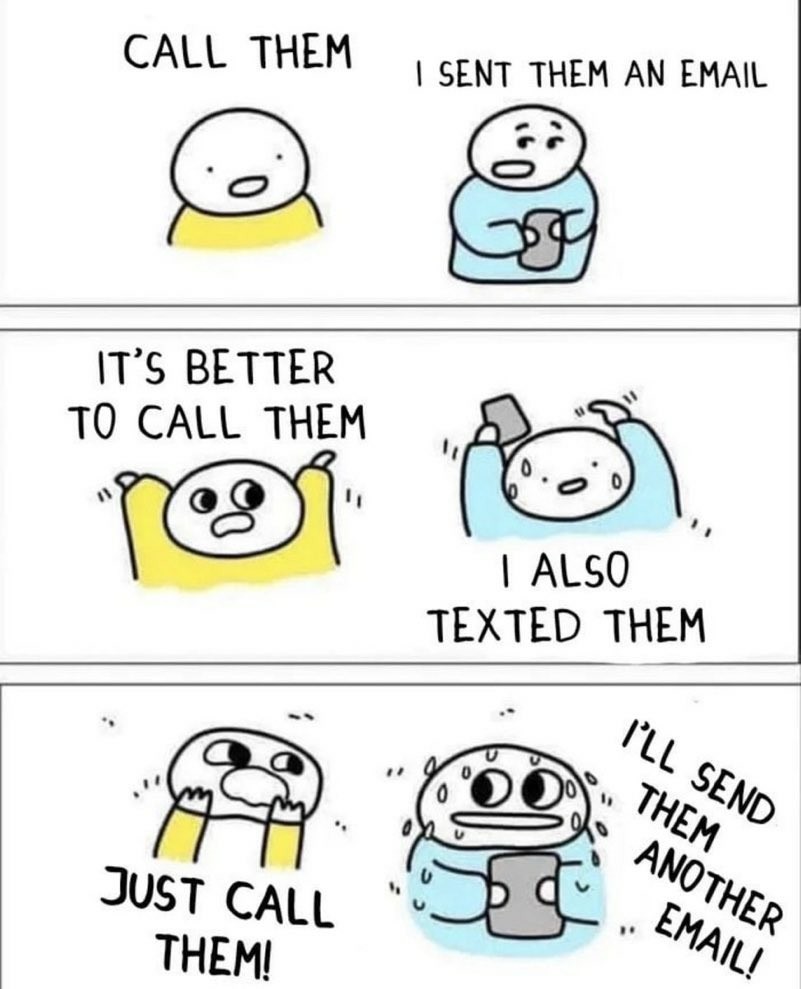
Some autistic people find making phone calls extremely stressful and unpleasant and will avoid them at all costs.
Please don’t try and force your communication preferences on others.
image: anon
#ActuallyAutistic #AuDHD @actuallyautistic
![Avatar for [a]mayz[ing]’s gaze](/proxy/identity_icon/507740677641041258/95a39e9135.jpeg)
I’m 23 and I still do not know what I want to do with my life.
I don’t have a dream, a vision.
I mean… maybe I do. There is a small tiny glimpse of a future I see myself in. A strength I aspire to have. A me that is strong and fighting. Wielding my pattern recognition as a weapon. I can see myself advocating, motivating, writing essays and looking for solutions.
But I am afraid of dreaming. I am insecure. I am still learning who I am, I have days where all I can feel is fragility. I need guidance but do not know how to ask for it. “Just start” doesn’t work for my brain. It is too much, too overwhelming.
I am surrounded by so many people who know so much more about these things than I do. Who are leading experts in adjacent fields. And still, I feel apprehension.
I am scared to take up room. Scared to spread my wings.
I have not told anyone about my glimpse because right now, it feels so far away, that I do not believe it possible.
I need time and space to think about it, to focus on myself unapologetically.
But life does not allow that right now, I have different responsibilities, a job I need to cover living expenses.
And I don’t know how to fix it. I don’t know how to start.
I miss believing more than I do dreaming.
Today I had a moment of autistic joy in a social situation.
Where I live there are no parks close by, but three beautiful graveyards, where I go for a walk with Lumi daily.
This morning a woman asked me for specific details about the graveyards, because she wanted to attend a funeral and didn't know which of the three was the right one and I was able to provide these details for her, because recognising details and patterns is how my autistic mind works and experiences joy. It made me very happy that I was able to help her and that I had a social interaction without having to mask my autism, but it being useful for someone else instead.
This reminds me of the comment of a mutual on my post about infodumping concerning the autistic need of gaining knowledge and sharing it with others.
"As an autist, adquiring expertise on something and beeing helpfull with it feels central to socialisation." @maleza
So true.