
How we built a virtual filesystem for our Assistant by @skeptrune https://lobste.rs/s/orqp4v #ai #unix #vibecoding
https://www.mintlify.com/blog/how-we-built-a-virtual-filesystem-for-our-assistant
unix

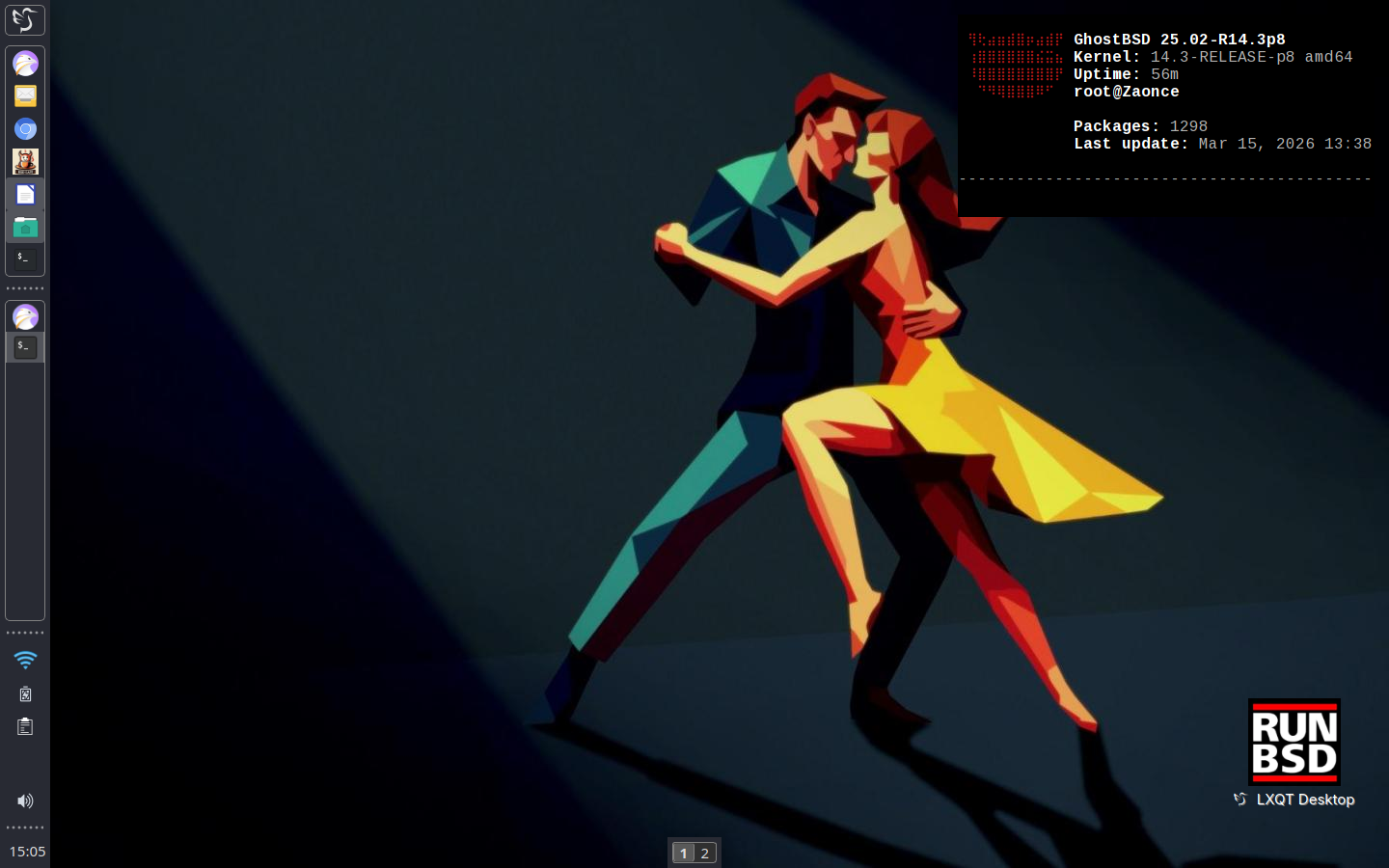
Old: "Zaonce" - Dell Inspiron 1525
Kernel: 14.3-RELEASE-p10 amd64
Operating System: GhostBSD 25.02-R14.3p8
Desktop: LXQT 2.3.0
Windowmanager: XFWM4
Qt Version: 6.10.1
Graphics Platform: X11
https://bsd-hardware.info/?probe=2904d8ae09
#runbsd #freebsd #ghostbsd #unix #foss #lxqt #desktop #screenshot
Edited 223d ago

I reviewed Linda Lamb’s classic "Learning the vi editor" 5th edition. Still very good:
https://drj11.github.io/2026-04-28/review-learning-the-vi.html

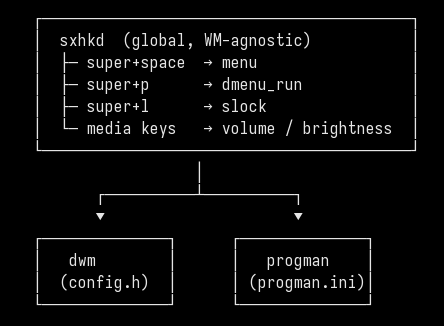
the secret:
sxhkd handles the keys.
the WM handles the windows.
dmenu handles the launching.
swap any one. the others don't notice.
┌─────────────────────────────────────────┐
│ sxhkd (global, WM-agnostic) │
│ ├─ super+space → menu │
│ ├─ super+p → dmenu_run │
│ ├─ super+l → slock │
│ └─ media keys → volume / brightness │
└─────────────────────────────────────────┘
│
┌──────────┴──────────┐
▼ ▼
┌──────────────┐ ┌──────────────┐
│ dwm │ │ progman │
│ (config.h) │ │ (progman.ini)│
└──────────────┘ └──────────────┘
#suckless #unix #dwm #slackware
If you really know your GNU coreutils, you probably don't need as many extra tools as you think. 🐧
KISS isn't just a design principle — it's already built into your system.
A comprehensive review of every coreutils command, with examples and honest opinions. The lobste.rs discussion is also worth reading.
Article: https://ratfactor.com/slackware/pkgblog/coreutils
Discussion: https://lobste.rs/s/xqf5ex/coreutils_comprehensive_review_2023
#linux #unix #coreutils #gnu
Amber-Lang 0.6.0 - New release, check what's new by @mte90 https://lobste.rs/s/heoyfd #linux #programming #unix
https://docs.amber-lang.com/getting_started/whats_new
Curly braces: An evolution of UNIX and C via @hugoarnal https://lobste.rs/s/vnr80q #c #unix
https://thalia.dev/blog/unix-braces/
Golfing Zig ELF Binaries (2025) https://lobste.rs/s/agojmb #programming #unix #zig
https://ctf.gg/blog/zig-binary-golfing
Nitpicking the shell history scene in ‘Tron: Legacy’ via @fanf https://lobste.rs/s/0zltfs #unix
https://www.chiark.greenend.org.uk/~sgtatham/quasiblog/tron-legacy/
Spent the day exploring heirloom-ex-vi (n-t-roff).
It's essentially the cleaned-up 1985 ex/vi 3.7 code — small
(~25k LOC for the editor itself vs ~38k for nvi), simple,
and very readable. Memory footprint is lower (~3MB RSS vs
~6MB for nvi in typical use). Feels snappy.
Limits are by design: fixed temp-file blocks, line pointer
table capped at LBLKS=900 in the default build (~230k lines,
~30MB of text). Above that: "Tmp file too large".
Trade-offs: no
meant for large files.
nvi is more practical for daily work; heirloom is closer
to the original. Beautiful codebase. Worth a look.
#vi #unix
It's essentially the cleaned-up 1985 ex/vi 3.7 code — small
(~25k LOC for the editor itself vs ~38k for nvi), simple,
and very readable. Memory footprint is lower (~3MB RSS vs
~6MB for nvi in typical use). Feels snappy.
Limits are by design: fixed temp-file blocks, line pointer
table capped at LBLKS=900 in the default build (~230k lines,
~30MB of text). Above that: "Tmp file too large".
Trade-offs: no
set ruler, single-level undo, and notmeant for large files.
nvi is more practical for daily work; heirloom is closer
to the original. Beautiful codebase. Worth a look.
#vi #unix
Reading an old UNIX Review article from September 1984 about
termcap. Fascinating how much modern terminal software still
inherits ideas from this era.
vi depended heavily on terminal capability databases to remain
portable across different hardware terminals. Bill Joy originally
wired vi only for Lear Siegler ADM-3A terminals, and termcap was
born from the flood of requests for support on other hardware.
"Termcap Unveiled" by Douglas R. Merritt, pages 42-48.
https://archive.org/details/Unix_Review_1984_Sep.pdf/page/n43/mode/2up
Also updated my nvi notes with a small historical section about
termcap/curses and terminal portability.
https://repo.or.cz/code-notes.git/blob_plain/HEAD:/notes/NVI_Editor_Guide.txt
#vi #unix #termcap #nvi #linux
Spent the day exploring heirloom-ex-vi (n-t-roff). It's
essentially the cleaned-up 1985 ex/vi 3.7 code, brought
forward by Gunnar Ritter and Carsten Kunze: small, simple,
and very readable — about 25k LOC for the editor itself,
versus 38k for nvi. The memory footprint is lower too,
around 3MB RSS against nvi's 6MB in typical use, and it
feels snappy in daily use.
The limits are by design rather than oversight. Fixed
temp-file blocks and a line-pointer table capped at
LBLKS=900 in the default build give you about 230k lines,
or roughly 30MB of text. Beyond that, you get the classic
"Tmp file too large" — and that's fine, because a screen
editor isn't the right tool for huge files anyway.
Trade-offs worth knowing: no
undo, and a hard ceiling on file size. nvi is more
practical for daily work, especially if you live in YAML
where column awareness matters. But heirloom is closer to
the original, and the codebase is genuinely beautiful.
Worth a look.
For anyone curious about the details, I keep a longer note
on heirloom-ex-vi here:
https://repo.or.cz/code-notes.git/blob_plain/HEAD:/notes/Exploring_Heirloom_ex_vi.txt.
Updated today with the LARGEF rebuild instructions for
files beyond the default ceiling.
#vi #unix #suckless #nvi
essentially the cleaned-up 1985 ex/vi 3.7 code, brought
forward by Gunnar Ritter and Carsten Kunze: small, simple,
and very readable — about 25k LOC for the editor itself,
versus 38k for nvi. The memory footprint is lower too,
around 3MB RSS against nvi's 6MB in typical use, and it
feels snappy in daily use.
The limits are by design rather than oversight. Fixed
temp-file blocks and a line-pointer table capped at
LBLKS=900 in the default build give you about 230k lines,
or roughly 30MB of text. Beyond that, you get the classic
"Tmp file too large" — and that's fine, because a screen
editor isn't the right tool for huge files anyway.
Trade-offs worth knowing: no
set ruler, single-levelundo, and a hard ceiling on file size. nvi is more
practical for daily work, especially if you live in YAML
where column awareness matters. But heirloom is closer to
the original, and the codebase is genuinely beautiful.
Worth a look.
For anyone curious about the details, I keep a longer note
on heirloom-ex-vi here:
https://repo.or.cz/code-notes.git/blob_plain/HEAD:/notes/Exploring_Heirloom_ex_vi.txt.
Updated today with the LARGEF rebuild instructions for
files beyond the default ceiling.
#vi #unix #suckless #nvi
Edited 185d ago
9p file server daemon for UNIX-like systems via @RunxiYu https://lobste.rs/s/bybg7e #networking #unix
https://kamid.omarpolo.com/
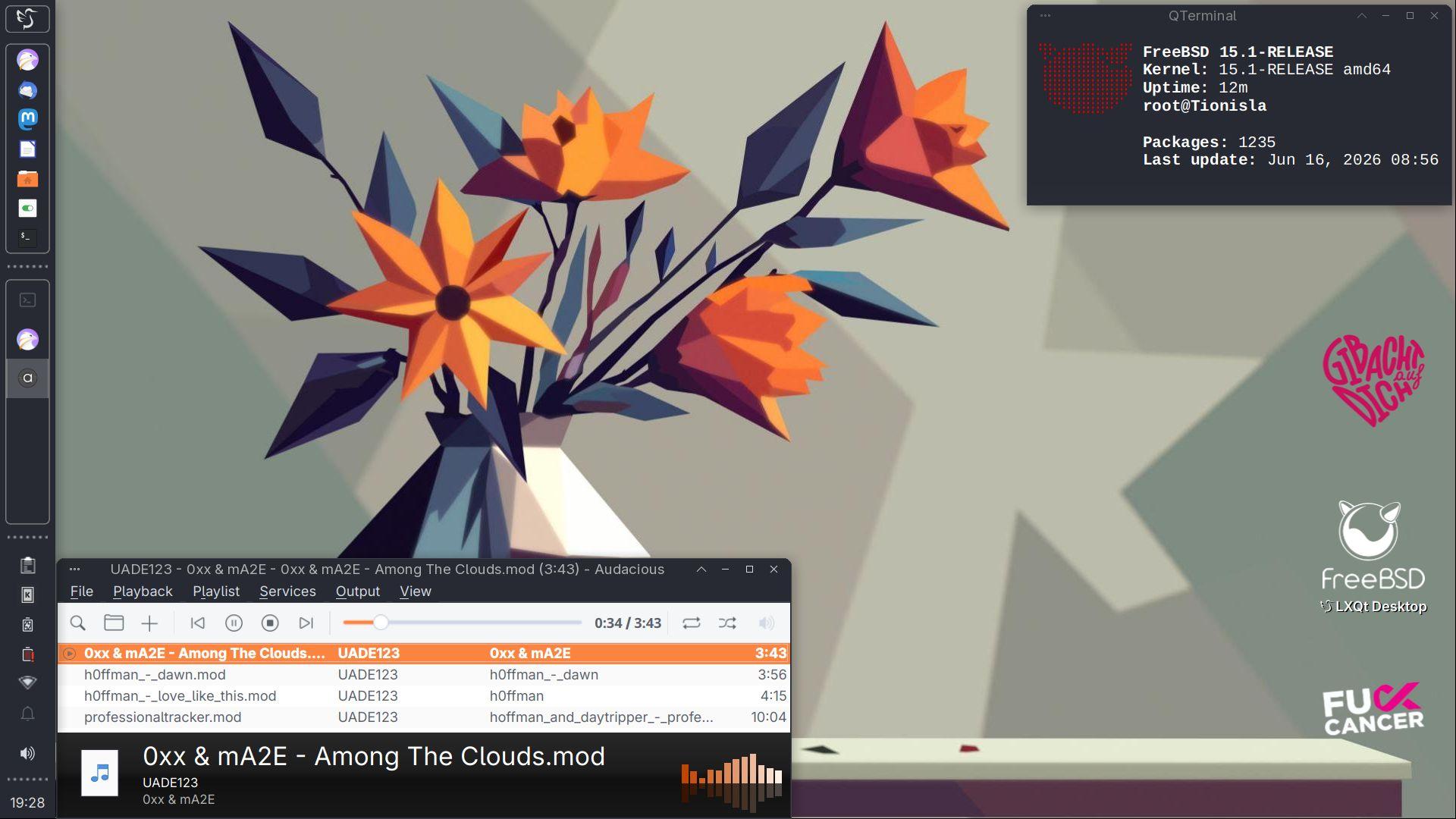
Main: "Tionisla - Dell Latitude e6540
Kernel: 15.1-RELEASE amd64
Operating System: FreeBSD 15.1-RELEASE
Desktop: LXQT 2.4.0
Windowmanager: XFWM4
Qt Version: 6.11.1
Graphics Platform: X11/xorg 7.7
https://bsd-hardware.info/?probe=7e1c664559
#runbsd #freebsd #unix #foss #lxqt #desktop #screenshot #shareyourdesktop
Edited 146d ago
The UNIX shell is still one of the best IDEs ever created.
grep/find/sed/awk/make/ssh/git/nvi often compose better than many modern “integrated” environments.
Small programs connected together still scale surprisingly well.
https://repo.or.cz/code-notes.git/blob_plain/HEAD:/notes/Unix_As_An_IDE.txt
#unix #linux #slackware #vi
grep/find/sed/awk/make/ssh/git/nvi often compose better than many modern “integrated” environments.
Small programs connected together still scale surprisingly well.
https://repo.or.cz/code-notes.git/blob_plain/HEAD:/notes/Unix_As_An_IDE.txt
#unix #linux #slackware #vi
A 90's era Keygen-like for X11 for Unix/Linux https://lobste.rs/s/98momh #c #freebsd #linux #unix
https://github.com/sbz/keygen
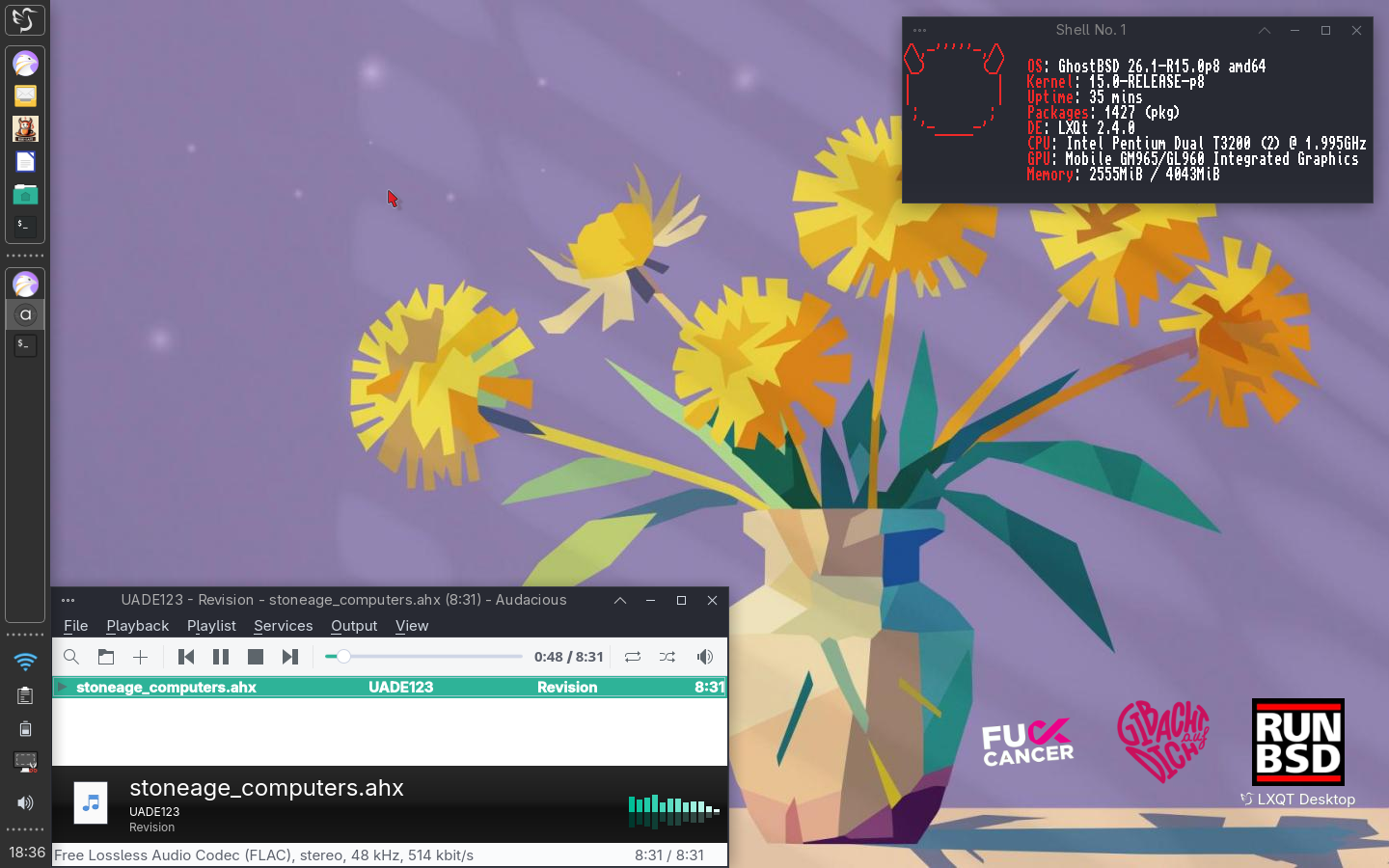
Old: "Zaonce" - Dell Inspiron 1525
Kernel: 15.0-RELEASE-p8 amd64
Operating System: GhostBSD 26.1-R15.0p8
Desktop: LXQT 2.4.0
Windowmanager: XFWM4
Qt Version: 6.10.2
Graphics Platform: X11/xorg 7.7_3
https://bsd-hardware.info/?computer=58b29987d5af
#runbsd #freebsd #ghostbsd #unix #foss #lxqt #desktop #screenshot #shareyourdesktop
UHF X11: X11 built for VisionOS and Apple Vision Pro https://lobste.rs/s/xebobo #unix
https://www.lispm.net/apps/uhf-x11/

The Linux/Unix Default Home Directory Receives An Update
Learn of about the recent update to Freedesktop.org’s XDG User Directories that adds a new directory to a GNU/Linux and Unix default home directory.
https://www.adamsdesk.com/posts/xdg-user-dir-linux-unix-new-default-directory/

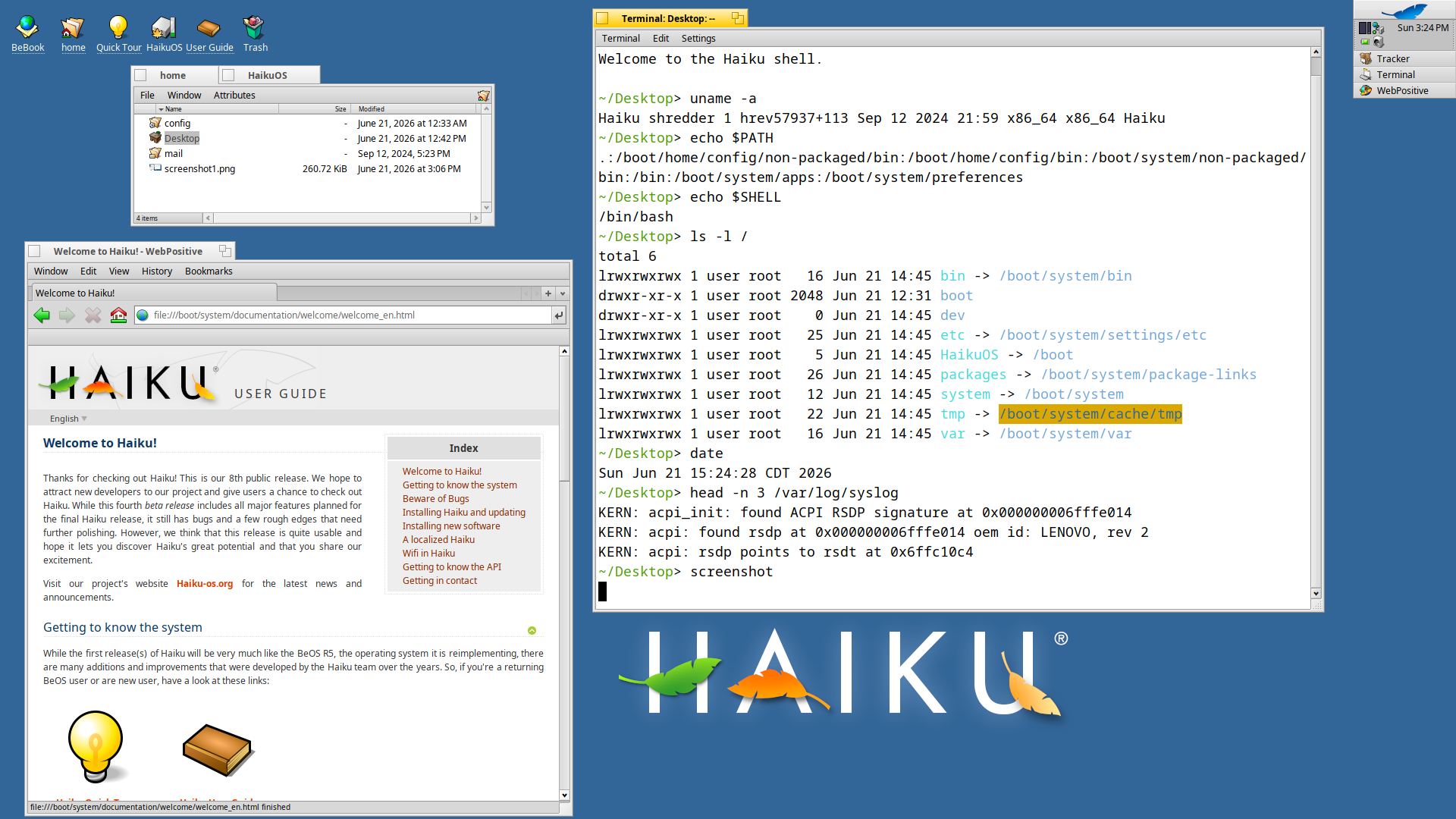
Well this is a nice surprise, #HaikuOS boots fast and even #WiFi and multi-finger touchpad scrolling work out of box on my #ThinkPad T470s. It is dual booting alongside #FreeBSD and #OpenBSD on the same hard disk. I can browser web sites fine. Only thing is sometimes touchpad becomes laggy and I have to plugin a mouse. It is very a fascinating system, I will keep it running for now and explore more about it.
#FOSS #Unix
#FOSS #Unix

#UNIX is not just an OS; it is the ultimate #IDE for #programmers. Arguably the best written introductory book on UNIX programming is "The UNIX Programming Environment", Kernighan (1983). This book covers UNIX V7, but I used it with 4.2BSD.
There is another jewel of a book of a similar kind, a free one to boot, by Prof. Ballesteros (King Juan Carlos University): "Introduction to Operating Systems Abstractions Using Plan 9 from Bell Labs" (2007). Prof. Ballesteros wrote this book to teach his CS students the fundamentals of good OS design.
Although almost no one uses #Plan9 today, it is alive and kicking. It even runs on Raspberry Pi. Anyone interested in OSs and likes the philosophical underpinnings of UNIX should take a look at Plan 9.
The other must-read book is his "Notes on the Plan 9 3ed Kernel Source" (2007).
Prof. Ballesteros has many Plan 9 related publications in PDF format.
https://lsub.org/books-papers/
PS—Those with a historical bent should also read Organick's "The Multics System: An Examination of Its Structure" (1980). Multix is the mother of UNIX, and Plan 9 is the grown-up UNIX.
Edited 140d ago
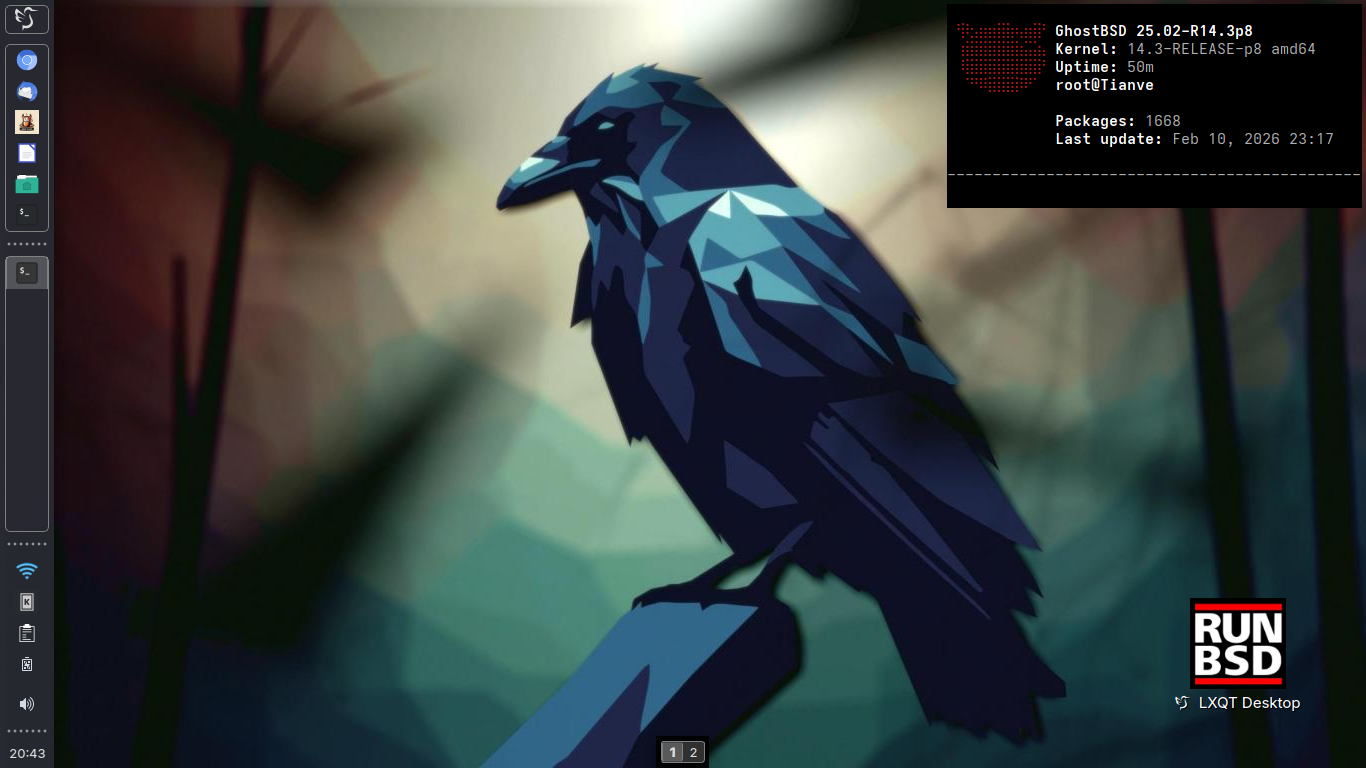
Secondary: "Tianve" - HP-250 G3
Kernel: 14.3-RELEASE-p8 amd64
Operating System: GhostBSD 25.02-R14.3p8
Desktop: LXQT 2.3.0
Windowmanager: XFWM4
Qt Version: 6.10.1
Graphics Platform: X11
https://bsd-hardware.info/?probe=77494a1526
#runbsd #freebsd #ghostbsd #unix #foss #lxqt #desktop #screenshot
Edited 271d ago