netbsd


Recently I got asked about my @BoxyBSD project, which offers free VPS instances of vary #BSD based systems for learning and educational purposes and I'm happy to share that this projects remains available. Several things could finally be clarified to continue this service to make sure people can learn and practice on real #FreeBSD, #OpenBSD, #NetBSD systems to #RUNBSD. Also, BoxyBSD starts moving over to #Sylve on #bhyve.
But not only that! We could also get some more new resources and locations to scale and this also brings up another new project for #free Linux #VPS instances at https://boxedtux.com (Fedi: @BoxedTux) where people will be able to learn and practice on different #Linux based distributions (e.g., #Debian, #Ubuntu, #Rocky,...). BoxedTux utilizes #Proxmox clusters as a foundation.
Hope you like this small update... Over & out!
#freeVPS #VPS #VM #Hosting #education #learning #learningplatform #service #opensource #BoxedTux

But at the end of day I am hypocrite because I need Fish Linux for y*-dlp and gov websites.
#noAI

Beneath the Linux surface: the UNIX legacy, a lively ecology https://lobste.rs/s/ct9mlh #freebsd #illumos #linux #netbsd #openbsd
https://club.unix.rocks/commentary/under-linux/


Happy International Day for Biological Diversity! 🌱
A diverse ecosystem is a strong ecosystem. In the tech world, NetBSD brings vital diversity by proving that clean, portable, and secure code can run on virtually any architecture. This adaptability keeps computing open and accessible to everyone.
Let's keep the digital ecosystem diverse. Consider supporting the NetBSD Foundation today by contributing code, writing documentation, or making a donation! 💻🚩
#NetBSD #BiodiversityDay #OpenSource #TechDiversity #FOSS #RetroComputing #Sustainability #Linux #RunBSD #FreeBSD #OpenBSD



 🍵
🍵 
New #blog #post: Package Manager Tier List
https://rldane.space/package-manager-tier-list.html
1521 words
Note: this is a very off-the-cuff tier list, using speed as the main qualifier, but the article explains exceptions to that as it goes on.
cc: my wonderful #chorus: @joel @dm @sotolf @thedoctor @pixx @orbitalmartian @adamsdesk @krafter @roguefoam @clayton @giantspacesquid @Twizzay @stfn
(I will happily add/remove you from the chorus upon request! :)
#rlDaneWriting #blost #DeadLikeMe #Linux #BSD #RunBSD #FreeBSD #OpenBSD #NetBSD #Debian #Arch #pacman #AUR #Fedora #homebrew #flatpak #snap #OpenSuSE #RPM
The requirements are pretty low:
NO IPv4
min. IPv6 /48 subnet routed
Network (ARIN/RIPE/…) should be personalized (netname, abuse,..)
Optionally: BYOIP
ARPA delegation for the net to my nameservers
min. 2x 500G disk space (SATA SSD or better)
min. 48G memory per node
bandwidth doesn’t really matter (100Mbit is fine)
Remote MGMT to systems
#bsd #freebsd #netbsd #openbsd #openindiana #education #learning #opensource
Interestingly, #FreeBSD comes with #nvi2 in base, while #OpenBSD and #NetBSD seem to be running #nvi 1:
FreeBSD 14.3-RELEASE-p12~~~Version 2.2.2 (2025-10-08) The CSRG, University of California, Berkeley.
OpenBSD 7.3(7.9 is still running the same version)~~~Version 1.79 (10/23/96) The CSRG, University of California, Berkeley.
NetBSD 10.1~~~Version (1.81.6-2013-11-20nb4) The CSRG, University of California, Berkeley.
They all seem to have nvi2 available as packages, though, which #Debian, oddly, does not.
rld@Intrepid:~$ uname -srFreeBSD 14.3-RELEASE-p12rld@Intrepid:~$ pkg search nvi |grep '^nvi2'nvi2-2.2.2 Updated implementation of the ex/vi text editorrld@Intrepid:~$
#(searching openbsd online)rld@Intrepid:~$ searchall -o nvi |grep ^nvinvi-2.2.2 (list) with wide and files limited bynvi-2.2.2-iconv (list) with wide and files limited by
rldane@rosa.tilde.pink$ uname -srNetBSD 10.1rldane@rosa.tilde.pink$ pkgin search nvi |grep ^nvi |grep -v nvidianvi-1.81.6nb13 Berkeley nvi with additional featuresnvi-m17n-1.79.20040608nb11 Clone of vi/ex, with multilingual patchnvi2-2.2.0 Multibyte fork of the nvi editor for BSDrldane@rosa.tilde.pink$
~ $ head -1 /etc/os-release PRETTY_NAME="Raspbian GNU/Linux 13 (trixie)"~ $ apt-cache search nvi |grep -E '^nvi2? 'nvi - 4.4BSD re-implementation of vi~ $
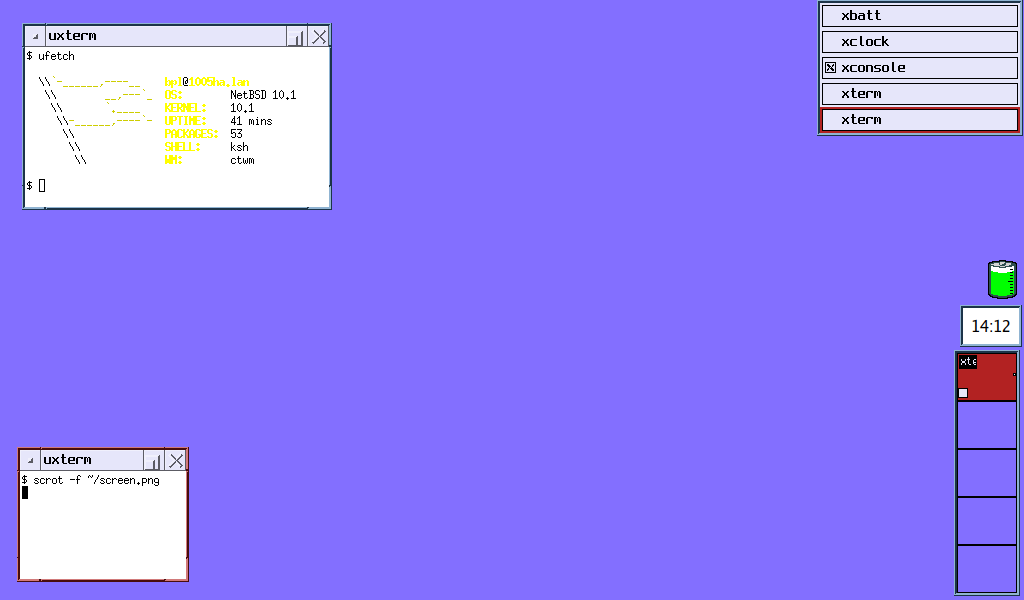
(1) System seems to be less integrated internally than #OpenBSD (it might not be fair comparison, but that's my only anchor point).
(2) Initial setup of Xorg needs some manual tuning (concerns non-US users), which is okay, not a problem to find answers.
(3) It boots up quickly, but shut downs longer than I would initially expect due to closing disk operations (to me this is not a problem).
(4) pkgsrc allows to pick over software, I tested Basilisk aka Snake web browser which I expected to work okay, but it was often choking due to JS. This browser is not accessible under Fish Linux.
(5) Thanks to pkgsrc I could test few alternatives to fetchmail, but I was not able to get them working. The best success I got with fetchmail because it was able to connect with server, but it was not able to hand e-mails over to postfix. I went over whole point regarding mails in guide, checked few articles, but nothing worked.
(6) I was missing lsblk.
(7) CTWM is very nice WM, copy system config file, do few tweaks and you are good to go.
As usual, YMMV. If you do not use archaic setups and do not care about 3D graphic acceleration, you will be content with NetBSD.


The nanopi r6s arrived this week, so now I'm trying to install NetBSD on it. Managed to install the EDK2-based UEFI firmware, which apparently is a prerequisite. Trying to figure out the next steps. I think it's writing arm64.img to an sd card and trying to boot that, and then ... sysinst?? or something??
I've only ever ran NetBSD on amd64, so it's a journey of discovery.
This World Environment Day, combat e-waste by recycling your old tech with #NetBSD. Don't let planned obsolescence dictate your hardware's lifespan. Give that old machine a second life as a rock-solid firewall, file server, or lightweight workstation. 🖥️🌱
#WorldEnvironmentDay #NetBSD #RunBSD #RetroComputing #EcoFriendly #FOSS #Linux
#OpenBSD
Direct donations
Official merch
#NetBSD
Direct donations
Merch
#somafm
Direct donations
Merch
#unix_surrealism
Direct donations
Merch


# FreeBSD
pkg ins vim # same as pkg install vim
pkg sea vim # same as pkg search vim
# NetBSD
pkgin in vim # same as pkgin install vim
pkgin se vim # same as pkgin search vim
# while in Debian
apt search vim # no apt se/sea
apt install vim # no apt in/ins
small screen, max 10 inch
runs #OpenBSD or #NetBSD
has a keyboard
can connect to Internet
it works
price is reasonable
MNT Reform Pocket (if I will be super rich one day, then I will take entire stock)
HP Jornada (especially 720, but availability is not great)
Zaurus machines (availability is almost zero and might not fill condition "it works")

LittleFedi: light, yet complete
I'm writing this post from a Raspberry Pi Zero W - 512 MB RAM, single-core ARMv6 - running NetBSD, powered by littleFedi. The process sits at 33 MB RSS, CPU basically asleep:
load averages: 0.05, 0.08, 0.09CPU states: 0.0% user, 0.0% nice, 0.0% system, 1.0% interrupt, 99.0% idleMemory: 301M Free PID COMMAND RES STATE 2082 littlefedi-armv6 33M kqueue
No Redis. No PostgreSQL (but optional). No Sidekiq. No Node.js build pipeline. One statically-linked binary, one SQLite file, and the full fediverse experience. And this is the part people tend to miss: the same binary that runs happily on a Pi Zero scales, on the right hardware, to numbers that have nothing to do with "lightweight". It's not a toy that stays a toy. It's built to grow when you need it to.
What LittleFedi actually ships
Federation - Full ActivityPub S2S: WebFinger, NodeInfo 2.1, host-meta, HTTP Signatures with anti-impersonation checks. Per-user and shared inboxes, outbox, followers, following, featured collections. Thread completion with bounded on-demand fetching of missing ancestors/replies (separate sync and background budgets, all hard-capped). Quote posts via FEP-044f with the full approval handshake (QuoteRequest -> QuoteAuthorization), matching Mastodon 4.4 semantics, plus _misskey_quote and Fedibird quoteUri aliases. Account migration (Move), both outgoing and incoming, with alsoKnownAs linking, automatic follower migration, follow import from AP collections, and CSV export/import. Remote interaction discovery - async like/boost resolution from origin servers with REST fallback.
Mastodon API - Broad coverage: timelines (home, public, local, hashtag, bubble, direct), status CRUD with edits, scheduled posts, polls, bookmarks, lists (with replies_policy and exclusive), filters v2 (keyword CRUD), featured tags, followed hashtags (posts appear in home), markers, conversations, notifications with type exclusion, follow requests, blocks (federated Block/Undo), mutes with duration/expiry and hide_notifications, per-user domain blocks. OAuth2 with app registration, authorization code, client credentials and refresh_token flows, PKCE, consent screen, and scope enforcement (read/write/admin:read/admin:write). It talks fine to Elk, Tusky, Ivory, Phanpy, Semaphore and MastoBlaster.
Streaming - WebSocket and SSE. In-process pub/sub hub with per-connection send buffers, zero cost when no client is connected. Broadcast streams for public, local, remote, hashtags and lists. Per-account streams for user timeline, notifications and direct messages. Optional PostgreSQL LISTEN/NOTIFY backend for cross-process fan-out. Mastodon-compatible event serialization.
Push notifications - Full Web Push / VAPID (RFC 8030/8291) with aes128gcm encryption. Per-type alert toggles (mention, follow, reblog, favourite, poll, follow_request, status). Notify-bell support on followed accounts. Subscription expiry detection, rate-limit handling, 5-retry delivery.
Media pipeline - Upload processing: thumbnail generation (600x600), blurhash computation, EXIF stripping, magic-byte validation, SVG rejection, MIME mismatch detection, UUID-based file renaming. Size limits (40 MB default), pixel caps (16 MP default, tunable down to 4 MP for SBCs).
Media privacy proxy - This is the part I actually care about most. All remote media streams through the instance via HMAC-signed URLs (/proxy/media?url=...&sig=...), so local users never expose their IP address to remote servers. SSRF-guarded: DNS resolution check, private/CGNAT IP rejection, redirect re-validation. Pure io.Copy pass-through, no disk, no decode, ~32 KB buffer. Forwards HTTP Range requests for audio/video seeking. Configure a proxy_secret for stable URLs across restarts. On low-RAM devices, set cache_remote = "off" and you still see every image on the fediverse, the instance just doesn't store or process them.
Remote media caching - Three modes: off, eager (background sweep caches all remote attachments, avatars, headers and emoji, backfills existing on mode switch), lazy (cache on first access). Content-addressed, deduplicated by origin URL. Age-based pruning with file GC. Negative-cache for permanently dead URLs. Transparent origin fallback on cache miss. Open Graph preview cards stored durably with posts.
S3-compatible storage - A separate build tag (-tags s3), deliberately excluded from the default binary to keep it small. Supports AWS S3, MinIO, SeaweedFS, Ceph, Backblaze B2, Wasabi, DigitalOcean Spaces. Native media migration CLI: littlefedi admin media storage-migrate between local and S3 (DB-queue-backed, resumable, bounded batches). storage-status, storage-cancel, storage-resume commands. storage-manifest for rclone JSONL integration.
Markdown posts - Powered by goldmark with GFM extensions: tables, strikethrough, bare URL autolinking, hard wraps. Raw HTML deliberately not rendered. Output sanitized through bluemonday (defense-in-depth). Composer toggle in the web UI. Federates source.mediaType: text/markdown (Pleroma/GTS convention). Inbound Markdown source is rendered to HTML.
Visibility modes - The standard four (public, unlisted, private, direct) plus local-only (local, instance timeline only, never federates) and local unlisted (local_unlisted, followers only, no federation). Useful for notes to your own instance community.
Bubble timeline - Curated set of instances whose posts appear alongside local posts in a special timeline. Akkoma-compatible extension. Admin panel for adding/removing bubble instances. API endpoint at /api/v1/timelines/bubble.
Moderation - Account states: suspended (tombstone, federates Delete(Person)), silenced (visible to followers only, dropped from public timelines), quiet (like silenced plus it downgrades federation to followers-only, a middle ground I haven't seen anywhere else), disabled (cannot log in, content stays visible). Self-suspend prevention, last-admin-demotion guard. Blocks (bidirectional, federated), mutes (local-only, with duration and hide_notifications), per-user domain blocks (distinct from admin instance-wide blocks). Reports pipeline: user submissions plus inbound/forwarded Flag into an admin triage UI with resolution actions. Admin notification on new reports. Domain blocks with severity (noop/silence/suspend) plus Mastodon-parity options (reject_media enforced in the proxy, reject_reports, obfuscate, public). A moderation audit log records every admin action.
Web UI - Server-rendered HTML with html/template, templates embedded via //go:embed. Inline CSS (dark mode, Inter font, gradients). htmx 2.x and Alpine.js for progressive enhancement. No build step, no Webpack, no Tailwind, no npm. Every action works as a plain form POST without JavaScript. Works in Lynx, eLinks, text-only browsers, and on mobile.
Full feature set: home/public/local/bubble timelines with infinite scroll, profile pages with follow/unfollow/bell toggle, status threads with reply composer and background thread completion, post creation with CW, visibility selector (6 modes), media upload with alt text, Markdown toggle, quote posts (pre-loads composer with the quoted post as an inline card), post editing, composer autocomplete for @mentions and #hashtags, settings (display name, bio, password, sessions, moderation, pruning, account move, timeline preferences), report form, search page, tag management.
Admin panel - Dashboard (user counts, pending approvals, unreachable instances, open reports), accounts (with suspend/silence/quiet/disable/approve/reject actions), invites (CRUD), domain blocks (with severity and options), reports (triage and resolution), audit log, instance health (per-instance status with follower/following counts, reachability tracking, purge with typed-domain confirmation), bubble instances, settings, housekeeping (on-demand pruning), queue console (ready/scheduled/running/failed by job kind), media storage (S3 migration controls in S3 builds).
Background jobs - DB-backed queue that survives restarts, 8 job kinds: inbox, delivery (16 attempts over roughly 26h with capped exponential backoff and equal jitter), push_notification, actor_refresh, poll_close, scheduled_status, media_cache, media_migration. Per-instance circuit breaker suspends delivery at backoff_count >= 10. Actor refresh dispatcher with stale-while-revalidate, crash-safe leases, and per-actor exponential backoff.
Backups - Periodic or on-demand, server-side, no external tooling required. Each run produces a timestamped directory with config.toml, a portable database dump (VACUUM INTO for SQLite, pg_dump for PostgreSQL), an optional copy of owned media, and a manifest. Toggle it on, set an interval (24h, 7d, whatever fits), decide whether to include owned media (the remote cache is always excluded, no point backing up other people's content), and set a retention count so old backups get pruned automatically. Off by default, one line to turn on.
Housekeeping - Automated pruning: remote statuses by age, own low-interaction statuses (per-user or server thresholds, min likes/boosts caps), tombstones, expired mutes, stale media (>24h unattached), orphaned media (deleted posts), unreferenced media files (disk files with no DB record), cached media by age, cache file GC. On-demand controls in the admin UI.
Security - Token-bucket rate limiting per IP. Security headers: X-Content-Type-Options, X-Frame-Options, Referrer-Policy, Strict-Transport-Security. Content-Security-Policy with nonce-based script/style. CORS. CSRF on all cookie-authenticated POSTs. Session fixation protection. Password reset token in a cookie, not the URL. OAuth consent screen (not auto-issuing). SSRF protection (DNS, IP and redirect re-validation) on all outbound HTTP. HTTP Signature algorithm enforcement (rsa-sha256 only). Inbox body size limit (1 MB). Backfill goroutine cap. Thread-fetch amplification limits. File upload validation (magic bytes, SVG rejection, MIME mismatch). Username enumeration hardening.
Operational - Prometheus metrics at /metrics (counters for API/inbox/fed/web requests, statuses, deliveries, thread fetches, queue depth; gauges for workers, pending follows, uptime). Health checks (/health, /readyz). CLI: admin create-user, admin set-admin, admin list-users, admin suspend/unsuspend, admin invite generate/list/revoke, admin media prune/prune-orphans/prune-files, admin media storage-migrate/status/cancel/resume/manifest, post (publish from stdin/file with Markdown, visibility, CW, media, reply, quote), migrate (run migrations only). SMTP for password reset and notifications (falls back to stdout). Config via TOML file plus environment variables (LITTLEFEDI_{SECTION}_{KEY}).
Platform support - CGO-free, compiles with CGO_ENABLED=0. 23+ GOOS/GOARCH combos via the modernc SQLite driver: macOS (amd64, arm64), Linux (386, amd64, arm, arm64, loong64, ppc64le, riscv64, s390x), FreeBSD (386, amd64, arm, arm64), Windows (386, amd64, arm64), OpenBSD (amd64, arm64). NetBSD (amd64, arm, arm64) via a WASM-based fallback SQLite driver, I don't think anything else in the fediverse space explicitly targets NetBSD. PostgreSQL is a separate build tag (-tags postgres), S3 is another (-tags s3). The default binary carries neither, keeping it small. ARMv6 (GOARM=6) gets special treatment in the release naming, that's the Pi Zero target.
Why it matters
The fediverse shouldn't demand a beefy VPS. It shouldn't require Docker, 2 GB of RAM, Redis, Sidekiq, or a JS toolchain that pulls in 800 packages. A 10 euro Raspberry Pi Zero W running NetBSD, sitting on a shelf, drawing less than 2 watts, can be a fully functional fediverse instance with a web UI, mobile app compatibility, streaming, push notifications, quote posts, account migration, and a moderation toolkit. That's not hypothetical, that's what this post is running on.
But don't mistake "runs on a Pi Zero" for "only runs on a Pi Zero". Point the same binary at real hardware and it scales to numbers that have nothing to do with hobby-instance territory. Low power is the floor, not the ceiling.
One binary, one config file, one SQLite database. Light, yet complete.
I've been involved in this project for a while now, though I can't say much more about it at the moment, there are other people involved besides me and it's not entirely my call to talk about it publicly yet.
Ok, I'm testing something cool.
A blend of #snac, #Mastodon, #honk, #GoToSocial...and more.
This is running on a Raspberry PI Zero W, powered by NetBSD. The same that is powering my own smart thermostat. And it's quick.
I'll use this account and try to "stress" it.
Own your data. Always own your data!
Port the Enlightenment desktop environment to NetBSD https://lobste.rs/s/xkdbhe #netbsd
https://blog.netbsd.org/tnf/entry/gsoc2026_enlightenment
if you need to use ffmpeg to merge video with music, you can symlink ffmpegX
(where is X is version of installed software) and ffprobeX to ffmpeg and ffprobe
respectively in /usr/pkg/bin, then yt-dlp will be able to find binaries.




Some journeys don't end where you expect them to. Sometimes they bring you right back to where everything began, only with a lot more experience and a much better ecosystem waiting for you.
That's exactly what is happening with BoxyBSD!
In my (longer) blog post I cover my circuit, where I moved from bhyve to Proxmox, developed many tools for Proxmox and now moved back to FreeBSD with bhyve and Sylve.
More details in my blog post: https://gyptazy.com/blog/boxybsd-moving-from-proxmox-to-bhyve-with-sylve/
#RUNBSD #bsd #freebsd #boxybsd #openbsd #netbsd #sylve #bhyve #opensource #vps #vpshosting #opensource #community #bsdcafe #boxybsd

On 10 March 2021, I had only just fallen asleep when my phone started buzzing. Then another notification, and another. In a matter of minutes, 142 of my servers went up in the clouds. And not the cloud-computing kind.
Most of them were physically going up in a column of smoke in Strasbourg.
My wife looked at me and asked if I wanted a coffee. I nodded. It was going to be a very long day.
At EuroBSDCon 2026, I won't be giving a theoretical lecture on high availability. Instead, I’m going to tell the raw story of that night: the emergency recovery, the architectural choices that actually saved us, and the ones that crumbled under pressure (because we rarely talk about what fails).
Most of all, I’ll explain why that night changed my perspective, and why I’ve come to see BSD systems not just as operating systems, but as essential, practical tools for building simpler, more resilient infrastructure.
The official schedule is now live. If you want to hear a real-world post-mortem, join me on Saturday, 12 Sept at 11:15 (Room D.0.02).
EuroBSDCon Full schedule: https://events.eurobsdcon.org/2026/schedule/
See you there! ☕️
#FreeBSD #NetBSD #OpenBSD #DragonFlyBSD #RunBSD #EuroBSDCon #SysAdmin #SelfHosted #IT #EuroBSDCon2026 #BSDCon