
Welcome! I’m Jendia Gammon, Nebula and BSFA finalist author of DUNGEON CRAWL AT THE HAUNTED MALL, THE SECRET OF THE SAPPHIRE SENTINEL, and many other books. Also as J. Dianne Dotson. I am EIC of @starsandsabers and CEO of Roaring Spring Productions, LLC. I’m mom to two teens. I’m also an artist and a science writer. I’m from Appalachia and I live in Los Angeles.
Learn more about me and my work at jendiagammon.com
#Author #Writer #Publisher #Editor #Artist #womeninstem #creative #books
editor


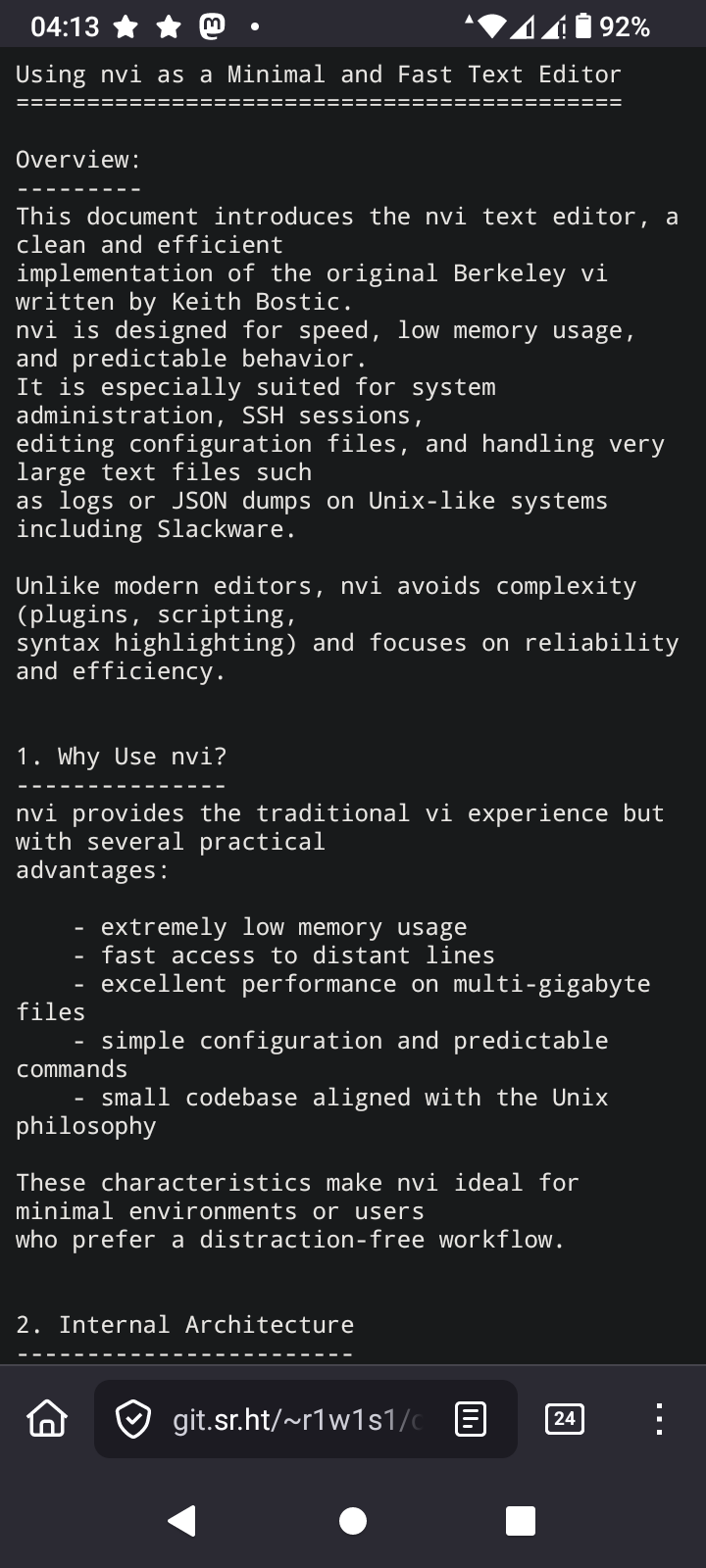
Still using nvi on Slackware.
No plugins. No syntax highlighting. Just speed, predictability, and classic vi behavior, even with multi-GB files.
I wrote a short guide explaining why nvi still matters and how its architecture enables fast, low-memory editing.
📄 https://4c6e.xyz/code_notes.html (NVI Editor Guide)
📄 https://git.sr.ht/~r1w1s1/code-notes/blob/main/notes/NVI_Editor_Guide.txt (plain text)
#slackware #editor #nvi #vi #unix #minimalism
No plugins. No syntax highlighting. Just speed, predictability, and classic vi behavior, even with multi-GB files.
I wrote a short guide explaining why nvi still matters and how its architecture enables fast, low-memory editing.
📄 https://4c6e.xyz/code_notes.html (NVI Editor Guide)
📄 https://git.sr.ht/~r1w1s1/code-notes/blob/main/notes/NVI_Editor_Guide.txt (plain text)
#slackware #editor #nvi #vi #unix #minimalism
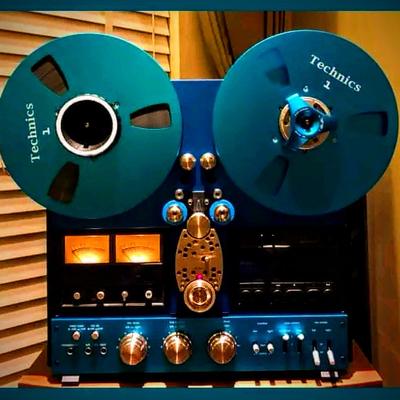
TIL again, about low ram footprint editors in OpenSource environments.
In the period where the following commands were valid
ATX3DT
ATA
Such editors were standard. I'm talking about vi. Over extremely noisy POTS lines without error correction, vi was the only editor you could use safely. I remember switching from editing mode to reading mode as frequently as possible, because the 2400 BPS modem from the SR University, had difficulty to keep the line as noise free as possible due to the archaic hardware infrastructure of the phone company.
The editor I'm learning again about is nvi
I'm going to take a deep dive into this, because one thing I love is using the least memory as possible while computing
#vi #nvi #vim #VimMasterRace #editor #SSH #AT #Hayes #OpenSource #programming #Linux #technology
https://4c6e.xyz/code_notes.html
Edited 112d ago

People ask why I use Neovim.
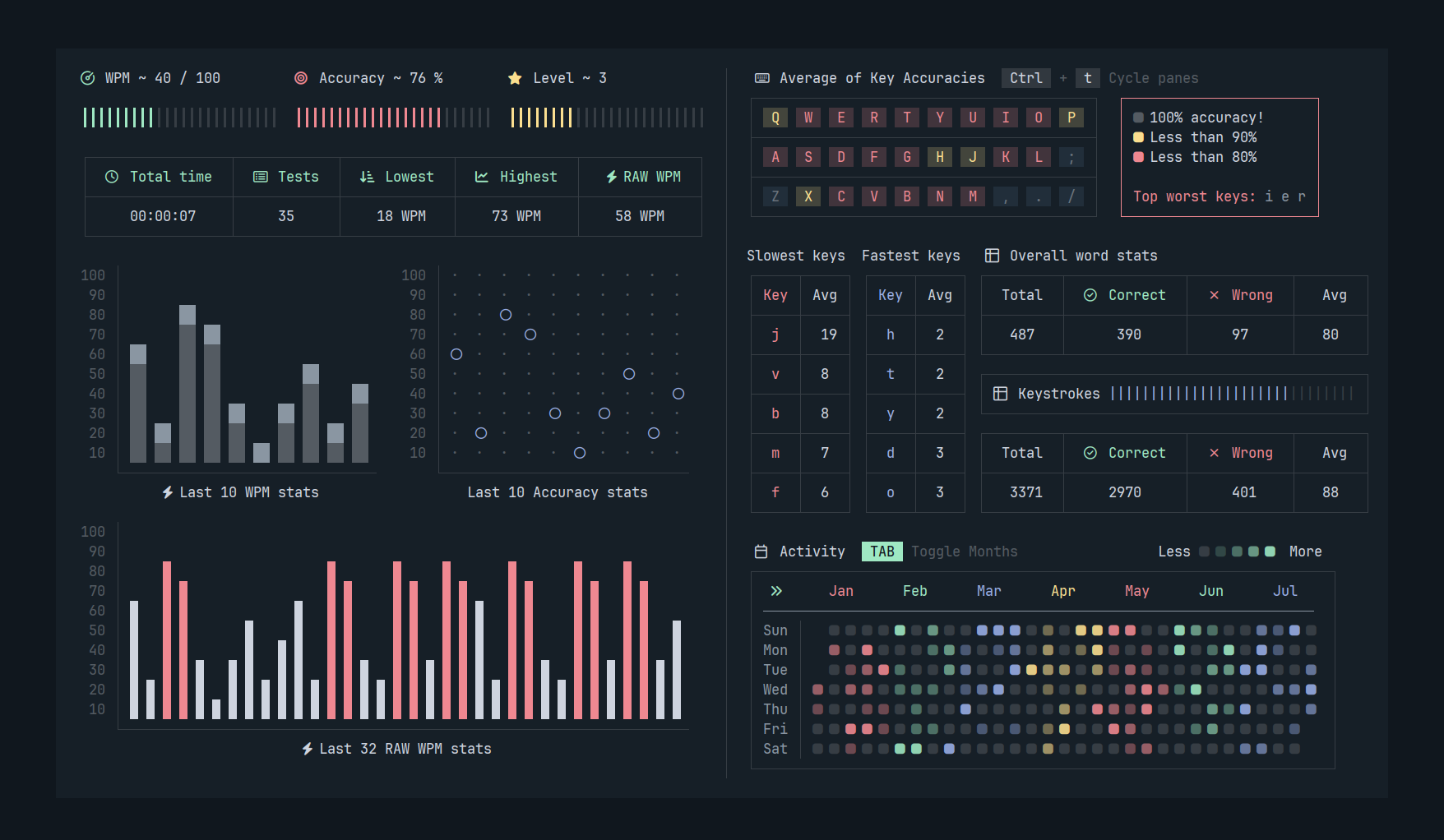
It's because of amazing plugins like this ⚡
⌨️ **typr**: Typing practice plugin for Neovim with dashboard.
💯 Supports showing detailed stats & configuration!
⭐ GitHub: https://github.com/nvzone/typr
#neovim #vim #plugin #typing #practice #speed #dashboard #terminal #editor #keyboard #commandline

Hello le Fediverse 
Moi c'est Oblio, je suis un artiste-éditeur handi ✌️ 
Je fais de la micro-édition qui mèle expérience graphique et recherche autour des questions crip et du travail de l'art. ♿
À côté de ça, j'ai aussi mille passions comme la teinture végétale, la couture de vêtement historique, la fermentation. (quand ma fatigue me le permet 🥺🩹)
Pour finir, sachez que je voue un culte à Linux et aimerais énormément apprendre le html2print 🤓 👀 
#artistsonmastodon #intro #introFR #introduction #introductionfr #artist
#art #editor #editionindependante #zine #editor #accessibilité #handicap #validisme #html2print #artcontemporain
Edited 57d ago
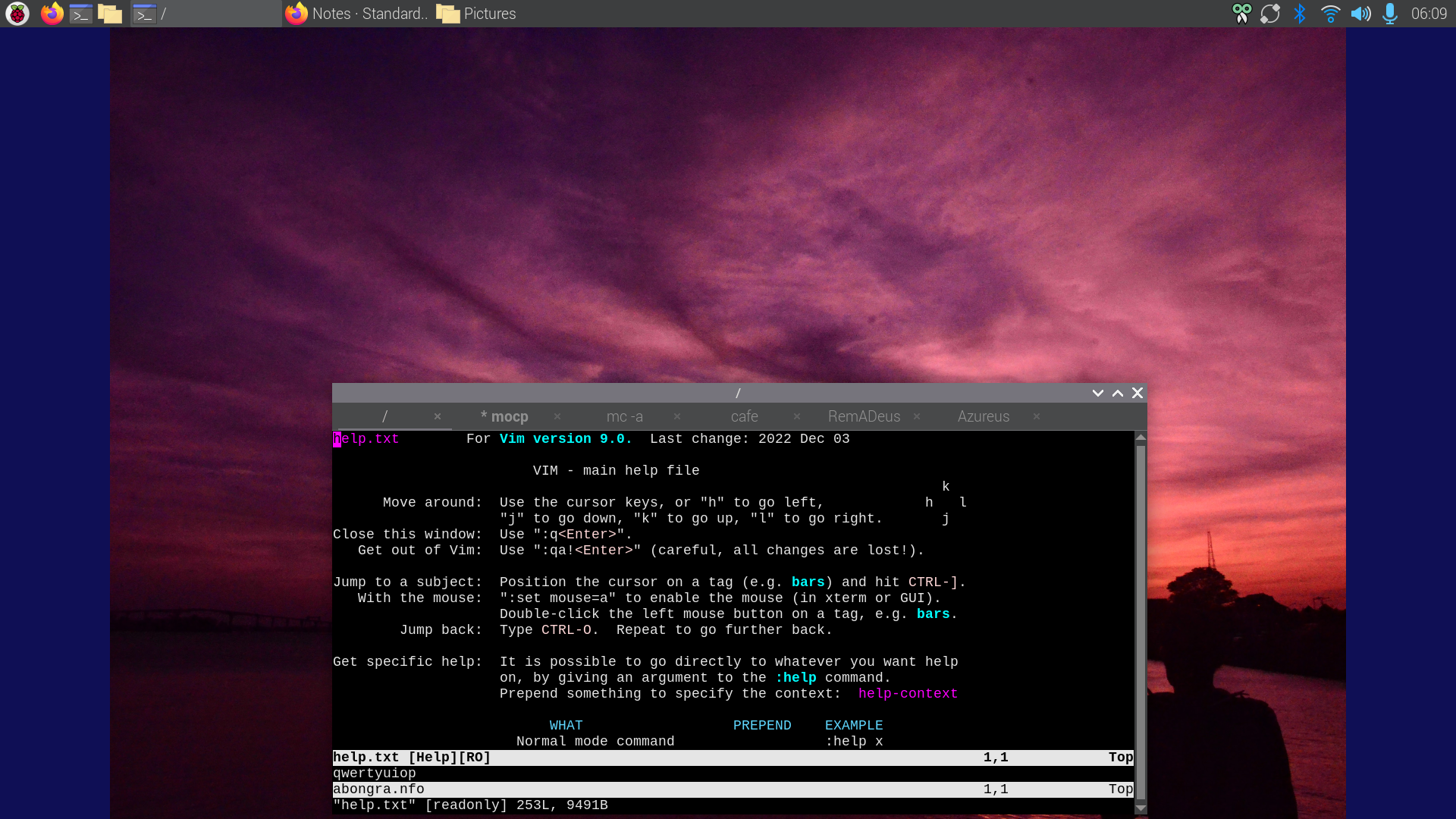
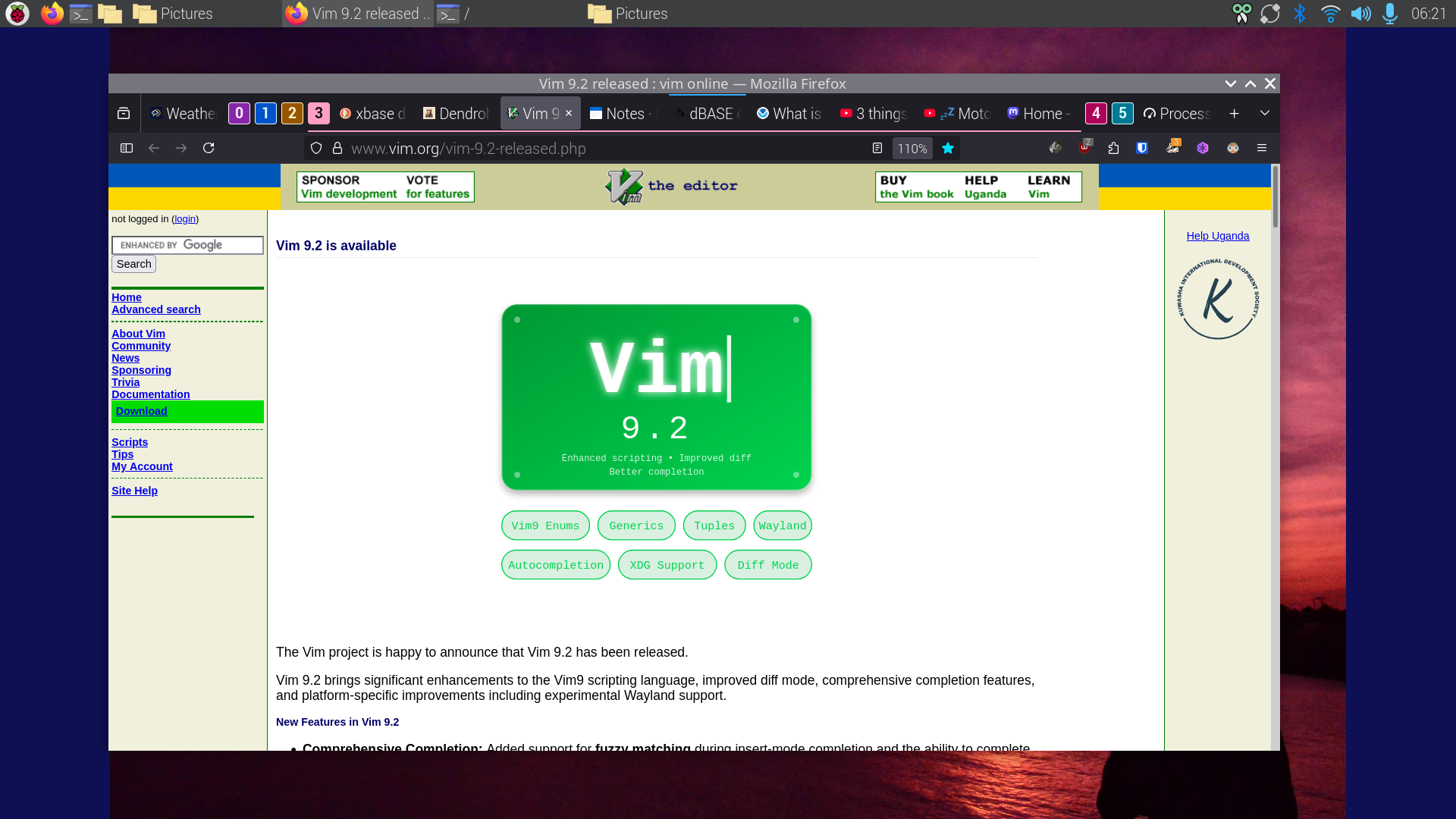
Vim v9.2 is released. There are many magnífico features I look forward to use. VIM is a Swiss Army Knife for editing Source Code & text.
The features are too many to mention, no really I don't know them all; NOBODY DOES!
Just like with the GiMP I know the functions I need and learn more when the requirement arizes. VIM has an extensive help system which Bram Molenaar et all developed over the decades that VIM exists.
History
VIM was initially coded on the Amiga computer systems of which I own an A4000T with a Cyberstorm 060 and Max Ram, with RTG card (Picasso 96), a A1200 vanilla with a stock HDD & an A500 with stock RAM (chip and fast) and 3 FDD 2x 3.5" 1x 5 1/4"
Bram wrote VIM in such a way that it runs on the A500 with just 512kB RAM!
There are people who love EMACS. To them I say
<flame bait>
EMACS can't hold a candle to VIM
</flame bait>
Of course that is just humour. In the Open Source world choice is what makes us all work and play well on whatever hardware we have with whatever tools we love
>> Quote
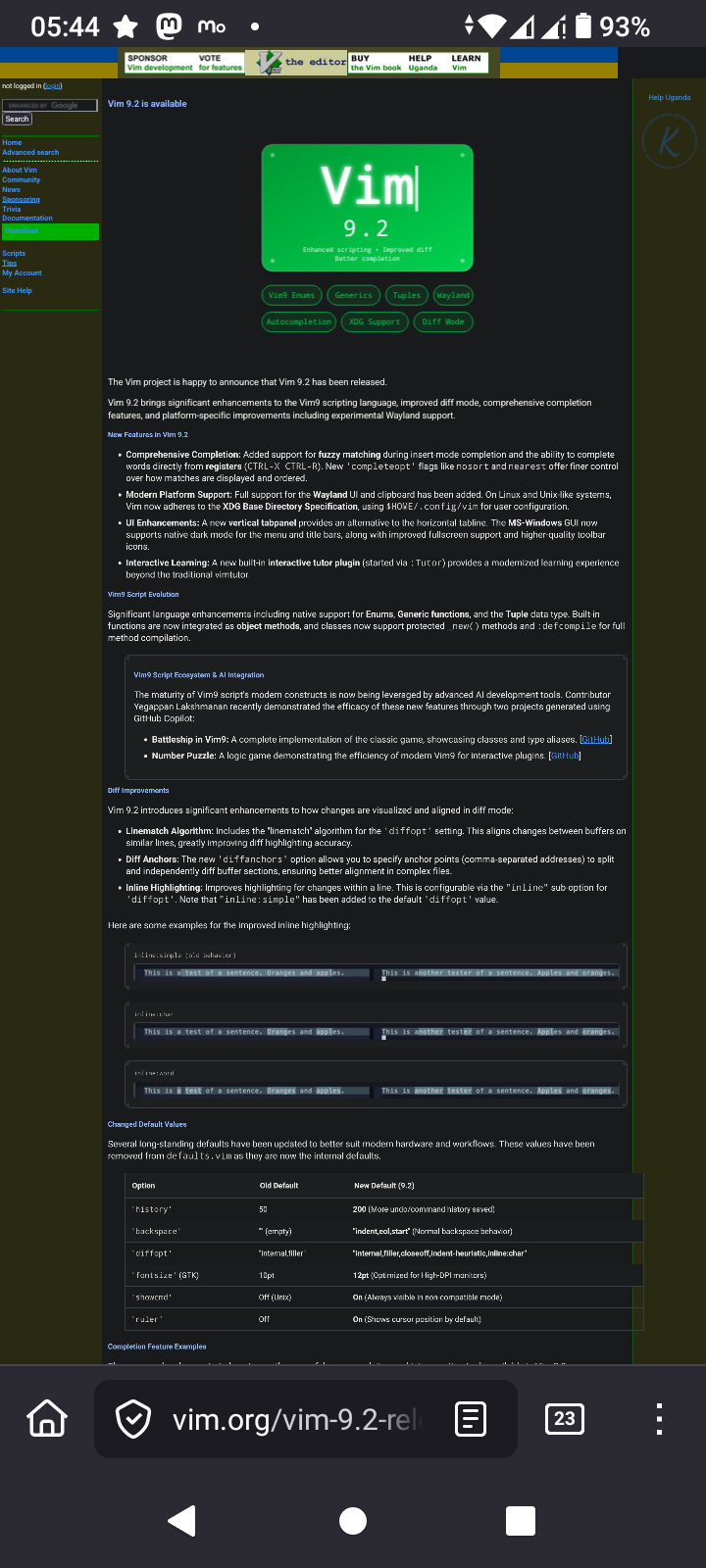
New Features in Vim 9.2
Comprehensive Completion: Added support for fuzzy matching during insert-mode completion and the ability to complete words directly from registers (CTRL-X CTRL-R). New 'completeopt' flags like nosort and nearest offer finer control over how matches are displayed and ordered.
Modern Platform Support: Full support for the Wayland UI and clipboard has been added. On Linux and Unix-like systems, Vim now adheres to the XDG Base Directory Specification, using $HOME/.config/vim for user configuration.
UI Enhancements: A new vertical tabpanel provides an alternative to the horizontal tabline. The MS-Windows GUI now supports native dark mode for the menu and title bars, along with improved fullscreen support and higher-quality toolbar icons.
Interactive Learning: A new built-in interactive tutor plugin (started via :Tutor) provides a modernized learning experience beyond the traditional vimtutor.
^Z
>> Quote II
Vim9 Script Ecosystem & AI Integration
The maturity of Vim9 script's modern constructs is now being leveraged by advanced AI development tools. Contributor Yegappan Lakshmanan recently demonstrated the efficacy of these new features through two projects generated using GitHub Copilot:
Battleship in Vim9: A complete implementation of the classic game, showcasing classes and type aliases. [GitHub]
Number Puzzle: A logic game demonstrating the efficiency of modern Vim9 for interactive plugins. [GitHub]
^Z
I wonder why they have LLM support?
Note
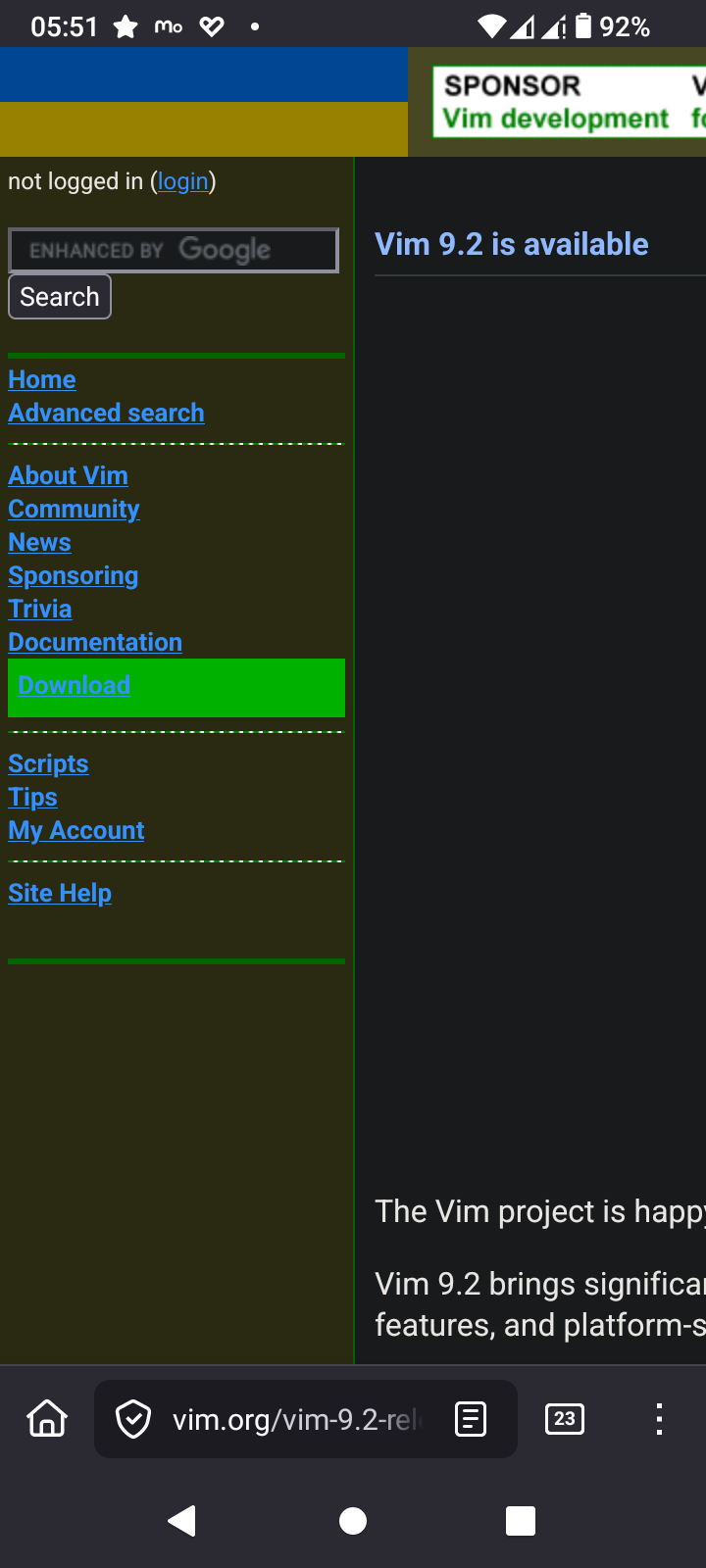
The download page looks horrible on mobile so you'd be wise to view it on desktop
If this is your first time using VIM and you didn't bother to read the help file with `:h`
Just exit VIM type `:wq` to write & exit or type `:q!` to exit without saving the file
#Vim #VimMasterRace #tips #tricks #handy #features #Vi #EMACS #editor #text #freeBSD #ghostBSD #BSD #Linux #OpenSource #POSIX
Edited 47d ago

An introduction to the usage and design of SEdit, the structure editor for Lisp code of Medley Interlisp:
https://files.interlisp.org/medley/docs/internal/sedit/old/intro.tedit.pdf
For more details on the usage and internals of SEdit see (especially code-editing.tedit.pdf):
Just received utterly fantastic developmental edits from @nantucketlit and while we couldn’t move forward with draft 1 of a fictional YA Romance I tried, he gave me such excellent feedback that it got me to answer questions I’ve never considered, because I’m a discovery writer and I rarely outline. I know other romance authors that outline vigorously and that’s not me. AnyWho, they were exceptionally great edits and developmental questions and I couldn’t tell that they are not natively a romance developmental editor. This is ultimately what I want you all to do, just take the genre seriously, understand at least the conventions of the genre, and what I’m trying to do within the romance framework. Just give us the same respect that you would give a fantasy author or a mystery author. #Romance #Editor #AmEditing