
The night 142 of my servers went up in the clouds Physically https://lobste.rs/s/pbmvov #netbsd
https://exquisite.tube/w/nQbc54t4G7YGaqiryZ7mg1
netbsd

Tiny tip for people using #NetBSD and yt-dlp to download videos/music from YT:
if you need to use ffmpeg to merge video with music, you can symlink ffmpegX
(where is X is version of installed software) and ffprobeX to ffmpeg and ffprobe
respectively in /usr/pkg/bin, then yt-dlp will be able to find binaries.
if you need to use ffmpeg to merge video with music, you can symlink ffmpegX
(where is X is version of installed software) and ffprobeX to ffmpeg and ffprobe
respectively in /usr/pkg/bin, then yt-dlp will be able to find binaries.




@BoxyBSD Returns to #FreeBSD: Migrating from #Proxmox to #Sylve (#bhyve)
Some journeys don't end where you expect them to. Sometimes they bring you right back to where everything began, only with a lot more experience and a much better ecosystem waiting for you.
That's exactly what is happening with BoxyBSD!
In my (longer) blog post I cover my circuit, where I moved from bhyve to Proxmox, developed many tools for Proxmox and now moved back to FreeBSD with bhyve and Sylve.
More details in my blog post: https://gyptazy.com/blog/boxybsd-moving-from-proxmox-to-bhyve-with-sylve/
#RUNBSD #bsd #freebsd #boxybsd #openbsd #netbsd #sylve #bhyve #opensource #vps #vpshosting #opensource #community #bsdcafe #boxybsd
Some journeys don't end where you expect them to. Sometimes they bring you right back to where everything began, only with a lot more experience and a much better ecosystem waiting for you.
That's exactly what is happening with BoxyBSD!
In my (longer) blog post I cover my circuit, where I moved from bhyve to Proxmox, developed many tools for Proxmox and now moved back to FreeBSD with bhyve and Sylve.
More details in my blog post: https://gyptazy.com/blog/boxybsd-moving-from-proxmox-to-bhyve-with-sylve/
#RUNBSD #bsd #freebsd #boxybsd #openbsd #netbsd #sylve #bhyve #opensource #vps #vpshosting #opensource #community #bsdcafe #boxybsd
Edited 112d ago



 🍵

Found out I needed to install mozilla certs for pkgin to work. Installed those, now running pkgin update
Gotta say, installing packages from #BSD #Ports is STUPID easy. Never had to do it before.
Edited 109d ago

The Blog Option in littleFedi
littleFedi, like many social platforms, had both a strength and a limit. Posts, by their nature, are ephemeral. They get published, federated (unless local-only, which littleFedi handles) and then, over time, lost. Partly through self-deletion, partly through their normal blending in with the thousands of other posts that pile up over time. Sometimes, though, we want something to stay. And not just stay as a social post, but as an actual blog. A bit like with BSSG, I had thought it would be convenient to have a minimal system. Not to compete with WordPress or other solutions, but to have a small blog, integrated into littleFedi, that would produce and serve a blog updated every now and then, whenever the person writing felt like doing it.
And that's why the blog option was born.
The idea is simple: when you write a post, from the web UI or from the CLI, there's a checkbox, "blog post". If you check it, that post stops being just a status that will scroll past and disappear. littleFedi renders it into a real static site. No JavaScript, just HTML and CSS, an Atom feed, tag pages, a chronological archive. Nothing exotic, nothing that needs maintenance five years from now.
The blog isn't a parallel system you have to feed separately. It's not an export, not an import, not a bridge to some other CMS. The post you wrote is the blog post. Same database, same act of writing, still boostable, still repliable, still part of the conversation on the fediverse side. The blog is just a second representation of the same content, generated automatically. Every time you create, edit, or delete a blog post, the whole static site for your account gets rebuilt from scratch, and the new version replaces the old one atomically, so nobody ever lands on a half-built page. If the build fails, the previous version stays in place. Simple, but it has to work reliably, or the whole idea is pointless.
That's the core of it: two representations of the same post. As a status, it lives in the fediverse, interactive, part of the conversation, subject to replies and boosts like anything else. As a static page, it lives on the web, durable, indexable, with a permalink, something an RSS reader can hold onto. You don't have to decide in advance which posts deserve to last. You write normally, and if something turns out to be worth keeping, you flag it, and it gets its own page.
One detail I cared about while thinking this through: the generated site has to be self-contained. When littleFedi builds it, media gets copied or hard-linked into the generated directory - images, audio, video. If it's stored on S3, it keeps its public URL directly. Either way, the point is that the site on disk doesn't depend on the instance staying up. If the server goes down tomorrow, the blog files are still a complete, working website. That wasn't an afterthought, it was one of the requirements from the start.
Not every account gets a blog, and that's intentional. The instance admin has to enable the feature globally ([blog] enabled = true), and then grant it per account. It's not meant to be a CMS, and I didn't want it to become one. Blog posts can't be replies, can't be boosts, have to be public and top-level. These are constraints, not missing features: the blog is for your own writing, not for threads or reshared content.
There's no JavaScript anywhere in the generated site. That was deliberate too. It loads fast, it works offline if you cache it, and it will still render correctly in ten years without anyone having to update a dependency.
In the end, the blog option doesn't ask you to choose between writing socially and writing something permanent. You keep writing the way you always do, on littleFedi, and if a post is worth keeping, you check a box. No separate platform, no migration, no vendor lock-in. Just your own posts, some of them rendered into a small static site you can host anywhere, built out of something that already existed on the open web.
Remember: all this is being currently served by a Raspberry PI Zero W powered by NetBSD
Here's the result: https://rpi0w.stefanomarinelli.it/@stefano/blog/691cb62e-e7a1-434b-ba65-d059ee58ac41/
#littleFedi #SSG #BSSG #OwnYourData #Blogging #Fediverse #NetBSD
I tried NetBSD as a desktop, and it felt like stepping into the '90s in a good way https://lobste.rs/s/ovbeds #netbsd
https://www.howtogeek.com/i-tried-netbsd-as-a-desktop-and-it-felt-like-stepping-into-the-90s-in-a-good-way/
Okay, #NetBSD on main computo, attempt no 2. I was able to get 1920x1080 resolution thanks to wsfb and gop. I need to accept that fetchmail is not going to work, but I would like to ask for your help.
(1) I am looking for GPU which will work out of box and give acceleration to web browser and tetris. I am going to review bsd-hardware.info and dmesgd.nycbug.org, but if someone is aware of good card I will happily take any advise. No new cards, no big power usage, HDMI. Currently I have RX550
(2) If anyone archives e-mails on own computo, could you share what software do you use for that?
(1) I am looking for GPU which will work out of box and give acceleration to web browser and tetris. I am going to review bsd-hardware.info and dmesgd.nycbug.org, but if someone is aware of good card I will happily take any advise. No new cards, no big power usage, HDMI. Currently I have RX550
(2) If anyone archives e-mails on own computo, could you share what software do you use for that?

Contemplating transitioning off Linux to #FreeBSD or #NetBSD but worried about #accessibility. Does anyone have experience of using #braille displays with the BSDs?
I think BRLTTY claims to run on those platforms, but I have found FreeBSD documentation disclaiming support for braille devices, but perhaps this is outdated.
This might be interesting for people running old computers and by various
reasons do not use corporate web browsers. Of course if you use simple web
browser like #Dillo, #Links2, #Lynx, #w3m and any other, you may still want to block
connections with 3rd party sites. If you run #OpenBSD or #NetBSD then you have
few options:
(1) Use PiHole, Blocky, Gravastar - but this will not help if you are out of
home.
(2) Use unwind - if you are running OpenBSD.
(3) Use hblock or tblock.
Hblock and tblock are bash/python scripts which update /etc/hosts file using
blocklists available in the Internet. Hblock depends only on bash, so it will
work after some tweaks even on OS/2. Tblock depends on python and few its
modules, so on BSDs it needs manual installation, but it is a little more
user-friendly. Refer to: https://github.com/hectorm/hblock and
https://codeberg.org/tblock/tblock for more information! Remember: running
tblock in aggresive mode on Atom N210 will drain computing powers
enough to block your Internet conenction totally.
reasons do not use corporate web browsers. Of course if you use simple web
browser like #Dillo, #Links2, #Lynx, #w3m and any other, you may still want to block
connections with 3rd party sites. If you run #OpenBSD or #NetBSD then you have
few options:
(1) Use PiHole, Blocky, Gravastar - but this will not help if you are out of
home.
(2) Use unwind - if you are running OpenBSD.
(3) Use hblock or tblock.
Hblock and tblock are bash/python scripts which update /etc/hosts file using
blocklists available in the Internet. Hblock depends only on bash, so it will
work after some tweaks even on OS/2. Tblock depends on python and few its
modules, so on BSDs it needs manual installation, but it is a little more
user-friendly. Refer to: https://github.com/hectorm/hblock and
https://codeberg.org/tblock/tblock for more information! Remember: running
tblock in aggresive mode on Atom N210 will drain computing powers
enough to block your Internet conenction totally.

The Blog Option in littleFedi
...and yes, this is build and served by the Raspberry Pi Zero W, powered by NetBSD
https://rpi0w.stefanomarinelli.it/@stefano/blog/691cb62e-e7a1-434b-ba65-d059ee58ac41/

Trying to install #netbsd on my old rpi zero.
Feels like pulling nails. Every time I manage to get further a new issue appears.
The main issue is that I don't know where the hdmi-microhdmi adapter is I used to have, because the rpi zero doesn't have a normal port, oh no.
So I know it's running fine. It installed, created a file system, and now even allows access via ssh. But not to root, and not with an empty password. I mean, that's sensible and all. But there's no other user account.

So Linus showed his entire ass ( again, if you've been paying attention in the last twenty years, but for some reason this one really got noticed ), and now I keep seeing people talking about building weird #NetBSD / Debian hybrids, how Devuan was trying that, and
You know you can just run NetBSD right? No need to loot it for replacement parts, it's a stable modern OS that works fine exactly as it is.
Putting the GNU userland on top of it will be a lot of work to catch up with what it already is, and carries the reward of having Richard Stallman's slime on everything.
Playing with #NetBSD on a hand-me-down Dell Inspiron with a spinny disc.
So far, it's a joy to use, even though #S3 #Suspend isn't working.
The spinny disc sounds are actually kinda therapeutic XD
So far, it's a joy to use, even though #S3 #Suspend isn't working.
The spinny disc sounds are actually kinda therapeutic XD
                     `-/oshdmNMNdhyo+:-`
y/s+:-``    `.-:+oydNMMMMNhs/-``           OS: NetBSD 11.0_RC7 amd64
-m+NMMMMMMMMMMMMMMMMMMMNdhmNMMMmdhs+/-`    Uptime: 8 hours, 12 mins
 -m+NMMMMMMMMMMMMMMMMMMMMmy+:`             Packages: 124 (pkg_info)
  -N/dMMMMMMMMMMMMMMMds:`                  Shell: ksh v5.2.14 99/07/13.2
   -N/hMMMMMMMMMmho:`                      Terminal: /dev/pts/5
    -N/-:/++/:.`                           CPU: Intel 686-class (4)
     :M+                                   Memory: 16234MiB / 16281MiB
      :Mo
       :Ms
        :Ms
         :Ms
          :Ms
           :Ms
            :Ms
             :Ms
              :Ms

GSoC 2026 Improving RAIDframe https://lobste.rs/s/5xbfin #netbsd
https://blog.netbsd.org/tnf/entry/gsoc2026_raidframe

I accidentally came across this #MediaTek #MT7601U #WiFi driver for #NetBSD on GitHub: https://github.com/MakwanaVihas/gsoc_2k22 but it seems long abandoned. I wonder if someone knows how to use it. I actually have such a USB WiFi dodge, and since the #iwm driver works on and off for my Intel 8260 card on NetBSD I think I can give this a try maybe.
#RunBSD #BSD #Unix
#RunBSD #BSD #Unix

Playtime!
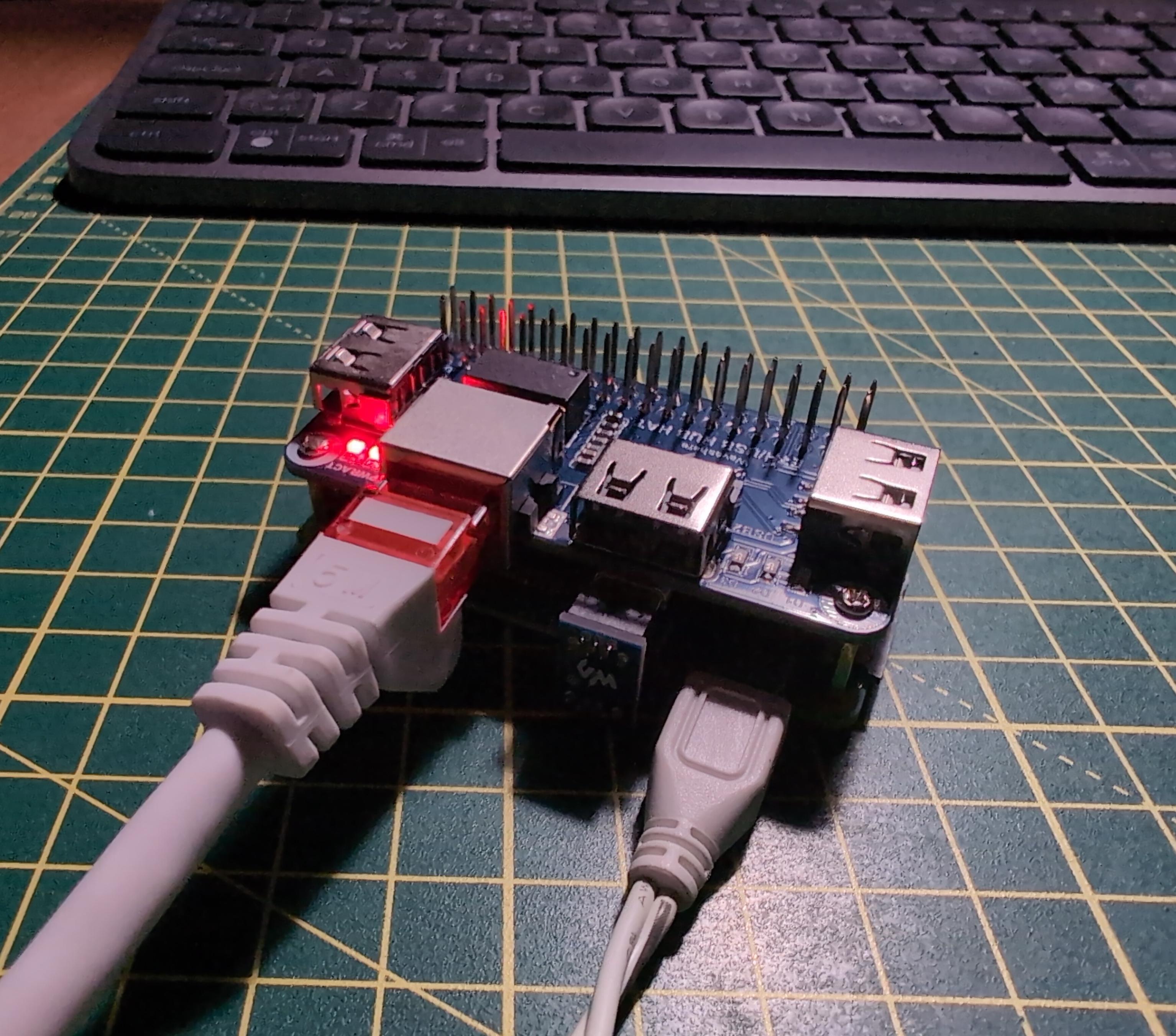
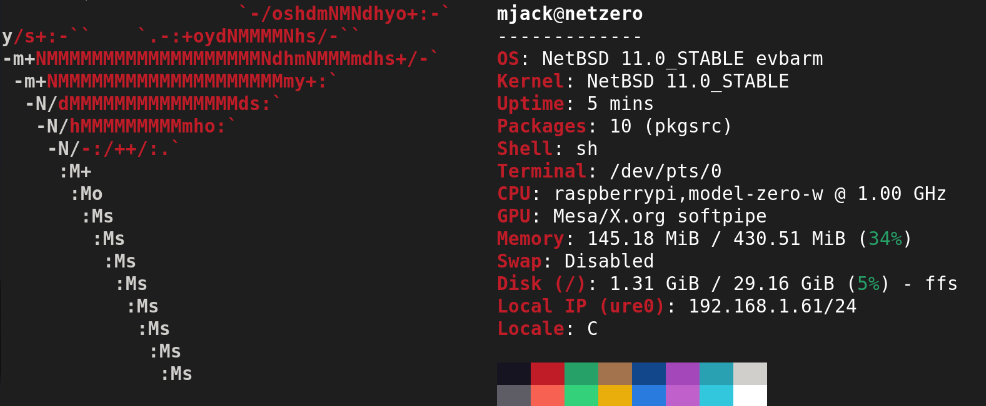
NetBSD 11.0 on a Raspberry Pi Zero with a Waveshare Ethernet/USB HAT.
I've been trying to explore the world outside GNU/Linux (or, as I've recently taken to calling it, "Sexual predator userspace plus egotistical botlicker kernel"). Naturally, the first stop on this road is the fragmented world of #BSD.
I won't lie, the experience is very reminiscent of running Linux in the 1990s: hardware support is dicey at best, it's very rare to find commercial software that will run on it, and the guiding philosophy seems to be that user-friendliness is an undesirable quality that will only result in The Wrong People using your software. Nevertheless, I'm committed to giving it a fair trial.
So far my favorite variant is #OpenBSD, especially for servers. I like the fact that it's secure by default, rather than being a hacker's dream out of the box that you then have to figure out how to secure. But I have questions.
- One of the #FreeBSD features I've heard touted a lot is "jails," which I gather means "like Docker but harder to use". But this doesn't seem to be a feature in OpenBSD. Is there something equivalent in the OpenBSD world, perhaps under another name?
- The only *BSD that I know for sure has banned LLM contributions is #NetBSD. What, if any, are the LLM policies of OpenBSD and FreeBSD?
- Has anybody tried audio production in BSD? What's the experience like? It took years for Linux to get to the point where you could more or less do serious audio work, and I hate to think of regressing back to "if you buy this one particular sound card they stopped making in 1998 and recompile the kernel with a dodgy patch someone posted to USENET you can maybe kind of play a .WAV file".
Thanks in advance for your help!
(I have been informed by an anonymous source that "BSD jails" are in fact what they put you in if you use the software without a valid BSD license. I am not sure this is correct.)
Strategic mistake: I assumed pihole had a bsd-compatible package. It doesn't. Now I have a working netbsd system on my ad blocking system, but no actual ad blocker.
Right now trying to see if I can get containers to work on netbsd
Or I just switch to some other software.
Although pihole is at least convenient.
#netbsd #unix


🚀 It goes to 11! The NetBSD Project is incredibly proud to announce the official release of NetBSD 11.0!
This release brings massive performance improvements, modernized hardware support, and the rock-solid stability you expect. Whether you are deploying on the latest ARM64 servers or keeping a classic toaster alive, NetBSD got you covered.
A huge thank you to developers, testers, and community for making this happen. 🧡
Check out the release notes and grab the images here: https://netbsd.org/releases/formal-11/NetBSD-11.0.html
#NetBSD #RunBSD #OpenSource #UNIX #RetroComputing #Server
Edited 101d ago
NetBSD 11.0 released https://lobste.rs/s/pvrnor #netbsd
https://blog.netbsd.org/tnf/entry/netbsd_11_0_released
Still no good news with the freshly out #NetBSD 11.0 RELEASE. S3 suspend woke up with dead WiFi (Intel 8265, iwm driver), in addition to keyboard and touchpad as before on my #ThinkPad T470s. So basically dead machine and no way to reset unless long press power button for a hard reboot. Desktop usability needs more love.
#runBSD #BSD #Unix #AskFedi
#runBSD #BSD #Unix #AskFedi


This is the umpteenth time I've tried this, starting with version 1.6.1 😅
Could this be the definitive? I hope 💪
Now I have to config automount for external disk/USB keys and I need to find a way to encrypt my external disk and use it both in GNU\Linux and NetBSD.
GDC (I never tried it on Linux and I didn't find anything online)?
ZFS? Anyone have an idea?
I know I can use OpenSSL or GPG but I think it's better and more confortable to encrypt the full drive...
P.S. I love NetBSD but pkgin is really slow 😅 (It's probably not a problem with pkgin, but rather my Wi-Fi card.)
#bsd #netbsd #bsdunix #unix #unixITA #unixitalia #guuf #guufxmpp #guufITA #linux #linuxITA #linuxitalia

Edited 105d ago
