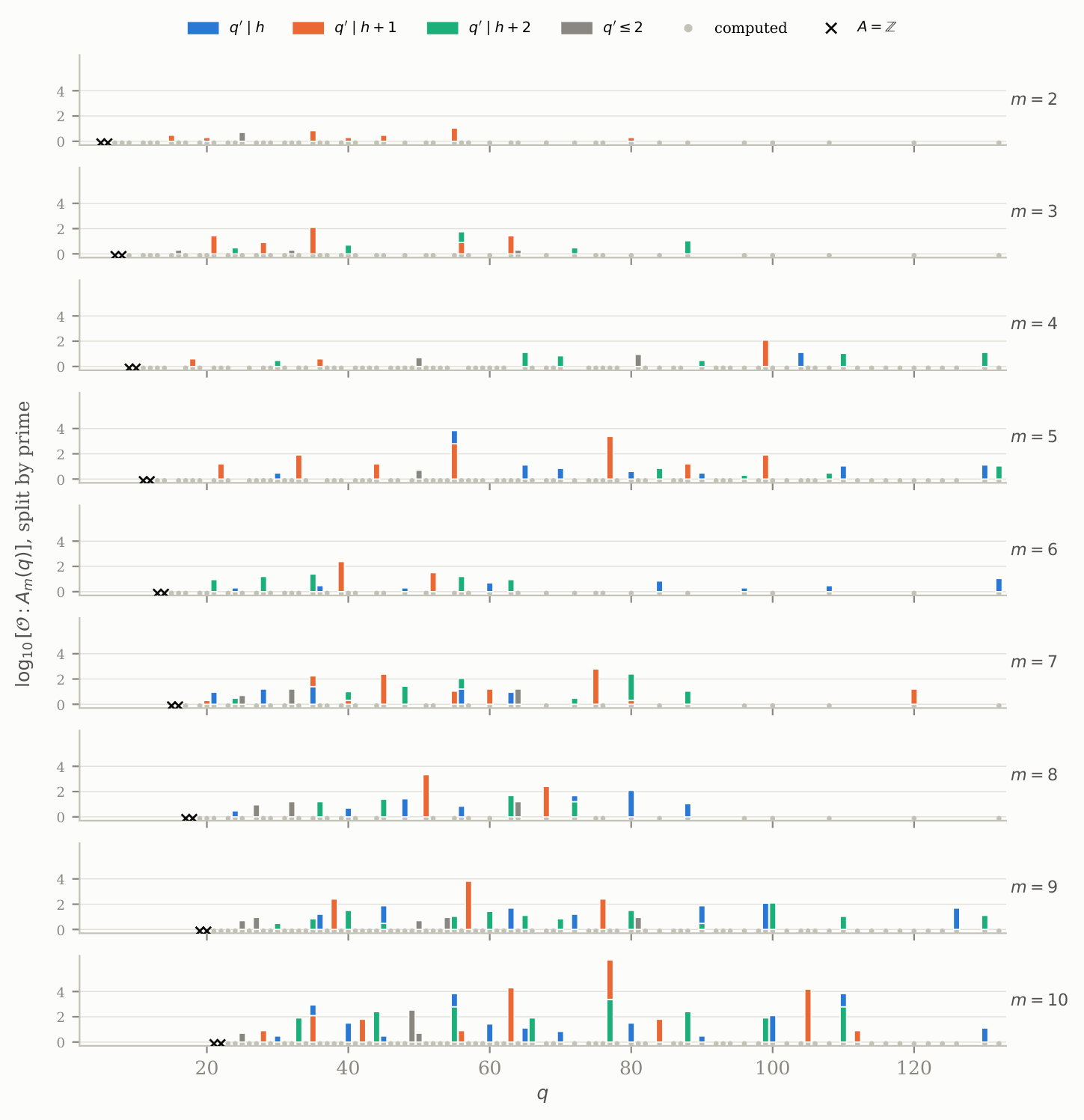
Fix a primitive \(q\)th root of unity \(\xi\) and take \(g\in Sp(2m)\) with eigenvalues \(\xi^{\pm1},\dots,\xi^{\pm m}\), \(1\le m<q/2\). Every character of \(Sp(2m)\) at \(g\) is an algebraic integer of the real cyclotomic field \(\mathbb{Q}(\xi)^+\). Together they generate a ring \(A\). When is \(A\) the whole ring of integers \(\mathcal{O}\), and when it is not, how exactly does it fail?
Write \(h=2m\) and \(q=p^vq'\) with \(p\nmid q'\). Every prime of the index divides \(q\), and for \(q'\notin\{1,2,3,4,6\}\):
\(p\mid[\mathcal{O}:A]\iff q'\mid h,\ h+1\ \text{or}\ h+2\)
The Coxeter number, or one past it, or two. Nothing else, at any rank. The picture is the sweep that tests it: 558 orders with a lattice computation, 156 of them with index \(>1\), and every coloured bar sits over such a pair.
29 pp, everything below: https://doi.org/10.5281/zenodo.22813216
#math #NumberTheory #RepresentationTheory #CommutativeAlgebra