Don’t fuck with moon dust. No seriously, do not fuck with moon dust.
Absent any moisture or atmosphere, millennia of asteroid impacts have turned lunar regolith (soil) into a fine powder of razor sharp, glass-like particles. What’s more, the solar wind imparts an electric charge on the dust, causing it to cling to any and every surface it touches through static electricity. On earth, sand tends to get smoother over time as wind and water tumble the grains about, eroding their sharpness. Not so on the moon – lunar dust is sharp and deadly. This is Not A Good Time if you’re an explorer looking to visit our celestial neighbor.
During Apollo, the astronauts faced a plethora of unexpected issues caused by dust. It clung to spacesuits and darkened them enough that exposure to sunlight overheated the life support systems. Dust got in suit joints and on suit visors, damaging them. It ate away layers of boot lining. It covered cameras. Upon returning to the cabin, astronauts attempting to brush it off damaged their suit fabric and sent the dust airborne, where it remained suspended in the air due to low gravity.
Inhaling moon dust causes mucus membranes to swell; every Apollo astronaut who stepped foot on the moon reported symptoms of “Lunar Hay Fever.” Sneezing, congestion, and a “smell of burnt gunpowder” took days to subside. Later Apollo missions even sent a special dust brush with the team to help clean each other and equipment. We don’t know exactly how dangerous the stuff is, but lunar regolith simulants suggest it might destroy lung and brain cells with long-term exposure. 1
In fact the dust is so nasty that it destroyed the vacuum seals of sample return containers. We no longer have any accurate samples of lunar dust, “Every sample brought back from the moon has been contaminated by Earth’s air and humidity […] The chemical and electrostatic properties of the soil no longer match what future astronauts will encounter on the moon.” 2
Whats worse, the solar-charged dust gets thrown up off the moon’s surface via electrostatic forces. The moon doesn’t technically have an atmosphere, but it does have a thin cloud of sharp dust itching to cling to anything it can find.
And it probably isn’t just the moon. “A 2005 NASA study listed 20 risks that required further study before humans should commit to a human Mars expedition, and ranked "dust" as the number one challenge.” 3
The coolest solution I’ve heard about in next-gen spacesuit design is a mesh of woven wires layered into the suit. When activated, the wire mesh would form an anti-static electric field that repels dust. Quite literally a force field. 4
#astronomy #apollo #moon #lunardust
apollo


I heard it is her birthday today. 🙂
It is Margaret Hamilton in #Lego form.
#LegoPhotography #photography #Apollo #AGC



Original Apollo 11 guidance computer (AGC) source code for Command Module (Comanche055) and Lunar Module (Luminary099)

Vale Margaret Hamilton.
She was a Software Engineer.
She was the _first_ Software Engineer because she defined the term, Software Engineering:
"When I first came up with the term, no one had heard of it before, at least in our world. It was an ongoing joke for a long time. They liked to kid me about my radical ideas. It was a memorable day when one of the most respected hardware gurus explained to everyone in a meeting that he agreed with me that the process of building software should also be considered an engineering discipline, just like with hardware. Not because of his acceptance of the new 'term' per se, but because we had earned his and the acceptance of the others in the room as being in an engineering field in its own right."
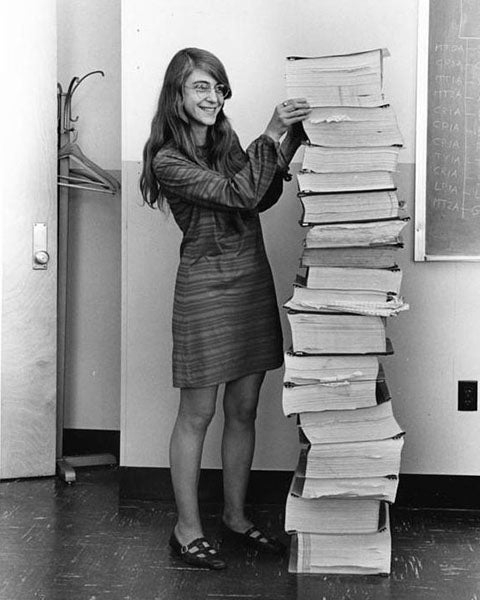
Margaret Hamilton led the Software Engineering team at MIT that created the software that ran NASA's Apollo Guidance Computer. The photo of her standing next to a stack of source code printouts — that's her work, and she was essential to NASA's mission of landing people on the Moon for the first time ever and getting them back to Earth again safely.
Margaret Hamilton, computing pioneer who led software development for the Apollo program, dies at 90
https://news.mit.edu/2026/margaret-hamilton-computing-pioneer-dies-1007
#MargaretHamilton #SoftwareEngineer #SoftwareEngineering #ComputerScience #NASA #MIT #Apollo #MoonLanding