

Society tells us rest is laying down and doing nothing. That's not what it looks like for everyone. In fact, it can be quite the opposite for some.
actuallyautistc
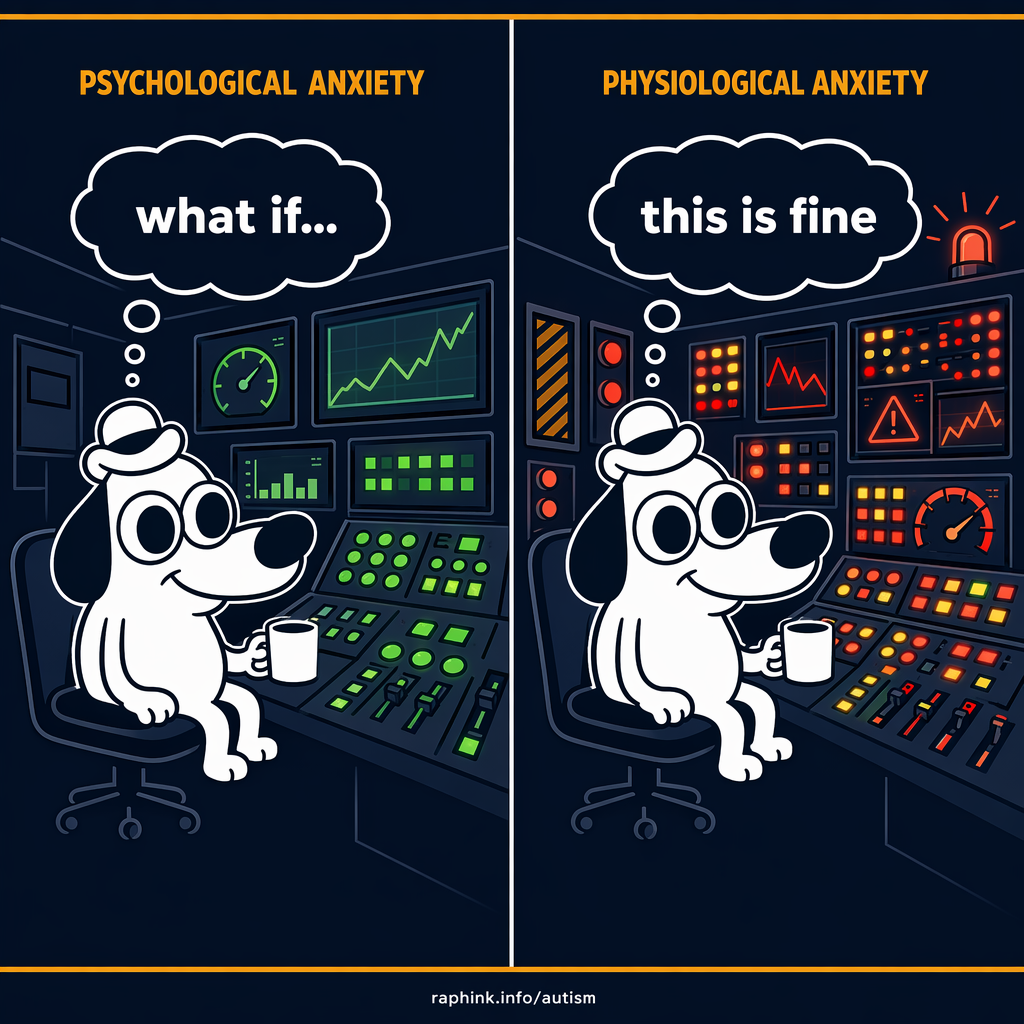
Two kinds of anxieties, with completely different sources.
🧠 Psychological anxiety (Top-down):
All sensors are reading fine, but the cortex induces an analytical loop. You can’t help thinking something might go wrong anyway ("what if..."). Because this loop is generated in the cortex, it can often be regulated through cognitive and psychological strategies.
🚦 Physiological anxiety (Bottom-up):
The subcortical sensors themselves are natively reporting a threshold higher than the normal alert baseline, even when the environment is perfectly safe. Cognitive regulation doesn't fix it because the loop didn't originate in the cortex.
On the outside, the person looks entirely calm: they are used to manually managing this level of continuous systemic load. But on the inside, the control room is redlining.
When the hardware runs at a permanent 97% alert status, you don't crash from psychological worry. You crash from sheer biological burnout.
Don't confuse a hardware alert for a software bug.
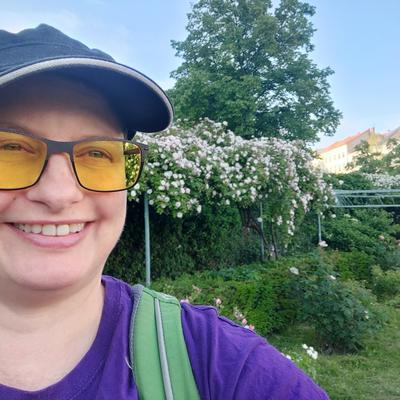
About 3 months ago I noticed something odd: when I chewed something hard on the left, my preferred chewing side, it sometimes caused a piercing pain that went right down my backmost lower left molar. So I went to the dentist. I have a nice dentist. When I went to see him for the first time, I was wearing my sunflower lanyard, and he asked me what invisible disability I was wearing it for. When I said I was autistic, he asked me how he could accommodate me, and I said I was very light sensitive, so I'd be wearing my yellow protective glasses during our session. He didn’t raise an eyebrow, and he did make sure that the terrible light dentists usually blind me with was pointed at my mouth, not my eyes. I never realized that was an option! Mind = blown! And also, before each step, he told me what he was going to do and the kind of noises and tactile experience it would cause. The guy’s a total gem 😻 (is what I think about what should probably be just standard practice in an autistic-friendly world).
So when I went to him with the weird intermittent tooth-ache, he knocked on the tooth and blew some air on it, warning me in advance and then asking me what it felt like. I said it was nothing compared to eating a nut with that tooth. He took an X-ray, and showed me the image on his screen. There was nothing there. So he said he thought it might be a gum inflammation and sent me home with some specific mouth-wash. He said to come back if it was still going on in a month or two. I did the mouth wash routine he recommended, which my gums did appreciate, but to no avail, toothwise. So 6 weeks later I was back in his chair. He looked at the X-ray again, repeated the whole tapping, air-blowing, gum-checking routine, and told me that he couldn’t see anything, but would I please get a longer appointment at the desk, and come back for him to remove a filling I had on that tooth, so he could look under it. I did that, and two weeks later I went to that longer appointment, where he took the old filling out, and to his utter astonishment, found a massive cavity going straight down, on the next tooth over where the two teeth met. He told me he was shocked that such a large cavity hadn’t shown on X-Ray, and went on to perform the necessary two fillings.
I thanked him for not just sending me home because the cavity hadn’t shown on X-Ray. “Not every dentist would believe me something was actually wrong and start digging around in there,” I said. He then confessed that if it weren’t for that old filling indicating something had previously already been afoot over there, he would have in fact sent me home without treatment. Had he done that, the cavity would have no doubt turned into a root canal. I know, because I have two of those from when teeth just didn’t hurt that much until the damage was already too bad for a filling. I guess my interoception of tooth cavities just isn’t the same as other folks’. I’ve also been known to walk around for a month with bone fractures orthopedic doctors couldn’t see on X-Ray. And to be sent home by medical professionals who just didn’t seem to be able to figure out what was wrong with me. And this is what the 3rd episode of my podcast The Autistic Rant Hour is about: Medical Gaslighting. Or as I like calling it: We’ve Run All the Tests and there’s Nothing Wrong with You.
In this episode I’m joined by Simo_tier (pronouns: it/they), a multimedia artist and activist I got to know on a local queer autistic meetup it organizes. Together we share some anecdotes about all those times we went to the doctor only to be met with disbelief, ignorance, discrimination and sometimes plain incompetence. We discuss the notorious pain scale, misdiagnoses, missing tests and wrong prescriptions, compounded discrimination of multiply marginalized patients, and the real life and death outcomes of everything autistic people have to endure when seeking medical services, including that moment when you just can’t deal with it all anymore, and don’t even seek those services.
I’d love to hear from you about your experiences with medical care, and whether you have some autistic life-hacks that make things better.
You can find The Autistic Rant Hour wherever you get your podcasts, or see here for links, player and transcripts: https://prepped.to/podcasts/autistic-rant-hour
#ActuallyAutistc #MedicalGaslighting #misdiagnosis #DentalCare #Podcast #Podcasting
Presenting: The Autistic Rant Hour
I'm launching Aut2Aut's first #ActuallyAutistic podcast on June 22, 2026 on the Autistic Culture Podcast Network. You'll be able to find it wherever you get your podcasts.
In the meantime, read my latest blogpost to find out what this network and podcast are about, what it was like to create the first 6-episode series, and how you can join the network with your own podcast, or who knows, become my editor. And of course, an invite to the network's online launch party: https://prepped.to/blog/presenting-the-autistic-rant-hour
Here's my trailer, see transcript in the description:
https://youtu.be/BBc8tycpR4E
Spoiler alert: I don't like podcast trailers! So I don't blame you if you rather read the blogpost instead.
CW: mental health, self-harm, checking out
On Thursday the Mental Health Services episode of my podcast The Autistic Rant Hour went online. And then I got a phone call from my mother’s cousin, a beloved elderly family member, where he heartbreakingly informed me of the passing of his 27 year old eldest grandson. It was self-inflicted and preceded by a lifetime in the Mental Healthcare system of a North-European country, with all the available resources at his disposal. I‘ve never met my first cousin twice removed, may his memory be a blessing, and I very barely know his father. So I cannot tell you whether he, like Rey, the wonderful guest on the podcast’s Mental Health Services episode, was also a misdiagnosed autistic person who got the wrong treatment for his condition, no accommodations, and often suffered extremely harmful neglect. Maybe he had a totally different mental struggle, maybe he did get the treatment he needed. I have no way of knowing. All I do know is that on his computer, his father found a document detailing the research he conducted regarding the recovery rate of people with the condition he was diagnosed with and about the kinds of help he could expect from Mental Health Services in his country. He came to the conclusion that his only way was the way out, and started planning his escape from life on a weekend off the ward he had coming.
Rey Rissanen, my guest on The Autistic Rant Hour’s 4th episode, was thankfully luckier. After years in and out of therapy and psych wards, they realized they were in fact, autistic, rather than depressive with a borderline personality disorder. This helped them understand that all their efforts to recover by following the prescribed treatment did not fail because they were a terrible person nor a terrible patient, but because they got the wrong diagnosis and the wrong treatment, if they even got any treatment at all. They learned to advocate for themself and figured out how to shape their life in a way that would enable them to pursue goals such as moving and attending university. There, they will also know how to request the accommodations they need and seek appropriate help in case of trouble.
Such a future was not to be for the family member we have lost, and we are left to mourn and wonder why.
I would like to dedicate this episode to his memory, and hope that those of you who need to hear a story of hope rather than despair, can get that from this episode. Whether you choose to listen to it or not, please know that there might be an explanation to your plight that Mental Health professionals are often woefully misinformed about, and that if you feel your treatment is failing, it might very well not be because of your shortcomings, but that of the system. Figuring out what is at the root of your suffering can make a world of difference and help you forwards and upwards. I hope you and your loved ones who may be struggling right now can find hope in this message, and maybe give yourself a few more years to try and figure this out before making any irreversible decisions.
You are very welcome to share your experiences with Mental Health Services on this thread, but please remember to add content warnings. Also please keep in mind that neither I nor most of the people reading this can give you professional help, so in case of emergency, please contact your local crisis center and try to advocate for your needs as best you can.
You can find The Autistic Rant Hour wherever you get your podcasts.
Here’s a link to the podcast on Aut2Aut’s website, where you can find a human-proofread transcript: https://prepped.to/podcasts/autistic-rant-hour
#ActuallyAutistc #MentalHealth #misdiagnosis #selfharm #AutismAwareness
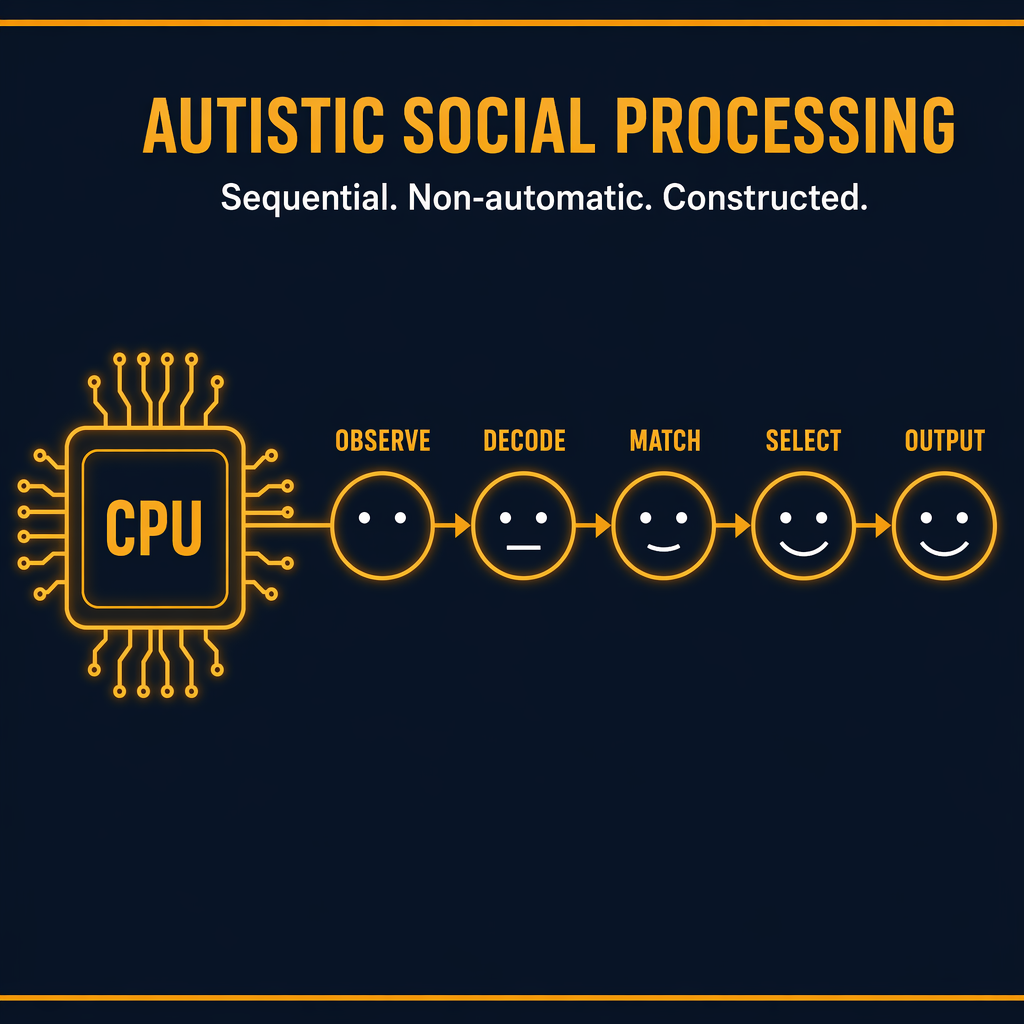
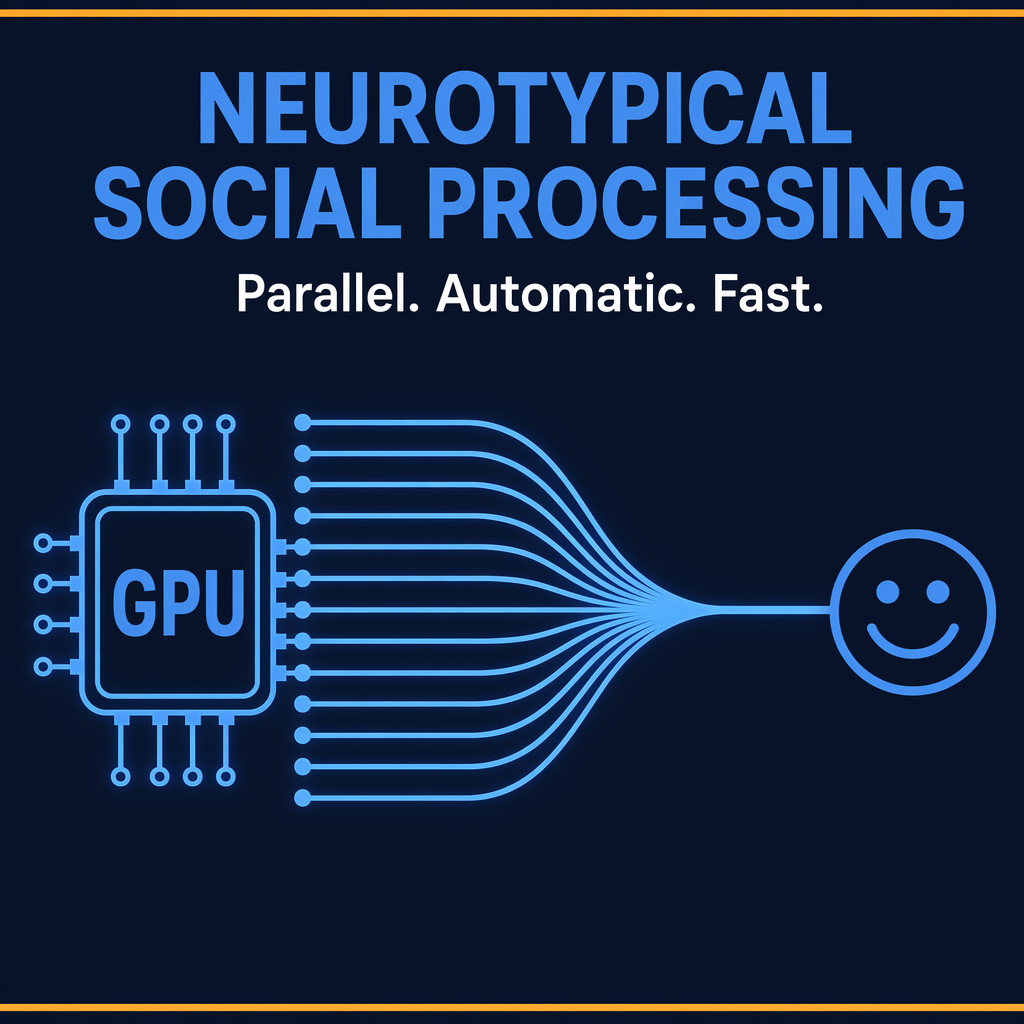
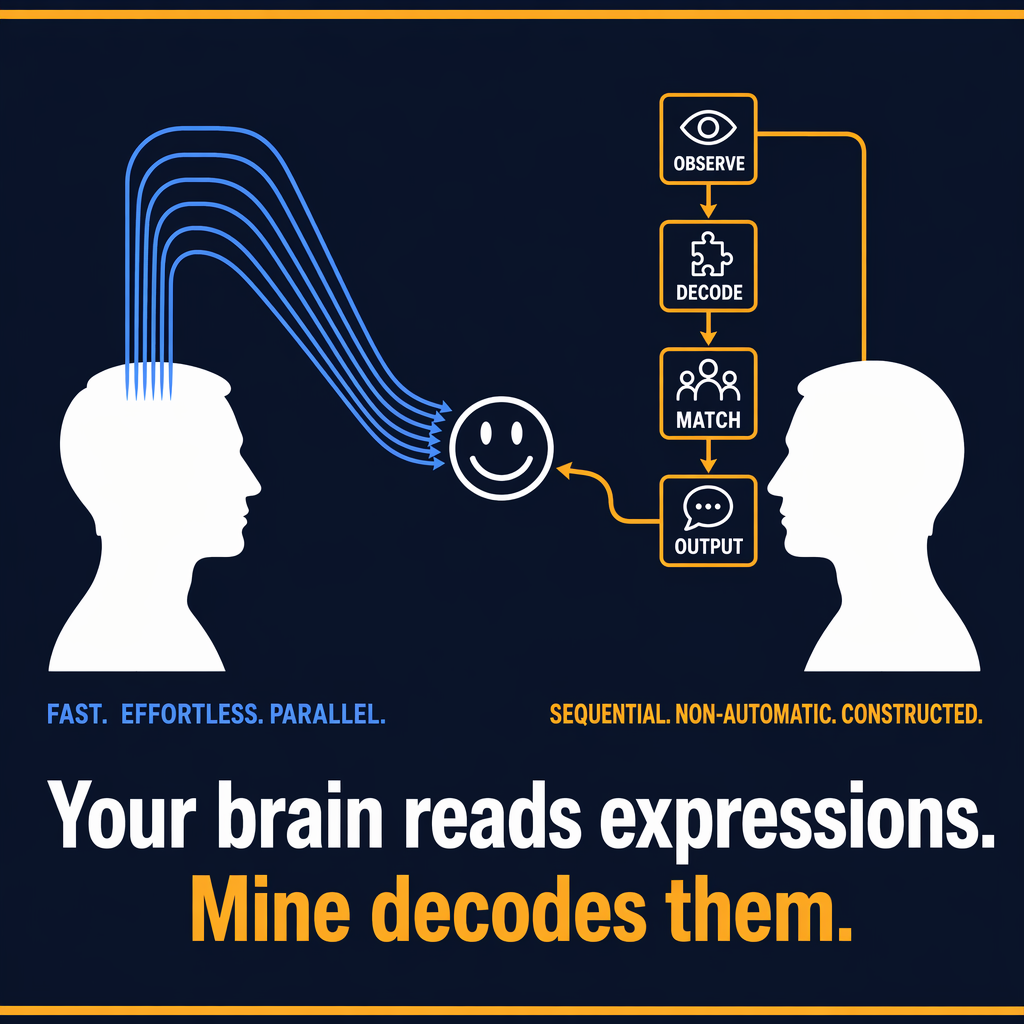
When neurotypical people read someone's expression, it happens automatically: parallel processing, fast, effortless. Like a GPU rendering a scene.
When an autistic brain does it, I run a different process: observe, decode, match, select, output. Sequential, non-automatic, constructed from scratch.
The result looks similar, but the cost doesn't.
This is why masking is exhausting: not because autistic people are bad at social interaction, but because they're running a CPU process where everyone else has a GPU. Same output. Different architecture.
🧵
Where are my scientists?
And what is the scientific practice that can drive you up the wall?
During the academic part of my career, I often found myself wondering why exact sciences are not in fact that… exact.
Maybe it’s my autistic drive to unearth the reason for anything and everything, maybe it was my autistic sense of justice, and maybe I was what the hegemony calls “autistic folks being too literal”
But seriously, can you really get too literal with science?
Not to mention: can people please just get ahead on their own merit instead of “borrowing” ideas from defenseless grad students?
In the latest episode of my Podcast, The Autistic Rant Hour, you can find out about my epic struggle against “commonly used values”, variables that pretend to be constants and less than fair competition. Some I won, some I lost, and all I explain in great detail.
Dr. Mary Sims, host of Clinical Misfits, a sister-podcast that was launched at the same time as mine on the Autistic Culture Podcast Network, joins me on this extra-nerdy ride, and makes sure I’m not the only one who gets what I’m even talking about.
For science shenanigans, surprise woo-woo intermissions, a bunch of nerdy laughs and a secret message from my cat Merlin, find Episode 5 of the Autistic Rant Hour wherever you get your podcasts.
See here for online player and human-proofread transcripts:
https://prepped.to/podcasts/autistic-rant-hour