Timnit Gebru — Author (2)
On the Dangers of Stochastic Parrots: Can Language Models Be Too Big? [Book] Goodreads
author: Emily M. Bender / Timnit Gebru publishing house: ACM 2021 - 3
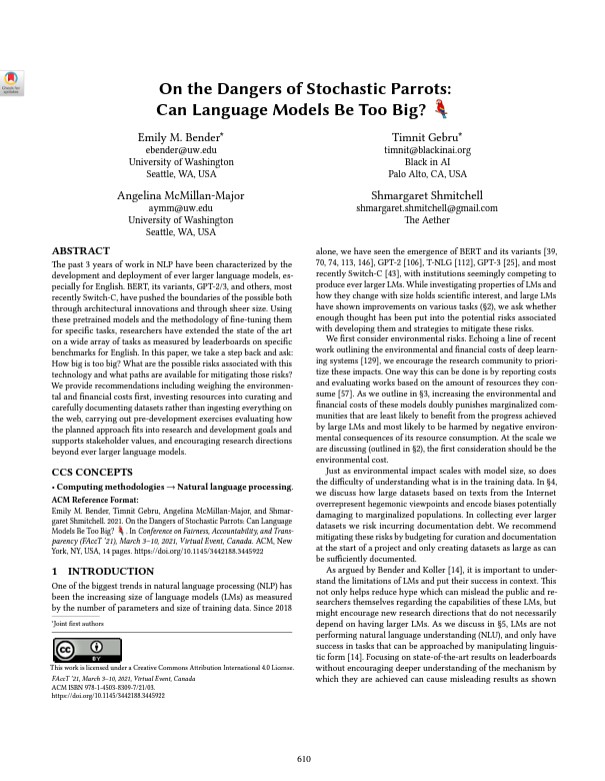
The past 3 years of work in NLP have been characterized by the development and deployment of ever larger language models, especially for English. BERT, its variants, GPT-2/3, and others, most recently Switch-C, have pushed the boundaries of the possible both through architectural innovations and through sheer size. Using these pretrained models and the methodology off fine-tuning them for specific tasks, researchers have extended the state of the art on a wide array of tasks as measured by leaderboards on specific benchmarks for English. In this paper, we take a step back and ask: How big is too big? What are the possible risks associated with this technology and what paths are available for mitigating those risks? We provide recommendations including weighing the environmental and financial costs first, investing resources into curating and carefully documenting datasets rather than ingesting everything on the web, carrying out pre-development exercises evaluating how the planned approach fits into research and development goals and supports stakeholder values, and encouraging research directions beyond ever larger language models.
Deep Unlearning [Book] kinkyreviews.site Goodreads Skybridge
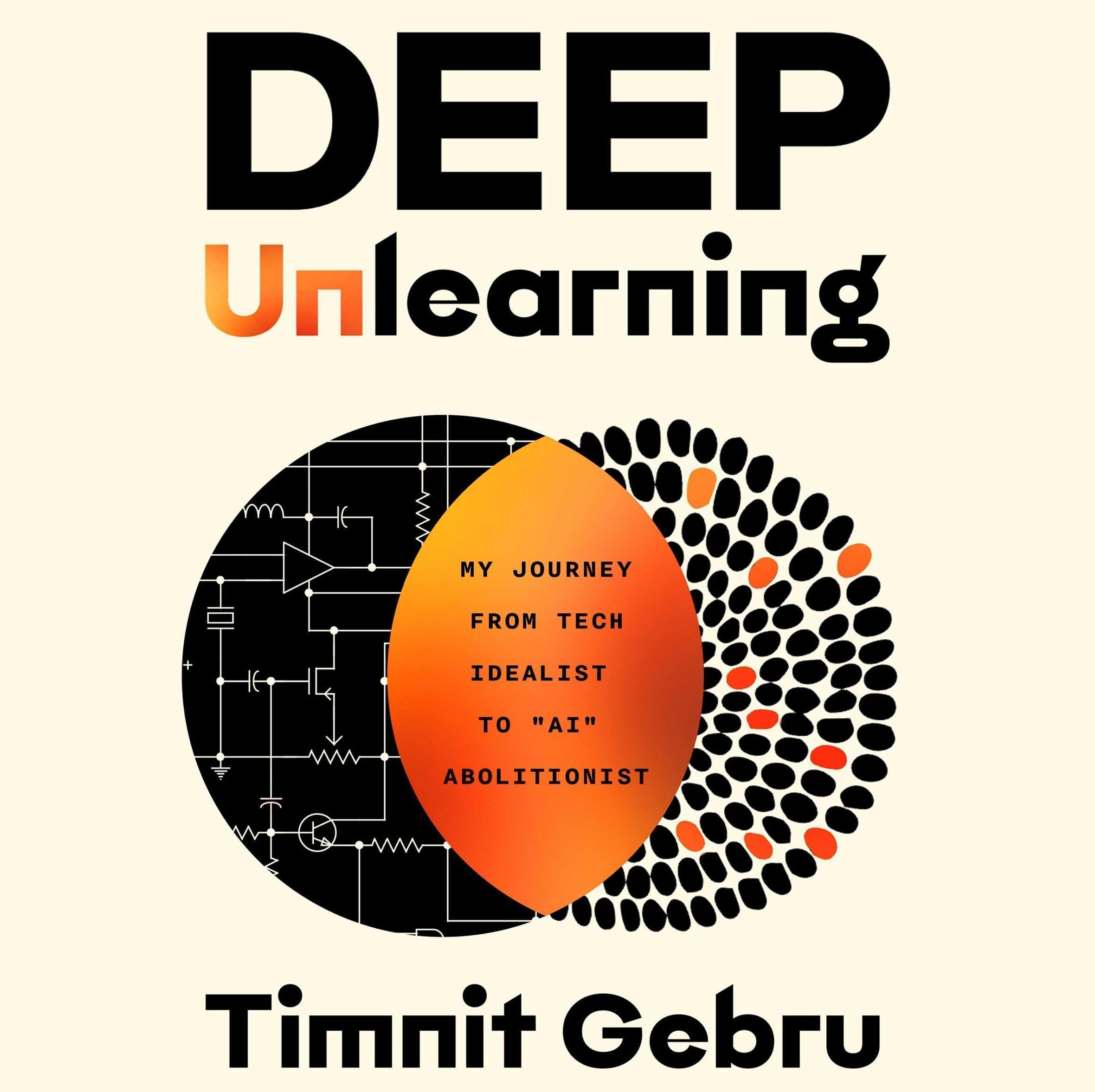
author: Timnit Gebru publishing house: Simon & Schuster Audio 2027 - 2 other title: Deep Unlearning: The Rise of AI and the Radicalization of a Tech Idealist
Timnit Gebru, one of the fiercest voices in the world speaking truth to power, chronicles her journey as a refugee and Black woman in STEM—delivering an inspiring vision for better, human-centered, equitable technology.

Timnit Gebru has been present at nearly every inflection point in tech’s recent history. She was an engineer at Apple on the cusp of the iPhone’s first release, a PhD student at Stanford’s computer vision lab as her advisor worked on the enormous datasets so crucial to AI’s development, and the most senior Black woman on the Ethical AI team at Google as DeepMind and Open AI took over the field of artificial intelligence—where she was forced out for having raised the alarm about bias in large language models, causing global shockwaves in the tech industry.

Starting with her childhood during which she was forced to flee the 1998 Ethiopian-Eritrean war, through the fraught process of achieving refugee status, Gebru shows how her early love of science and math was inextricably intertwined with her belief that these were reliably objective safe spaces. Over time, through high school in Greater Boston, college at Stanford, and jobs at Apple, Microsoft, and Google, she came to realize that perhaps some of the biases and injustices she witnessed in her life outside of academics were true about technology, too.

Over the course of her life, Gebru has seen up close how the destructive ideologies and outsized egos of the tech world have come to wreak havoc on our environment, our economies, and the lives of billions of people. She has also come to understand how we could have made a different choice every step of the way, and how we still can.

Part memoir and part manifesto, Deep Unlearning is as much about ideology as it is about technology—and about how to privilege justice in both.