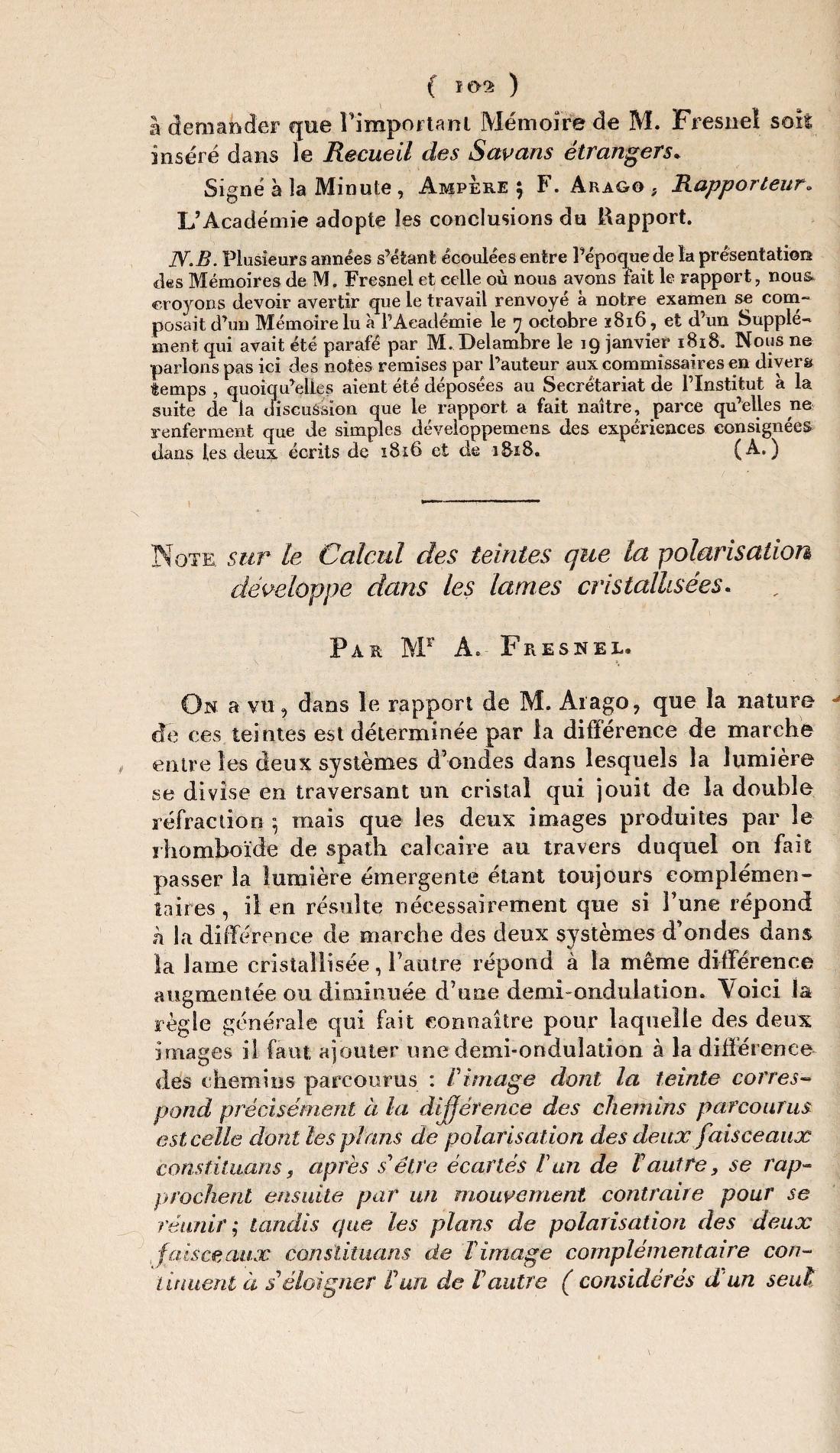
<p><a href="/tags/otd/" rel="tag">#OTD</a> in 1818.</p><p>French physicist Augustin Fresnel signs his preliminary "Note on the Theory of Diffraction" (deposited on the following day). The document ends with what we now call the Fresnel integrals.</p><p>The Fresnel integrals have various applications in optics, such as in the calculation of the diffraction pattern produced by a single slit or a circular aperture, as well as in the study of the propagation of light through various optical systems. </p><p><a href="/tags/books/" rel="tag">#books</a> <a href="/tags/science/" rel="tag">#science</a> <a href="/tags/physics/" rel="tag">#physics</a> <a href="/tags/optics/" rel="tag">#optics</a></p>
optics
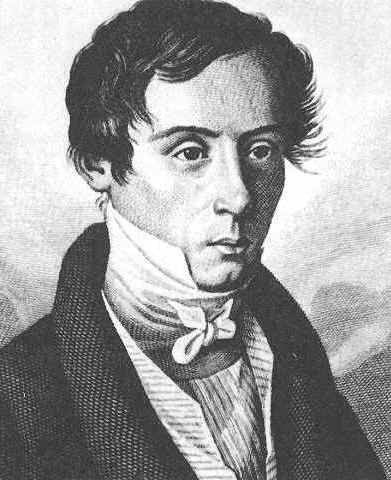
<p><a href="/tags/otd/" rel="tag">#OTD</a> in 1822.</p><p>French physicist Augustin-Jean Fresnel, in a "note" read to the Academy of Sciences, reports a direct refraction experiment verifying David Brewster's hypothesis that photoelasticity (as it is now known) is stress-induced birefringence.</p><p><a href="https://en.wikipedia.org/wiki/Birefringence" rel="nofollow" class="ellipsis" title="en.wikipedia.org/wiki/Birefringence"><span class="invisible">https://</span><span class="ellipsis">en.wikipedia.org/wiki/Birefrin</span><span class="invisible">gence</span></a></p><p><a href="/tags/science/" rel="tag">#science</a> <a href="/tags/physics/" rel="tag">#physics</a> <a href="/tags/optics/" rel="tag">#optics</a></p>
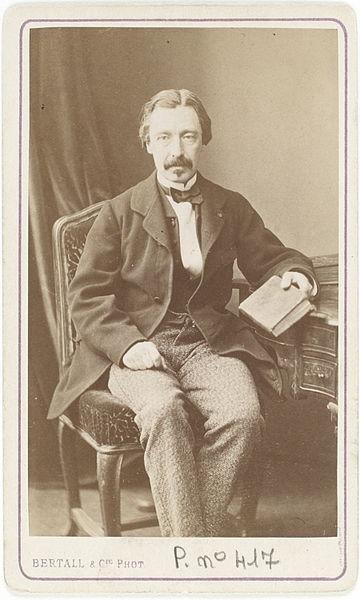
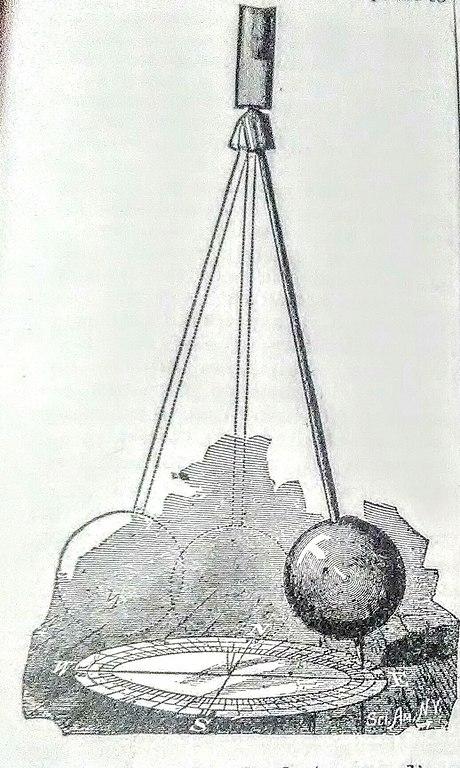
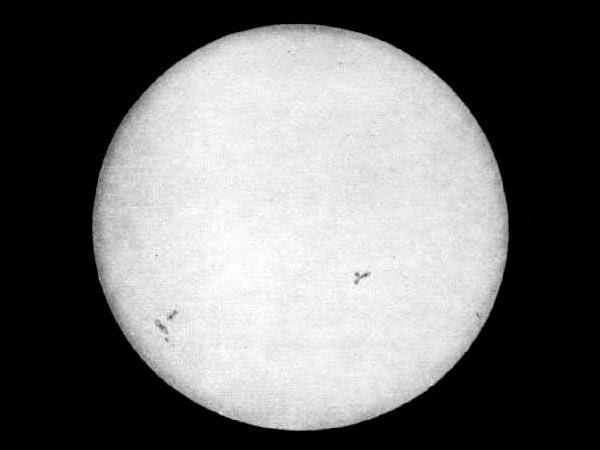
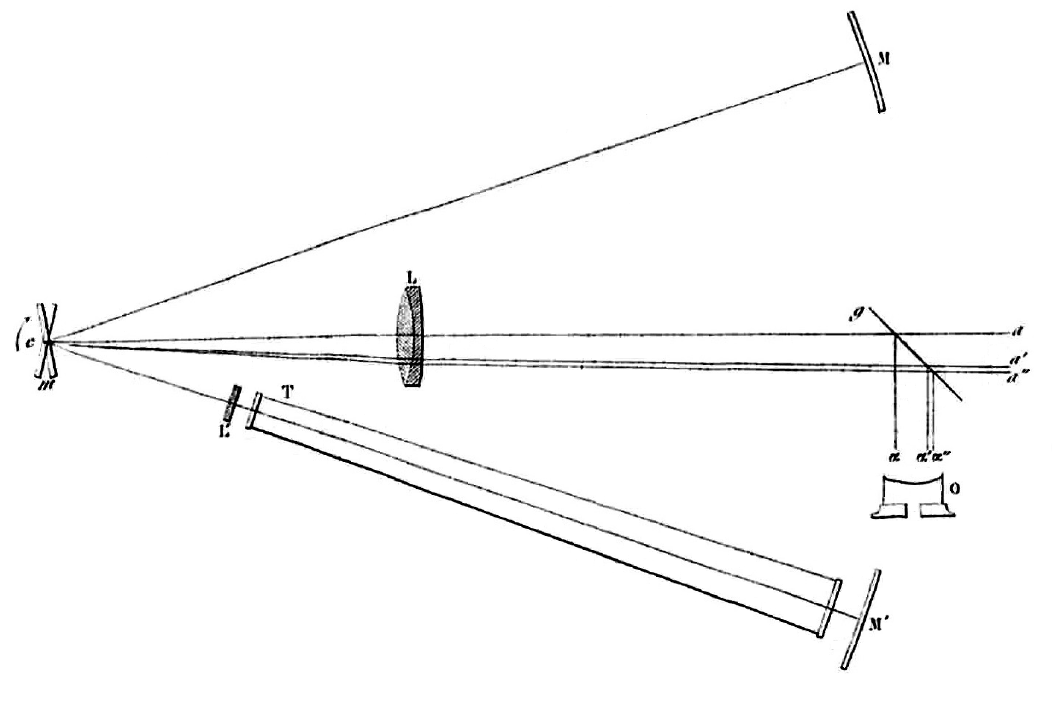
<p>French physicist Léon Foucault was born <a href="/tags/otd/" rel="tag">#OTD</a> in 1819.</p><p>He is best known for his demonstration of the Foucault pendulum, a device demonstrating the effect of Earth's rotation. With Hippolyte Fizeau he carried out a series of investigations on the intensity of the light of the sun, as compared with that of carbon in the arc lamp, and of lime in the flame of the oxyhydrogen blowpipe. His is one of the 72 names inscribed on the Eiffel Tower.</p><p><a href="https://en.wikipedia.org/wiki/L%C3%A9on_Foucault" rel="nofollow" class="ellipsis" title="en.wikipedia.org/wiki/L%C3%A9on_Foucault"><span class="invisible">https://</span><span class="ellipsis">en.wikipedia.org/wiki/L%C3%A9o</span><span class="invisible">n_Foucault</span></a></p><p><a href="/tags/physics/" rel="tag">#physics</a> <a href="/tags/optics/" rel="tag">#optics</a> <a href="/tags/mechanics/" rel="tag">#mechanics</a></p>
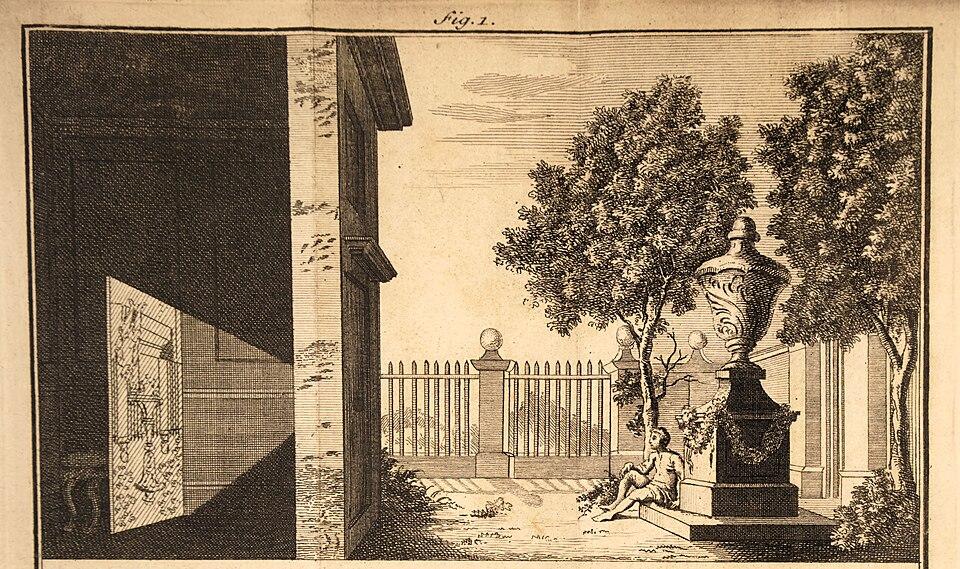
<p>Watching the World in a Dark Room<br>The Early Modern Camera Obscura</p><p>By Julie Park</p><p>Centuries before photography froze the world into neat frames, scientists, poets, and artists streamed transient images into dark interior spaces with the help of a camera obscura. </p><p><a href="https://publicdomainreview.org/essay/the-early-modern-camera-obscura/?utm_source=newsletter" rel="nofollow" class="ellipsis" title="publicdomainreview.org/essay/the-early-modern-camera-obscura/?utm_source=newsletter"><span class="invisible">https://</span><span class="ellipsis">publicdomainreview.org/essay/t</span><span class="invisible">he-early-modern-camera-obscura/?utm_source=newsletter</span></a></p><p>Books about Photography at PG:<br><a href="https://www.gutenberg.org/ebooks/subject/117" rel="nofollow" class="ellipsis" title="www.gutenberg.org/ebooks/subject/117"><span class="invisible">https://</span><span class="ellipsis">www.gutenberg.org/ebooks/subje</span><span class="invisible">ct/117</span></a></p><p><a href="/tags/camera_obscura/" rel="tag">#camera_obscura</a> <a href="/tags/photography/" rel="tag">#photography</a> <a href="/tags/optics/" rel="tag">#optics</a></p>
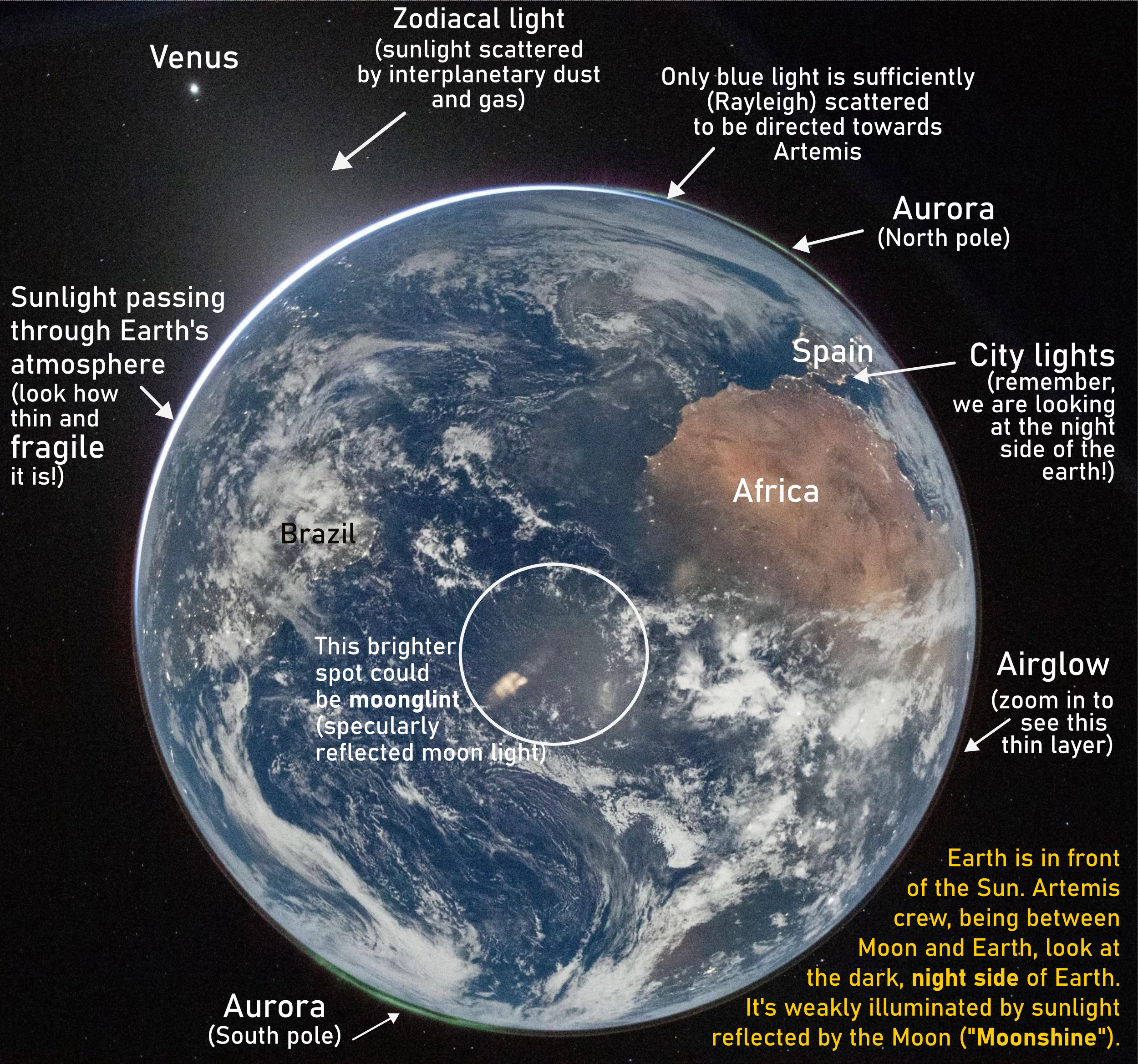
<p>By now, you have seen the Earth image by the <a href="/tags/artemis/" rel="tag">#Artemis</a> crew at least a hundred times. In this annotated version, several <a href="/tags/optics/" rel="tag">#optics</a> effects are highlighted. It also shows how fragile planet <a href="/tags/earth/" rel="tag">#Earth</a> is, with a super thin <a href="/tags/atmosphere/" rel="tag">#atmosphere</a> protecting us from the harsh vacuum of space. <br>Let's protect it.</p>