
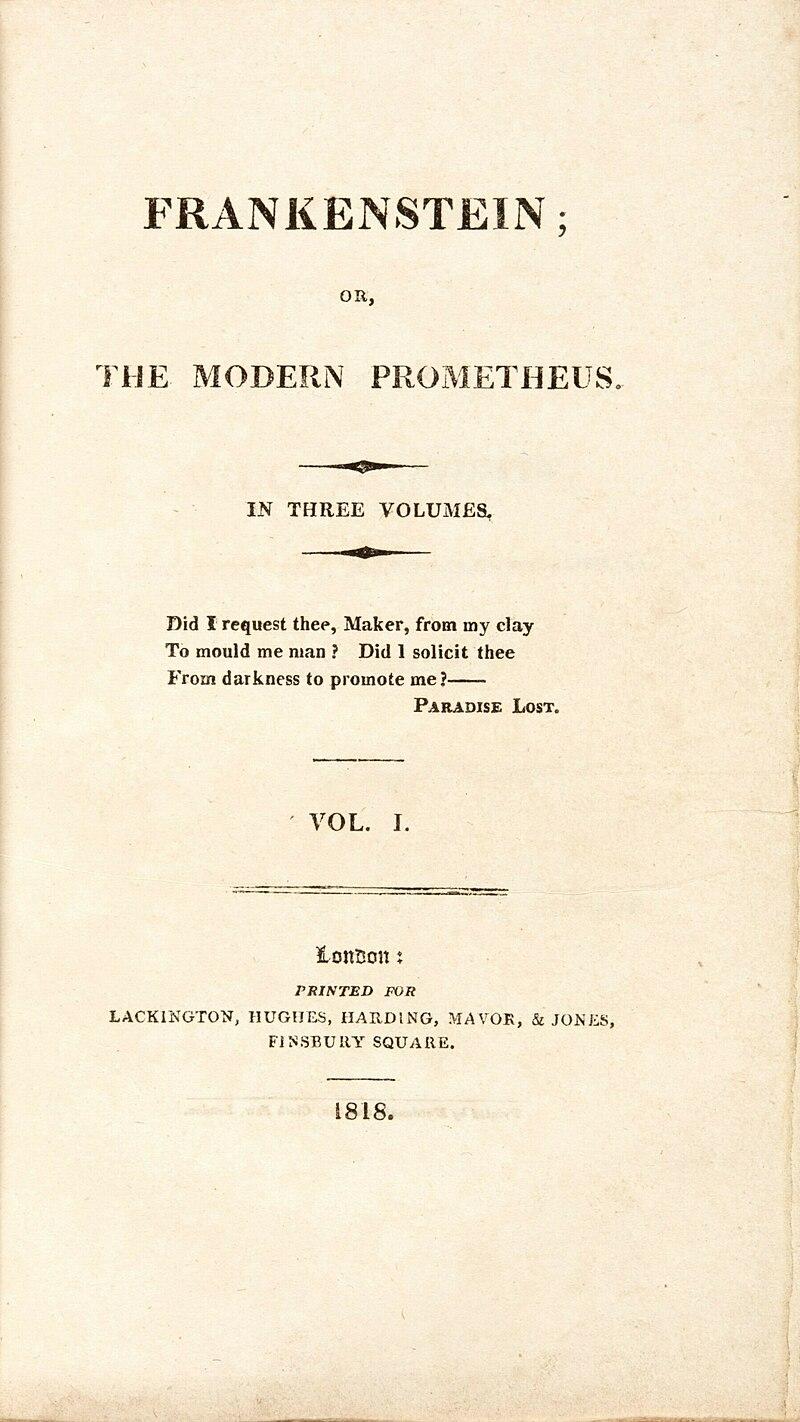
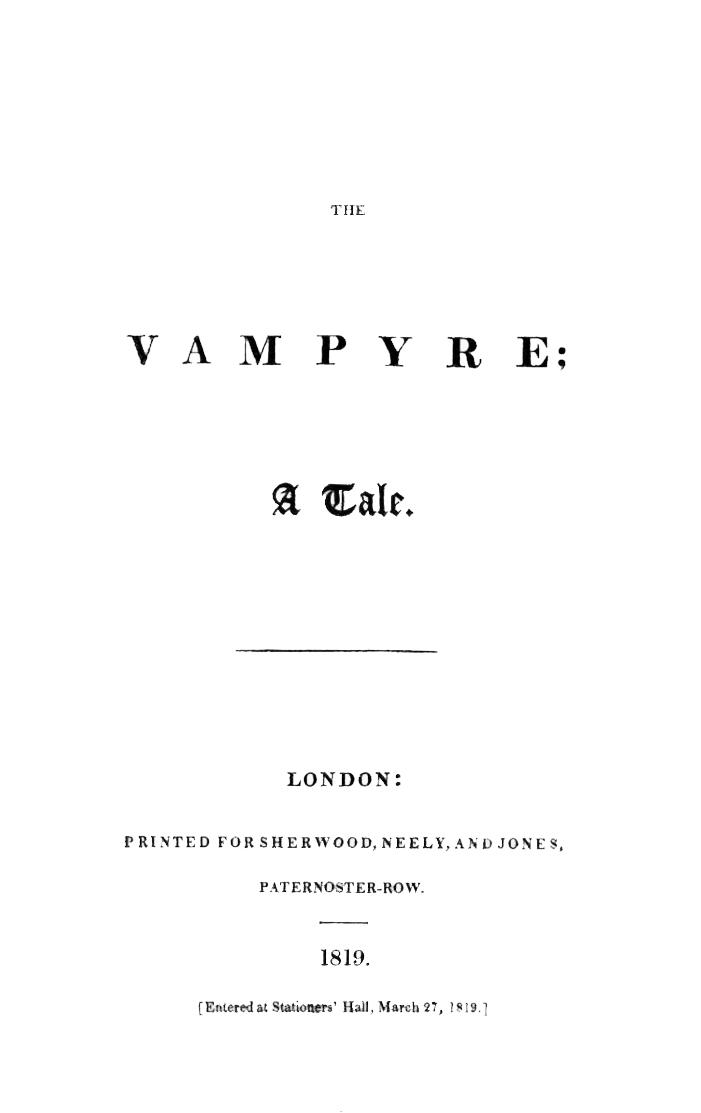
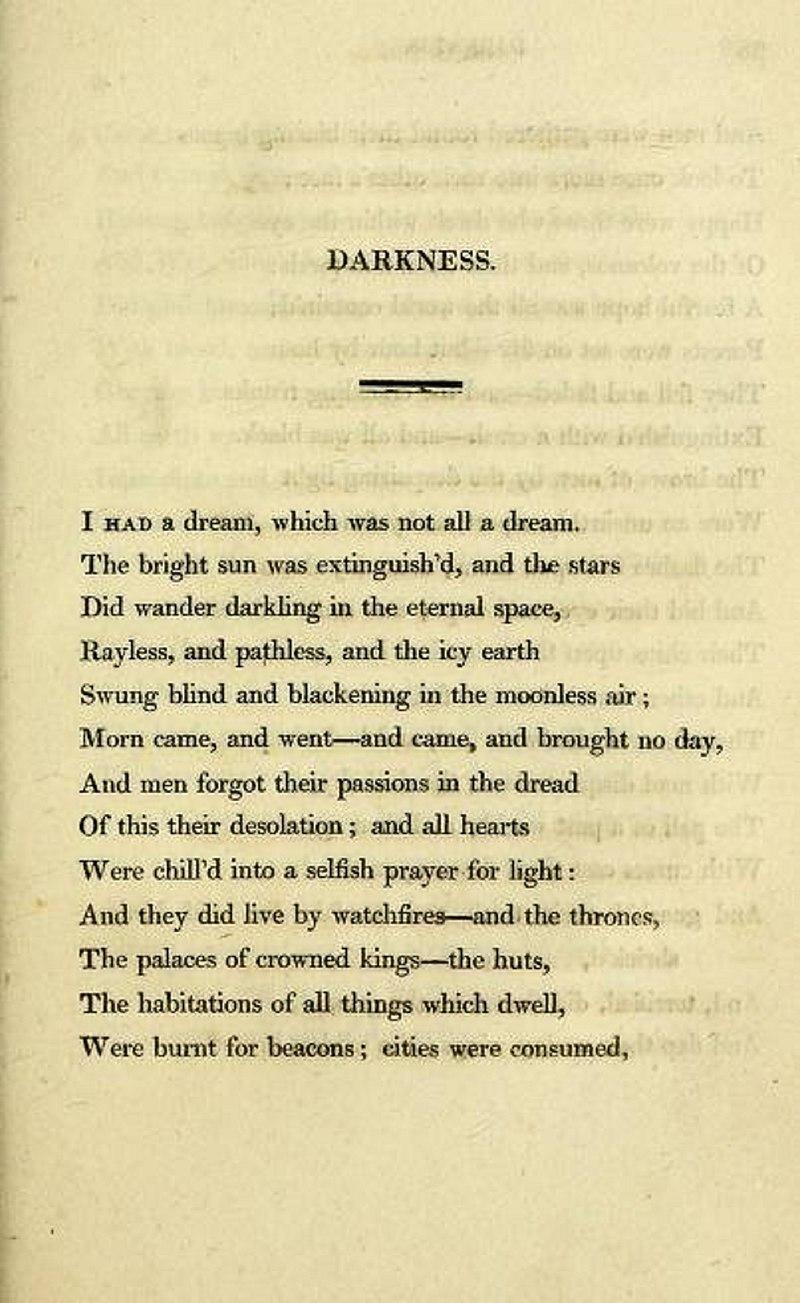
<p>In July 1816.</p><p>Lord Byron, Mary Wollstonecraft Godwin, Percy Bysshe Shelley & John Polidori, who have gathered at the Villa Diodati by Lake Geneva in a rainy Switzerland in this 'Year Without a Summer', tell each other tales. This spawns two classic Gothic narratives, Mary Shelley's Frankenstein and Polidori's The Vampyre. Byron also writes the poem Darkness. </p><p>Frankenstein<br><a href="https://gutenberg.org/ebooks/41445" rel="nofollow"><span class="invisible">https://</span>gutenberg.org/ebooks/41445</a></p><p>The Vampyre<br><a href="https://gutenberg.org/ebooks/6087" rel="nofollow"><span class="invisible">https://</span>gutenberg.org/ebooks/6087</a></p><p>Darkness<br><a href="https://www.gutenberg.org/ebooks/20158" rel="nofollow"><span class="invisible">https://</span>www.gutenberg.org/ebooks/20158</a></p><p><a href="/tags/books/" rel="tag">#books</a> <a href="/tags/literature/" rel="tag">#literature</a> <a href="/tags/poetry/" rel="tag">#poetry</a></p>
literature

<p>Look who has come knocking for Halloween...</p><p>Fascinating and most informative, this detailed and deeply researched biography draws on previously unavailable correspondence to present a fuller picture of the life of Edgar Allan Poe.</p><p><a href="https://inquisitivebiologist.com/2025/10/31/book-review-edgar-allan-poe-a-life/" rel="nofollow" class="ellipsis" title="inquisitivebiologist.com/2025/10/31/book-review-edgar-allan-poe-a-life/"><span class="invisible">https://</span><span class="ellipsis">inquisitivebiologist.com/2025/</span><span class="invisible">10/31/book-review-edgar-allan-poe-a-life/</span></a></p><p><a href="/tags/books/" rel="tag">#Books</a> <a href="/tags/bookreview/" rel="tag">#BookReview</a> <a href="/tags/bookstodon/" rel="tag">#Bookstodon</a> <a href="/tags/edgarallanpoe/" rel="tag">#EdgarAllanPoe</a> <a href="/tags/eapoe/" rel="tag">#EAPoe</a> <a href="/tags/biography/" rel="tag">#Biography</a> <a href="/tags/literature/" rel="tag">#Literature</a> <a href="/tags/goth/" rel="tag">#Goth</a> <a href="/tags/gothic/" rel="tag">#Gothic</a> <a href="/tags/horror/" rel="tag">#Horror</a> <a href="/tags/halloween/" rel="tag">#Halloween</a> <span class="h-card"><a href="https://fedigroups.social/@bookstodon" class="u-url mention" rel="nofollow noopener noreferrer" target="_blank">@<span>bookstodon</span></a></span></p>

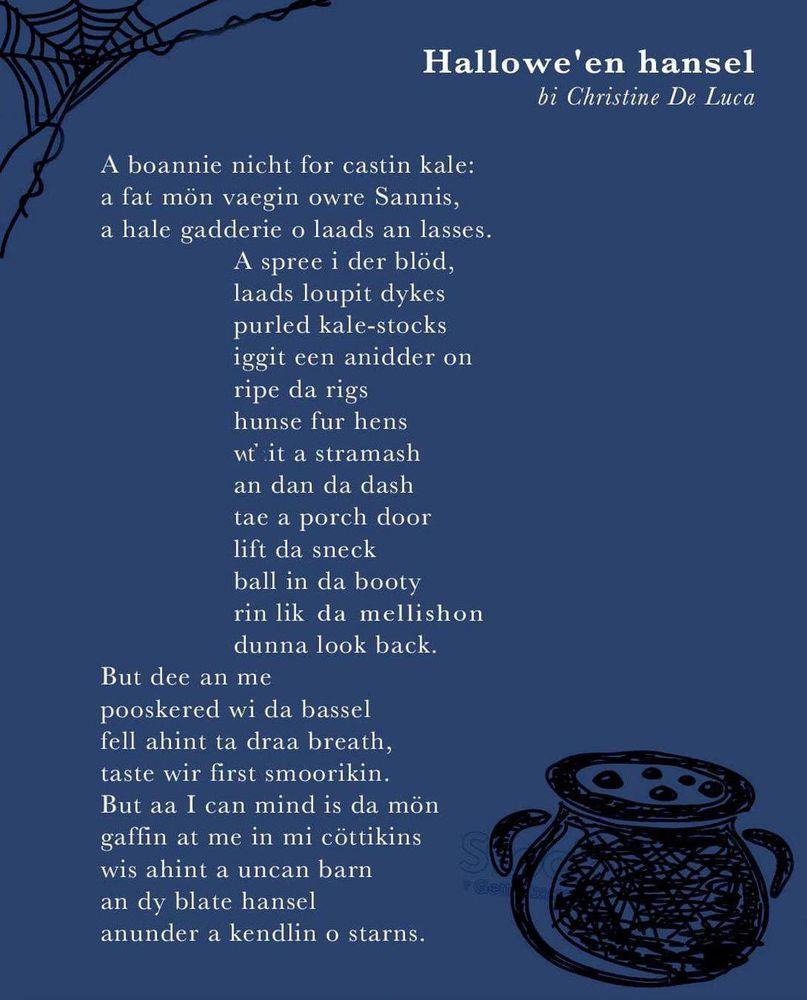
<p>A boannie nicht for castin kale:<br>a fat mön vaegin owre Sannis,<br>a hale gadderie o laads an lasses…</p><p>—Christine De Luca, “Hallowe’en Hansel”<br>published in WAST WI DA VALKYRIES</p><p>Listen to Christine reading her poems online here</p><p><a href="https://www.christinedeluca.co.uk/pages/wast_wi_da_valkyries" rel="nofollow" class="ellipsis" title="www.christinedeluca.co.uk/pages/wast_wi_da_valkyries"><span class="invisible">https://</span><span class="ellipsis">www.christinedeluca.co.uk/page</span><span class="invisible">s/wast_wi_da_valkyries</span></a></p><p><a href="/tags/scottish/" rel="tag">#Scottish</a> <a href="/tags/literature/" rel="tag">#literature</a> <a href="/tags/shetland/" rel="tag">#Shetland</a> <a href="/tags/halloween/" rel="tag">#Halloween</a> <a href="/tags/poem/" rel="tag">#poem</a> <a href="/tags/poetry/" rel="tag">#poetry</a> <a href="/tags/scots/" rel="tag">#Scots</a> <a href="/tags/scotslanguage/" rel="tag">#Scotslanguage</a> <a href="/tags/shetlandic/" rel="tag">#Shetlandic</a></p>
<p><a href="/tags/otd/" rel="tag">#OTD</a> in 1923.</p><p>A riot breaks out at the re-staging of Tristan Tzara's Dadaist play The Gas Heart at the Théâtre Michel, Paris, between those aligned with André Breton and those aligned with Tzara. The conflict leads to a permanent split in the Dada movement and the founding of Surrealism as an alternative.</p><p>Francis Picabia at PG:<br><a href="https://www.gutenberg.org/ebooks/author/49071" rel="nofollow" class="ellipsis" title="www.gutenberg.org/ebooks/author/49071"><span class="invisible">https://</span><span class="ellipsis">www.gutenberg.org/ebooks/autho</span><span class="invisible">r/49071</span></a></p><p>Tristan Tzara at PG:<br><a href="https://www.gutenberg.org/ebooks/author/48499" rel="nofollow" class="ellipsis" title="www.gutenberg.org/ebooks/author/48499"><span class="invisible">https://</span><span class="ellipsis">www.gutenberg.org/ebooks/autho</span><span class="invisible">r/48499</span></a></p><p>André Breton at PG:<br><a href="https://www.gutenberg.org/ebooks/search/?query=andr%C3%A9+breton&submit_search=Go%21" rel="nofollow" class="ellipsis" title="www.gutenberg.org/ebooks/search/?query=andr%C3%A9+breton&submit_search=Go%21"><span class="invisible">https://</span><span class="ellipsis">www.gutenberg.org/ebooks/searc</span><span class="invisible">h/?query=andr%C3%A9+breton&submit_search=Go%21</span></a></p><p><a href="/tags/books/" rel="tag">#books</a> <a href="/tags/literature/" rel="tag">#literature</a></p>
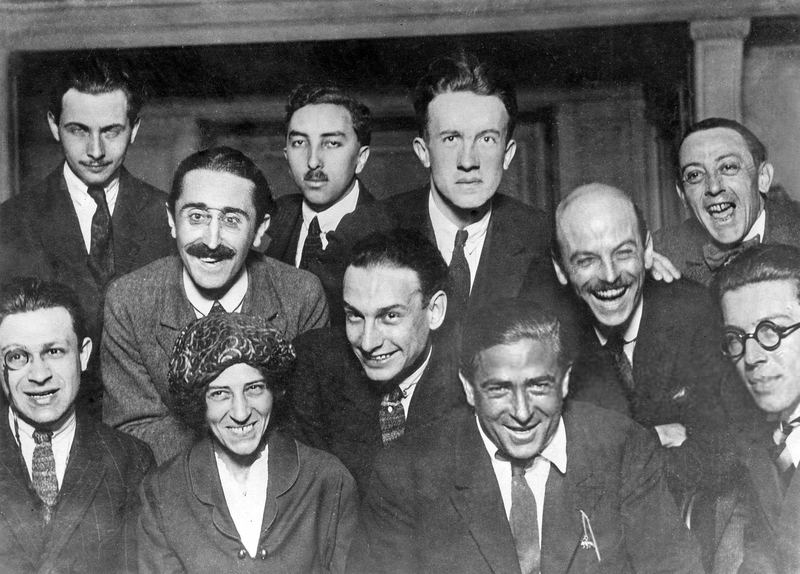
<p>Famous Medieval Words and Their Surprising Origins</p><p>Words like castles, Vikings, and even medieval itself instantly evoke the Middle Ages. Some of these terms were used by people of the time, while others were coined centuries later to describe their world. Each carries traces of history, revealing how language has preserved — and reimagined — the medieval past.</p><p><a href="https://www.medievalists.net/2025/10/medieval-words-origins/" rel="nofollow" class="ellipsis" title="www.medievalists.net/2025/10/medieval-words-origins/"><span class="invisible">https://</span><span class="ellipsis">www.medievalists.net/2025/10/m</span><span class="invisible">edieval-words-origins/</span></a></p><p>Medieval words at PG:<br><a href="https://www.gutenberg.org/ebooks/search/?query=medieval+words" rel="nofollow" class="ellipsis" title="www.gutenberg.org/ebooks/search/?query=medieval+words"><span class="invisible">https://</span><span class="ellipsis">www.gutenberg.org/ebooks/searc</span><span class="invisible">h/?query=medieval+words</span></a></p><p><a href="/tags/books/" rel="tag">#books</a> <a href="/tags/literature/" rel="tag">#literature</a></p>
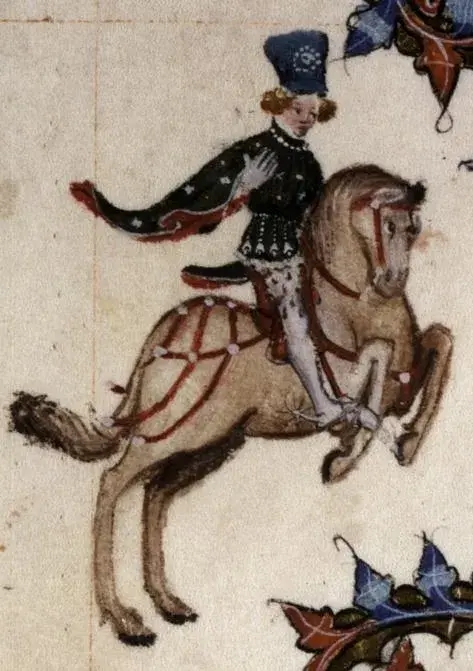
<p>In July 1866.</p><p> Anthony Trollope's novel Nina Balatka: The Story of a Maiden of Prague is initially published anonymously (serialisation in Blackwood's Magazine July 1866–January 1867). Trollope is interested in discovering whether his books sell on their own merits or as a consequence of the author's name and reputation.</p><p>Nina Balakta at PG:<br><a href="https://www.gutenberg.org/ebooks/8897" rel="nofollow"><span class="invisible">https://</span>www.gutenberg.org/ebooks/8897</a></p><p><a href="/tags/books/" rel="tag">#books</a> <a href="/tags/literature/" rel="tag">#literature</a></p>
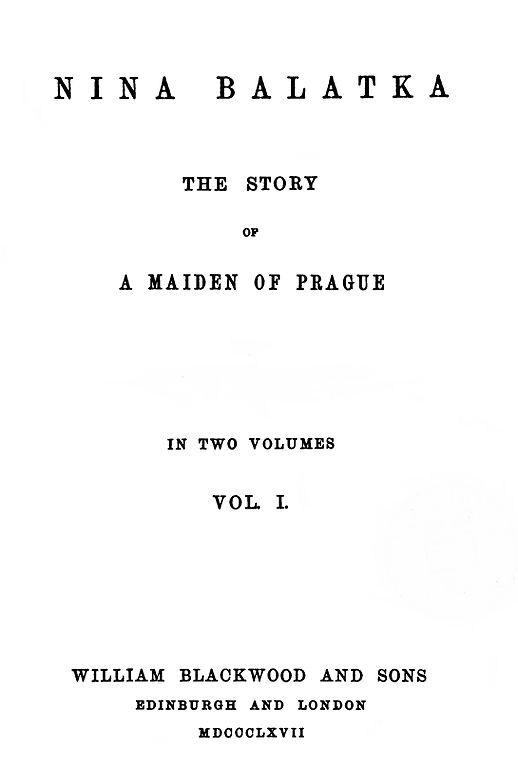
<p>"Our deeds are like children that are born to us; they live and act apart from our own will."</p><p>In July 1862.</p><p>George Eliot's historical novel Romola begins serialization in Cornhill Magazine, the first time she has published a full-length book in this format. George Murray Smith of the publishers Smith, Elder & Co. has agreed a £7,000 advance for it. It was first published as a book, in three volumes, by Smith, Elder & Co. in 1863.</p><p>Romola at PG:<br><a href="https://gutenberg.org/ebooks/24020" rel="nofollow"><span class="invisible">https://</span>gutenberg.org/ebooks/24020</a></p><p><a href="/tags/books/" rel="tag">#books</a> <a href="/tags/literature/" rel="tag">#literature</a></p>
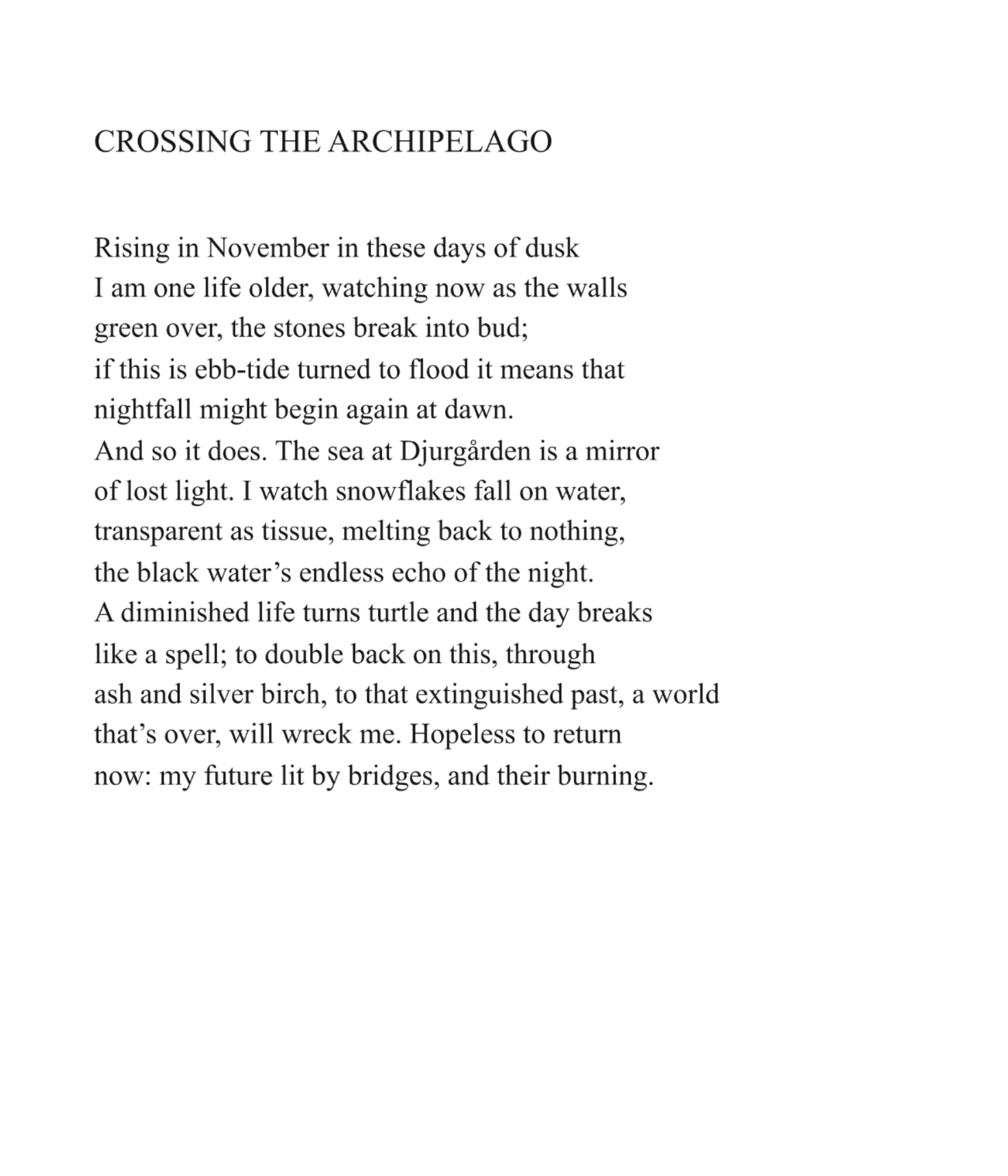
<p>Rising in November in these days of dusk<br>I am one life older, watching now as the walls<br>green over, the stones break into bud;<br>if this is ebb-tide turned to flood it means that<br>nightfall might begin again at dawn.<br>And so it does…</p><p>—Robin Robertson, “Crossing the Archipelago”<br>published in SAILING THE FOREST (Picador, 2014)</p><p><a href="https://www.panmacmillan.com/authors/robin-robertson/sailing-the-forest/9781447231554" rel="nofollow" class="ellipsis" title="www.panmacmillan.com/authors/robin-robertson/sailing-the-forest/9781447231554"><span class="invisible">https://</span><span class="ellipsis">www.panmacmillan.com/authors/r</span><span class="invisible">obin-robertson/sailing-the-forest/9781447231554</span></a></p><p><a href="/tags/scottish/" rel="tag">#Scottish</a> <a href="/tags/literature/" rel="tag">#literature</a> <a href="/tags/poem/" rel="tag">#poem</a> <a href="/tags/poetry/" rel="tag">#poetry</a> <a href="/tags/november/" rel="tag">#November</a></p>
<p>Bluidy Jack’s Prisoner<br>13 Nov, Edinburgh. Free, unticketed.</p><p>While writing Kidnapped & other classics such as Jekyll & Hyde, Robert Louis Stevenson was suffering from the pulmonary disease he called ‘Bluidy Jack’. Join members of the Robert Louis Stevenson Club for an insight into the strange double life of a great Scottish author as they celebrate his 175th birthday</p><p><a href="https://cultureedinburgh.com/events/bluidy-jacks-prisoner" rel="nofollow" class="ellipsis" title="cultureedinburgh.com/events/bluidy-jacks-prisoner"><span class="invisible">https://</span><span class="ellipsis">cultureedinburgh.com/events/bl</span><span class="invisible">uidy-jacks-prisoner</span></a></p><p><a href="/tags/scottish/" rel="tag">#Scottish</a> <a href="/tags/literature/" rel="tag">#literature</a> <a href="/tags/19thcentury/" rel="tag">#19thcentury</a> <a href="/tags/victorian/" rel="tag">#Victorian</a> <a href="/tags/robertlouisstevenson/" rel="tag">#RobertLouisStevenson</a></p>
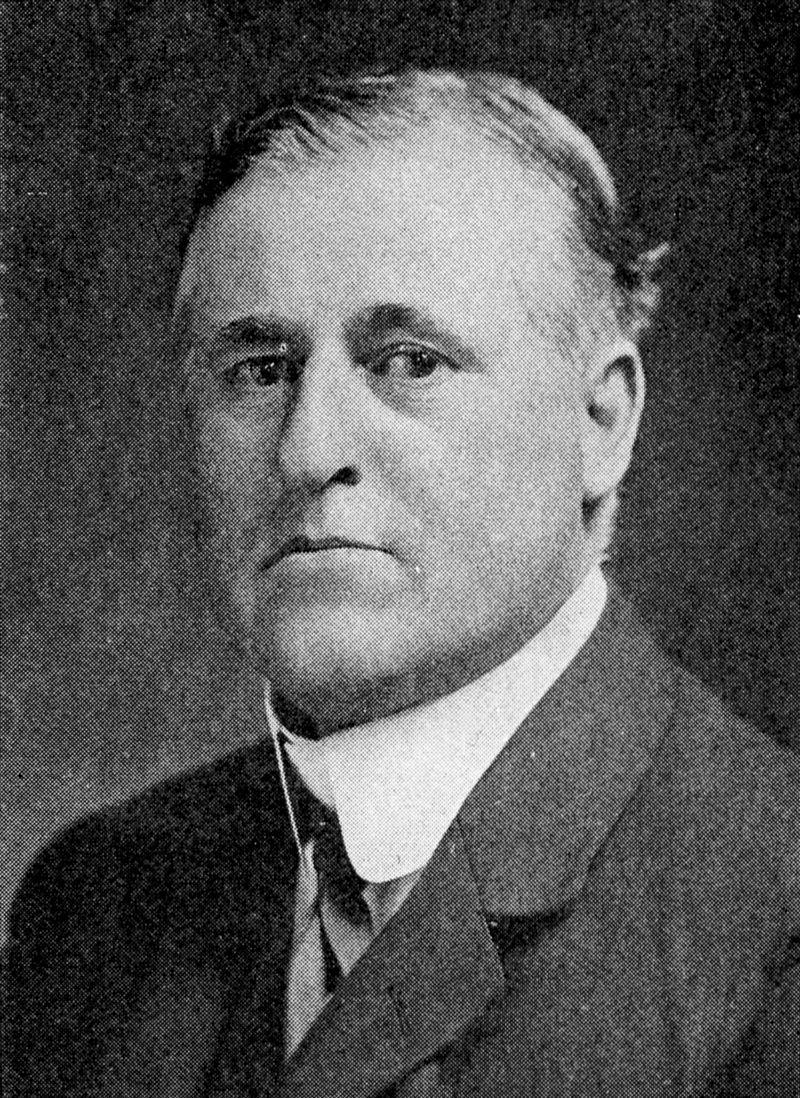
<p>"Empires dissolve and peoples disappear,<br>Song passes not away."</p><p>English poet William Watson died <a href="/tags/otd/" rel="tag">#OTD</a> in 1935.</p><p>Watson's early work, like Wordsworth's Grave (1890), demonstrated his deep admiration for the Romantic poets and established him as a significant literary figure. Despite his popularity and influence during his lifetime, his work fell out of favor in the years following his death, and he is less well-known today. </p><p>William Watson at PG:<br><a href="https://www.gutenberg.org/ebooks/author/4885" rel="nofollow" class="ellipsis" title="www.gutenberg.org/ebooks/author/4885"><span class="invisible">https://</span><span class="ellipsis">www.gutenberg.org/ebooks/autho</span><span class="invisible">r/4885</span></a></p><p><a href="/tags/books/" rel="tag">#books</a> <a href="/tags/literature/" rel="tag">#literature</a></p>
<p>Portuguese poet Tomás António Gonzaga was born <a href="/tags/otd/" rel="tag">#OTD</a> in 1744.</p><p>He is best known for his work Marília de Dirceu, a collection of pastoral love poems that became a classic of Portuguese literature. His life took a dramatic turn when he was implicated in the Inconfidência Mineira, a failed conspiracy against Portuguese rule in Brazil. He was arrested and exiled to Mozambique, where he spent the remainder of his life. </p><p>Books by Tomás António Gonzaga at PG:<br><a href="https://www.gutenberg.org/ebooks/author/7794" rel="nofollow" class="ellipsis" title="www.gutenberg.org/ebooks/author/7794"><span class="invisible">https://</span><span class="ellipsis">www.gutenberg.org/ebooks/autho</span><span class="invisible">r/7794</span></a></p><p><a href="/tags/books/" rel="tag">#books</a> <a href="/tags/literature/" rel="tag">#literature</a></p>
![A drawing of Gonzaga
Unknown author - Pantheon Escolar Brazileiro. p. Cartão 09 (THOMAZ Antonio Gonzaga: Inconfidente, Desmbargador Poeta de "Marilia e Dirceu". Rio de Janeiro, RJ: Livraria de J. G. de Azevedo, [18--]. 1 cartão, zincogravura, p&b, 13,4 x 9cm.
Disponível em: http://objdigital.bn.br/objdigital2/acervo_digital/div_iconografia/icon95726_1396400/icon1396386.jpg. Acesso em: 5 ago. 2019.).](/proxy/post_attachment/321430/ac21ce0e2b.jpg "A drawing of Gonzaga
Unknown author - Pantheon Escolar Brazileiro. p. Cartão 09 (THOMAZ Antonio Gonzaga: Inconfidente, Desmbargador Poeta de \"Marilia e Dirceu\". Rio de Janeiro, RJ: Livraria de J. G. de Azevedo, [18--]. 1 cartão, zincogravura, p&b, 13,4 x 9cm.
Disponível em: http://objdigital.bn.br/objdigital2/acervo_digital/div_iconografia/icon95726_1396400/icon1396386.jpg. Acesso em: 5 ago. 2019.).")
<p>In Praise of Librarians in Dangerous Times</p><p>Sarah Weinman on the Awesome Responsibility of the Seekers and Keepers of Truth</p><p><a href="https://lithub.com/in-praise-of-librarians-in-dangerous-times/" rel="nofollow" class="ellipsis" title="lithub.com/in-praise-of-librarians-in-dangerous-times/"><span class="invisible">https://</span><span class="ellipsis">lithub.com/in-praise-of-librar</span><span class="invisible">ians-in-dangerous-times/</span></a></p><p>Librarians at PG:<br><a href="https://www.gutenberg.org/ebooks/subjects/search/?query=librarians" rel="nofollow" class="ellipsis" title="www.gutenberg.org/ebooks/subjects/search/?query=librarians"><span class="invisible">https://</span><span class="ellipsis">www.gutenberg.org/ebooks/subje</span><span class="invisible">cts/search/?query=librarians</span></a></p><p><a href="/tags/books/" rel="tag">#books</a> <a href="/tags/literature/" rel="tag">#literature</a></p>

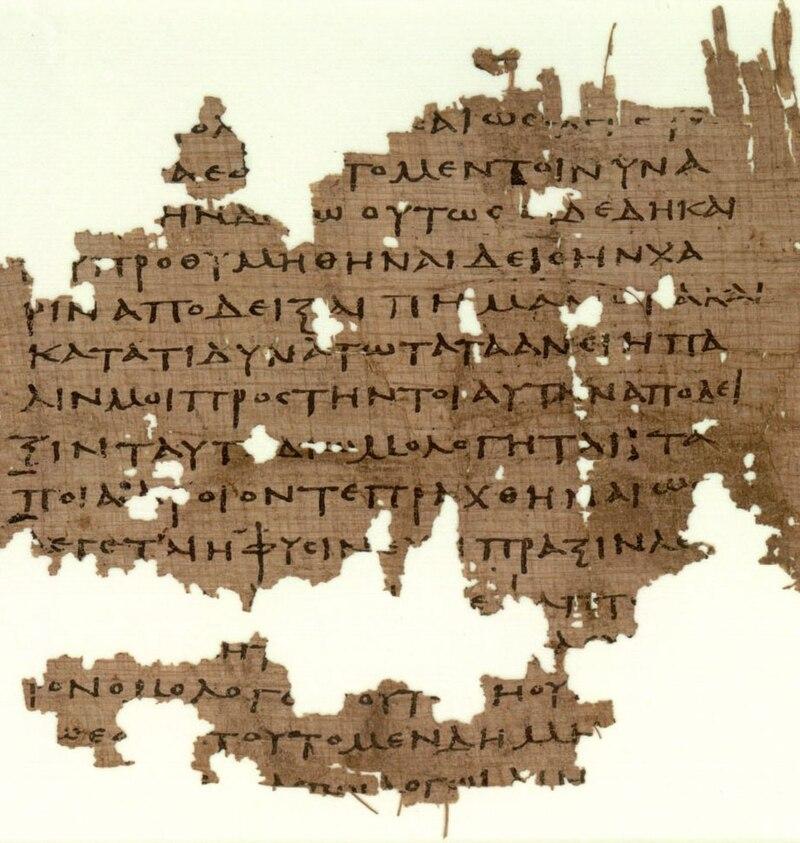
<p>Plato and the Poets</p><p>The centuries-old debate should be settled: an intellectual world bereft of poetry is a damaged one.</p><p>by Elaine Scarry</p><p><a href="https://www.bostonreview.net/articles/plato-and-the-poets/" rel="nofollow" class="ellipsis" title="www.bostonreview.net/articles/plato-and-the-poets/"><span class="invisible">https://</span><span class="ellipsis">www.bostonreview.net/articles/</span><span class="invisible">plato-and-the-poets/</span></a></p><p>Plato at PG:<br><a href="https://www.gutenberg.org/ebooks/author/93" rel="nofollow" class="ellipsis" title="www.gutenberg.org/ebooks/author/93"><span class="invisible">https://</span><span class="ellipsis">www.gutenberg.org/ebooks/autho</span><span class="invisible">r/93</span></a></p><p><a href="/tags/books/" rel="tag">#books</a> <a href="/tags/literature/" rel="tag">#literature</a> <a href="/tags/philosophy/" rel="tag">#philosophy</a></p>
<p>In December 1894.</p><p>An abridgement of Stephen Crane's American Civil War novel The Red Badge of Courage is first published as a serial in The Philadelphia Press. This version of the story, which was culled to 18,000 words by an editor specifically for the serialization, was reprinted in newspapers across America, establishing Crane's fame.</p><p><a href="https://en.wikipedia.org/wiki/The_Red_Badge_of_Courage#" rel="nofollow" class="ellipsis" title="en.wikipedia.org/wiki/The_Red_Badge_of_Courage#"><span class="invisible">https://</span><span class="ellipsis">en.wikipedia.org/wiki/The_Red_</span><span class="invisible">Badge_of_Courage#</span></a></p><p>The Red Badge of Courage at PG:<br><a href="https://gutenberg.org/ebooks/73" rel="nofollow"><span class="invisible">https://</span>gutenberg.org/ebooks/73</a></p><p><a href="/tags/books/" rel="tag">#books</a> <a href="/tags/literature/" rel="tag">#literature</a></p>
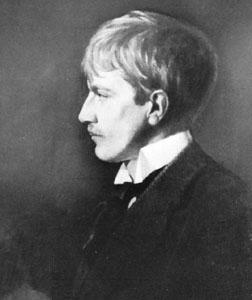
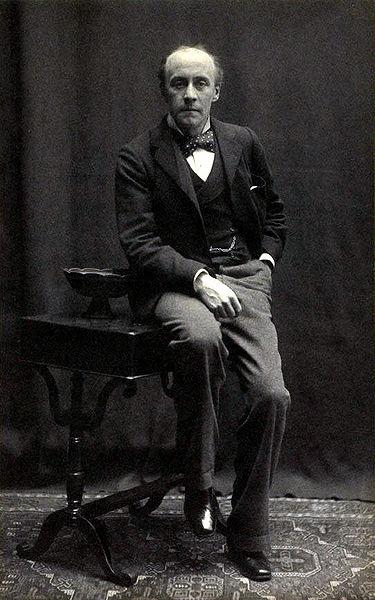
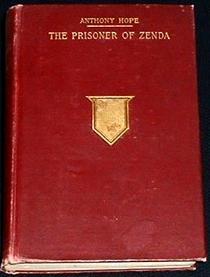
<p>"Unless one is a genius, it is best to aim at being intelligible."<br>The Dolly Dialogues</p><p>British novelist and playwright Anthony Hope died <a href="/tags/otd/" rel="tag">#OTD</a> in 1933.</p><p>Hope wrote numerous other novels and plays, though none achieved the same level of acclaim as "The Prisoner of Zenda." Notable works include "The Dolly Dialogues", a collection of witty sketches, and "The Chronicles of Count Antonio", an adventure novel set in Renaissance Italy.</p><p>Anthony Hope at PG:<br><a href="https://www.gutenberg.org/ebooks/author/63" rel="nofollow" class="ellipsis" title="www.gutenberg.org/ebooks/author/63"><span class="invisible">https://</span><span class="ellipsis">www.gutenberg.org/ebooks/autho</span><span class="invisible">r/63</span></a></p><p><a href="/tags/books/" rel="tag">#books</a> <a href="/tags/literature/" rel="tag">#literature</a></p>

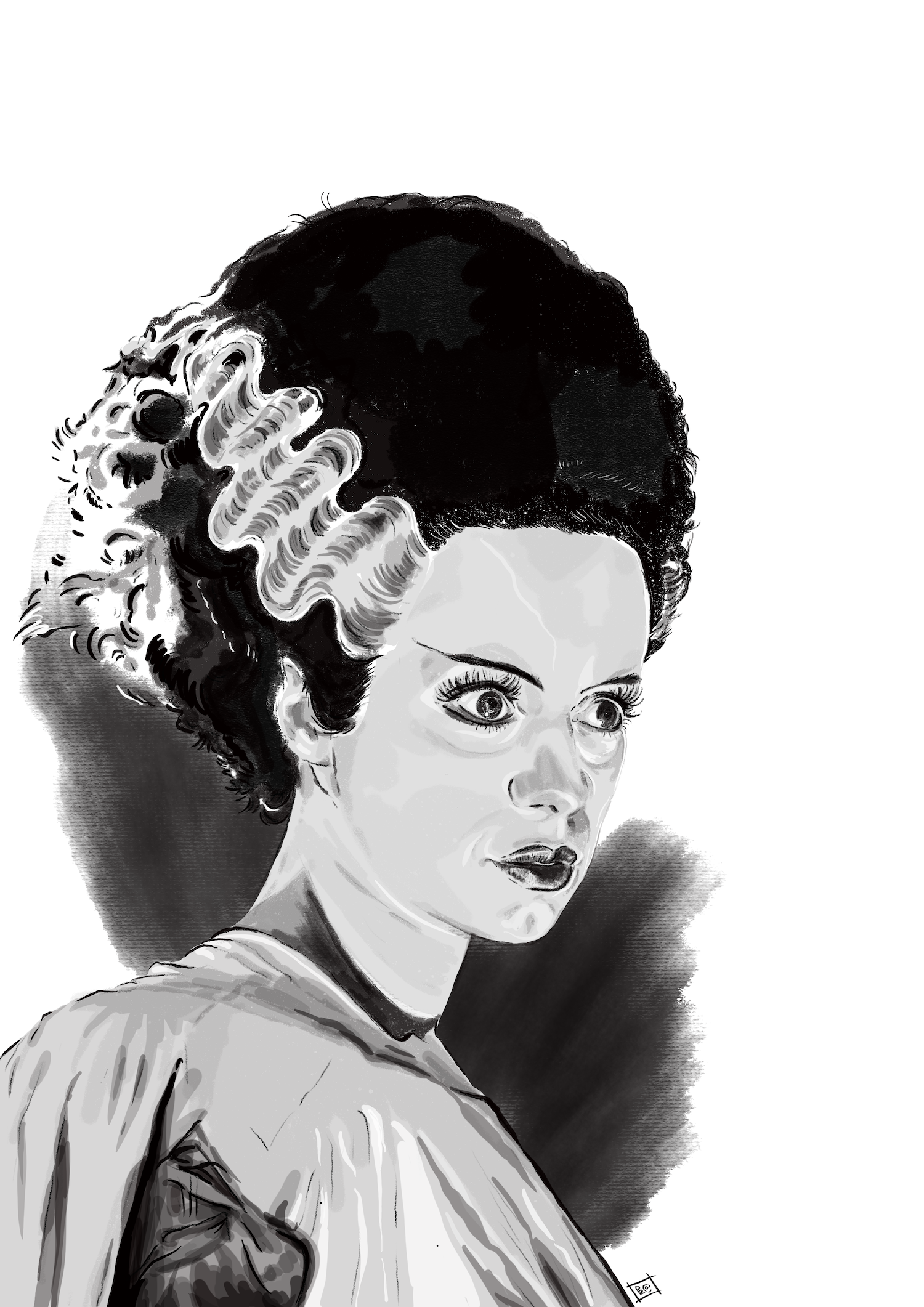
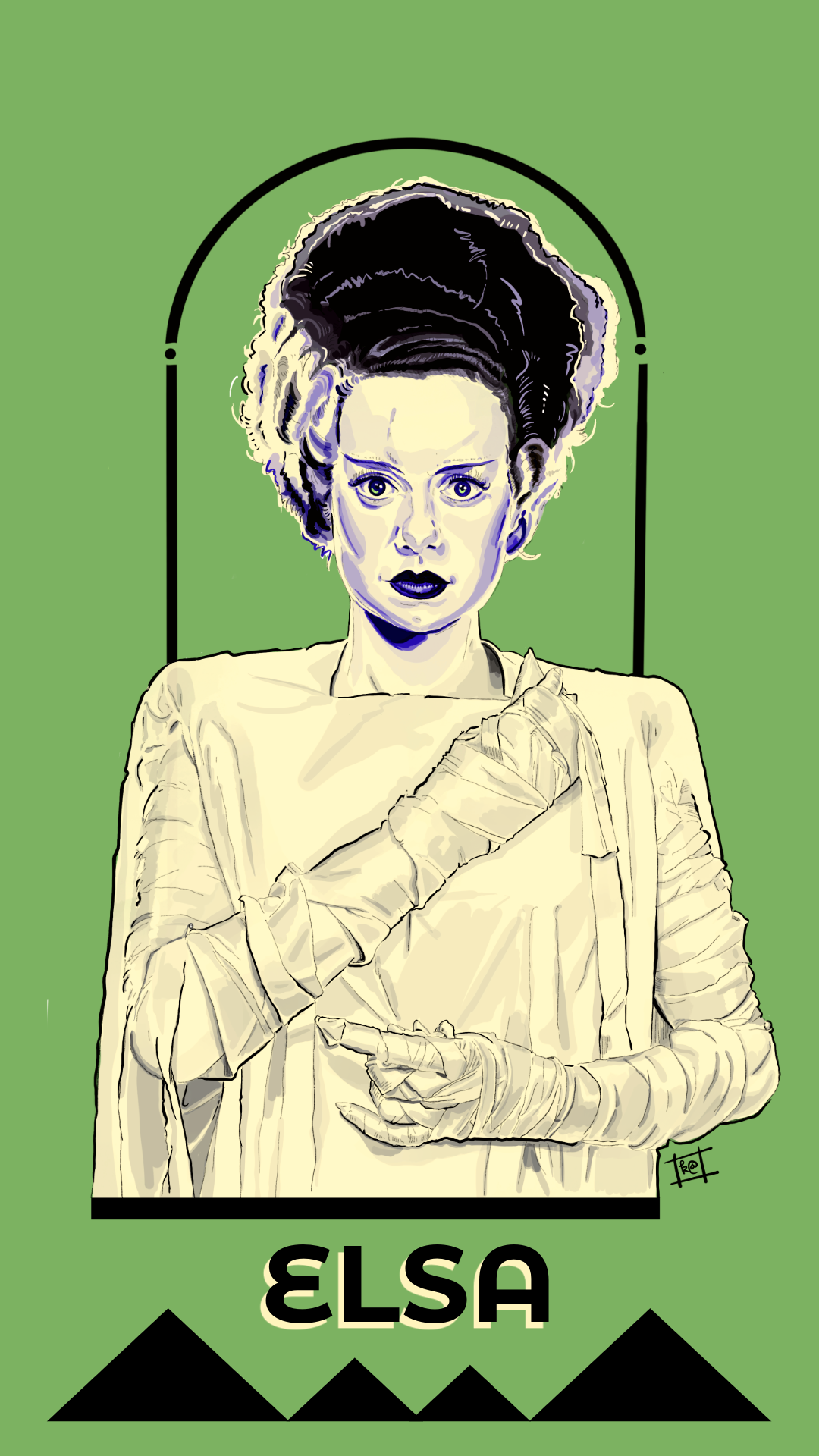
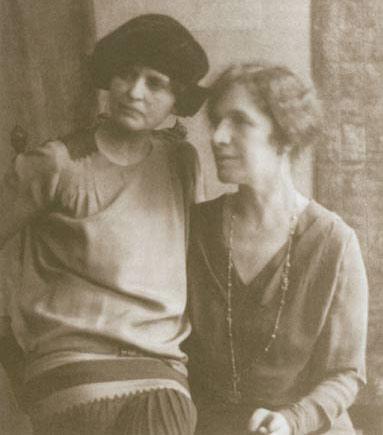
<p><a href="/tags/art/" rel="tag">#art</a> <a href="/tags/history/" rel="tag">#history</a>: every 28th october, i use elsa lanchester (born <a href="/tags/otd/" rel="tag">#otd</a> in 1902) as an excuse to pay homage to mary wollstonecraft shelley's masterpiece, 'frankenstein'. mind you, elsa was pretty cool, herself. difficult not to be when you're the daughter of a suffragette who was also secretary to eleanor marx. <br>i've got more to say about elsa in the response posts below, so read or ignore as you wish. <br><a href="/tags/wip/" rel="tag">#wip</a> <a href="/tags/illustration/" rel="tag">#illustration</a> <a href="/tags/cinema/" rel="tag">#cinema</a> <a href="/tags/literature/" rel="tag">#literature</a> <a href="/tags/frankenstein/" rel="tag">#frankenstein</a> <a href="/tags/maryshelley/" rel="tag">#maryShelley</a> <a href="/tags/elsalanchester/" rel="tag">#elsaLanchester</a></p>
Edited 161d ago
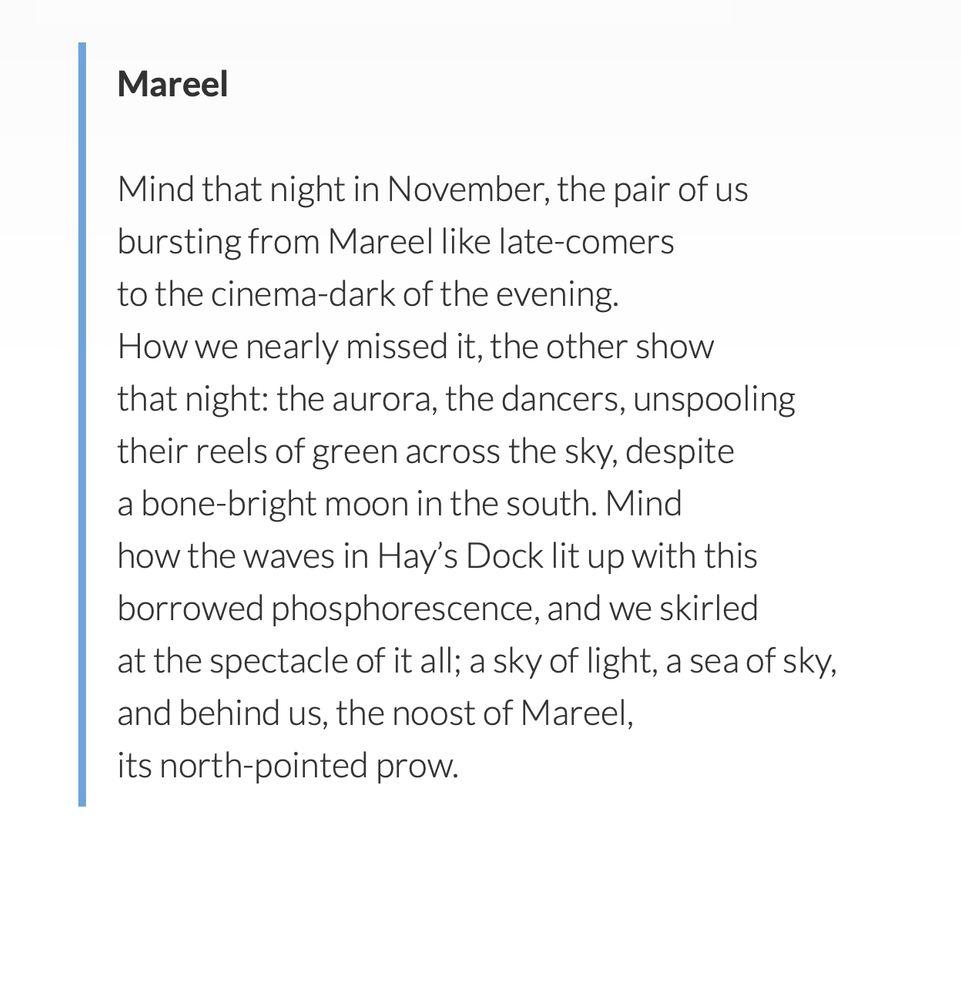
<p>Mind that night in November, the pair of us<br>bursting from Mareel like late-comers<br>to the cinema-dark of the evening.<br>How we nearly missed it, the other show<br>that night: the aurora, the dancers, unspooling<br>their reels of green across the sky…</p><p>—Roseanne Watt, “Mareel”<br>published in MODER DY (Polygon, 2019)</p><p><a href="https://birlinn.co.uk/product/moder-dy/" rel="nofollow" class="ellipsis" title="birlinn.co.uk/product/moder-dy/"><span class="invisible">https://</span><span class="ellipsis">birlinn.co.uk/product/moder-dy</span><span class="invisible">/</span></a></p><p><a href="/tags/scottish/" rel="tag">#Scottish</a> <a href="/tags/literature/" rel="tag">#literature</a> <a href="/tags/poem/" rel="tag">#poem</a> <a href="/tags/poetry/" rel="tag">#poetry</a> <a href="/tags/shetland/" rel="tag">#Shetland</a> <a href="/tags/november/" rel="tag">#November</a> <a href="/tags/auroraborealis/" rel="tag">#auroraborealis</a></p>

<p>So here's <a href="/tags/autumn2025/" rel="tag">#Autumn2025</a> with box fresh <a href="/tags/shortstories/" rel="tag">#ShortStories</a> from Helon Habila, Ephameron, Caroline Clark, Kōtuku Titihuia Nuttall and Kasimma – plus Chadwick Allen on the classics of <a href="/tags/indigenous/" rel="tag">#Indigenous</a> <a href="/tags/literature/" rel="tag">#literature</a> </p><p>Catch them all at <a href="https://fictionable.world" rel="nofollow"><span class="invisible">https://</span>fictionable.world</a></p><p><a href="/tags/books/" rel="tag">#books</a> <a href="/tags/reading/" rel="tag">#reading</a> <a href="/tags/writing/" rel="tag">#writing</a> <a href="/tags/fiction/" rel="tag">#fiction</a> <a href="/tags/comics/" rel="tag">#comics</a> <a href="/tags/translation/" rel="tag">#translation</a> <a href="/tags/blog/" rel="tag">#blog</a> <a href="/tags/bookstodon/" rel="tag">#bookstodon</a> @bookstodon</p>

<p>"The dusk crept out across the fields wiping out the day's light."<br>Black April (1927)</p><p>American author Julia Peterkin died <a href="/tags/otd/" rel="tag">#OTD</a> in 1961.</p><p>In 1929 she won the Pulitzer Prize for Novel/Literature for her novel Scarlet Sister Mary. She wrote several novels about the plantation South, especially the Gullah people of the Lowcountry. She was one of the few white authors who wrote about the African-American experience.</p><p><a href="https://en.wikipedia.org/wiki/Julia_Peterkin" rel="nofollow" class="ellipsis" title="en.wikipedia.org/wiki/Julia_Peterkin"><span class="invisible">https://</span><span class="ellipsis">en.wikipedia.org/wiki/Julia_Pe</span><span class="invisible">terkin</span></a></p><p><a href="https://www.gutenberg.org/ebooks/72611" rel="nofollow"><span class="invisible">https://</span>www.gutenberg.org/ebooks/72611</a></p><p><a href="/tags/books/" rel="tag">#books</a> <a href="/tags/literature/" rel="tag">#literature</a></p>
Edited 1y ago
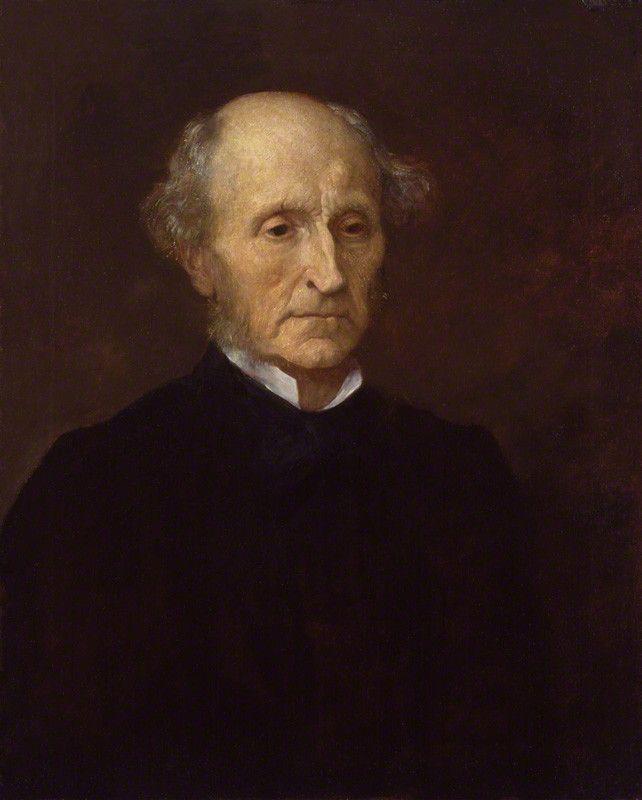
<p>c. 1813, London. Reading List</p><p>John Stuart Mill turns the page. via @laphamsquart </p><p>"I have no remembrance of the time when I began to learn Greek. I have been told that it was when I was three years old...."</p><p><a href="https://www.laphamsquarterly.org/ways-learning/reading-list/?campaign=FE7LQA2" rel="nofollow" class="ellipsis" title="www.laphamsquarterly.org/ways-learning/reading-list/?campaign=FE7LQA2"><span class="invisible">https://</span><span class="ellipsis">www.laphamsquarterly.org/ways-</span><span class="invisible">learning/reading-list/?campaign=FE7LQA2</span></a></p><p><a href="/tags/books/" rel="tag">#books</a> <a href="/tags/literature/" rel="tag">#literature</a></p>
<p>Robert Louis Stevenson’s KIDNAPPED began life serialised in a children’s magazine, but its sophistication & depth won the lifelong admiration of Henry James.</p><p>In this episode of NOVEL APPROACHES, Clare Bucknell, Andrew O’Hagan & Tom Crewe explore RLS’s startlingly modern handling of perspective & pacing, his approach to the art of fiction, & the value of being ‘betwixt & between’.</p><p><a href="https://www.lrb.co.uk/podcasts-and-videos/podcasts/close-readings/novel-approaches-kidnapped-by-robert-louis-stevenson" rel="nofollow" class="ellipsis" title="www.lrb.co.uk/podcasts-and-videos/podcasts/close-readings/novel-approaches-kidnapped-by-robert-louis-stevenson"><span class="invisible">https://</span><span class="ellipsis">www.lrb.co.uk/podcasts-and-vid</span><span class="invisible">eos/podcasts/close-readings/novel-approaches-kidnapped-by-robert-louis-stevenson</span></a></p><p><a href="/tags/scottish/" rel="tag">#Scottish</a> <a href="/tags/literature/" rel="tag">#literature</a> <a href="/tags/19thcenyury/" rel="tag">#19thcenyury</a> <a href="/tags/robertlouisstevenson/" rel="tag">#RobertLouisStevenson</a> <a href="/tags/kidlit/" rel="tag">#KidLit</a> <a href="/tags/childrensliterature/" rel="tag">#ChildrensLiterature</a></p>
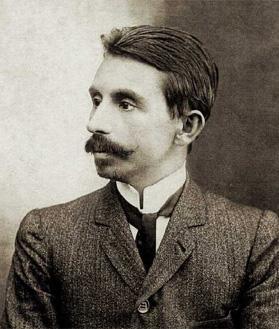
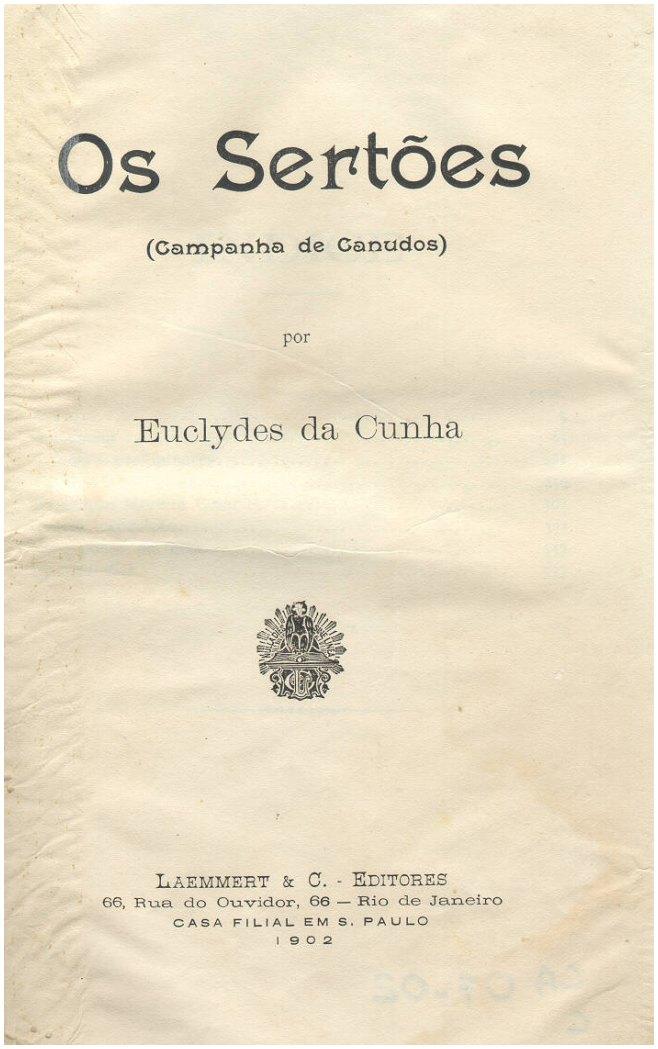
<p>“It's not the barbarian who threatens us, it's civilization that frightens us.”</p><p>Brazilian sociologist and journalist Euclides da Cunha died <a href="/tags/otd/" rel="tag">#OTD</a> in 1909.</p><p>His most important work is Os Sertões (Rebellion in the Backlands), a non-fictional account of the military expeditions promoted by the Brazilian government against the rebellious village of Canudos, known as the War of Canudos.</p><p><a href="https://en.wikipedia.org/wiki/Euclides_da_Cunha" rel="nofollow" class="ellipsis" title="en.wikipedia.org/wiki/Euclides_da_Cunha"><span class="invisible">https://</span><span class="ellipsis">en.wikipedia.org/wiki/Euclides</span><span class="invisible">_da_Cunha</span></a></p><p><a href="/tags/books/" rel="tag">#books</a> <a href="/tags/literature/" rel="tag">#literature</a></p>
<p>The Oxfam bookshop on Glasgow’s Byres Road moved, recently, to a new location further down the hill – but I’m very pleased that they managed to take Alasdair Gray’s mural with them! I think he did this when on a break from painting the ceiling in Òran Mór …</p><p><a href="/tags/scottish/" rel="tag">#Scottish</a> <a href="/tags/literature/" rel="tag">#literature</a> <a href="/tags/glasgow/" rel="tag">#Glasgow</a> <a href="/tags/alasdairgray/" rel="tag">#AlasdairGray</a> <a href="/tags/murals/" rel="tag">#Murals</a> <a href="/tags/visualart/" rel="tag">#VisualArt</a></p>

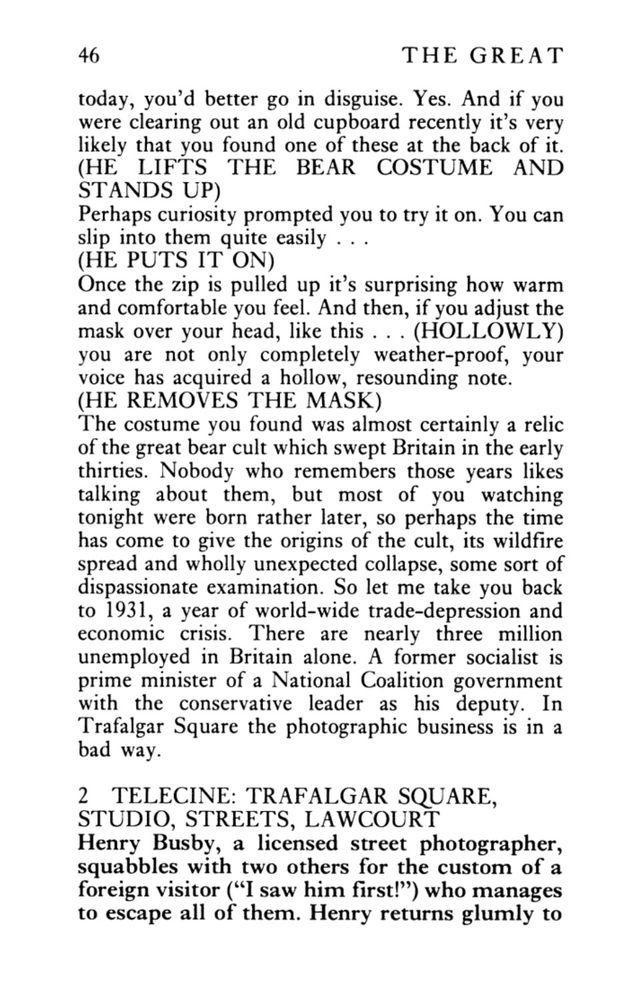
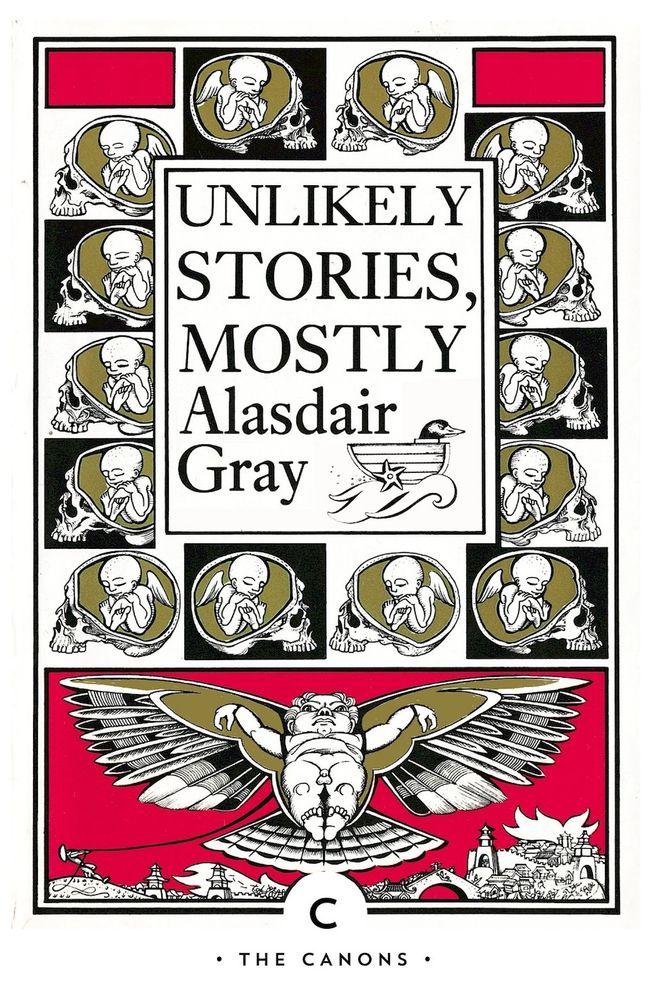
<p>Alasdair Gray’s “The Great Bear Cult” is a script for a (rejected) documentary on the movement which briefly swept Britain in the 1930s. Although mention of the Cult is still suppressed, <span class="h-card"><a href="https://bookish.community/@canongatebooks" class="u-url mention" rel="nofollow noopener noreferrer" target="_blank">@<span>canongatebooks</span></a></span> includes the script in UNLIKELY STORIES, MOSTLY</p><p>Today, 7 November, is Hug A Bear Day 🧸</p><p>@bookstodon </p><p><a href="https://canongate.co.uk/books/100-unlikely-stories-mostly/" rel="nofollow" class="ellipsis" title="canongate.co.uk/books/100-unlikely-stories-mostly/"><span class="invisible">https://</span><span class="ellipsis">canongate.co.uk/books/100-unli</span><span class="invisible">kely-stories-mostly/</span></a></p><p><a href="/tags/scottish/" rel="tag">#Scottish</a> <a href="/tags/literature/" rel="tag">#literature</a> <a href="/tags/alasdairgray/" rel="tag">#AlasdairGray</a> <a href="/tags/hugabearday/" rel="tag">#HugABearDay</a></p>
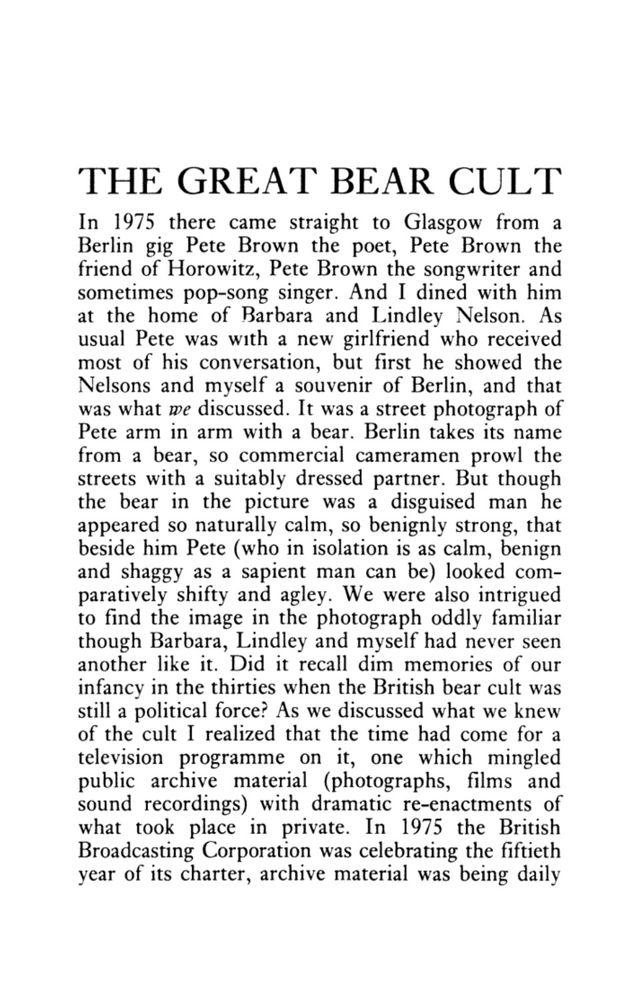
![broadcast and displayed, surely the BBC would be interested? It was not. I discovered that although Lord Reith's restrictions upon clothing, drink and sexual conduct had for years been matter for jest in the corridors of Broadcasting House and the Television Centre, his tabu upon all reference to the cult after Ramsay McDonald's famous broadcast to the nation was still in force. The BBC rejected my documentary drama. I offer it here, hoping readers will not be afraid to view it upon the television screen of their minds.
[ILLUSTRATION: In the centre is Rupert the Bear's smiling face, a tartan scarf around his neck; on either side, between 2 tall bearskin hats as worn by British guardsmen on parade, stand 2 portly, Winnie-the-Pooh-like figures, facing inwards, heads tilted proudly skywards. Each has their right arm raised in a fascist salute.]
1 STUDIO INTRODUCTION
To a recording of The Teddy Bears' Picnic the camera advances upon a commentator leaning casually against a table on which is displayed: a fancy-dress bear costume, a toy teddy bear, a Buckingham Palace sentry's bearskin helmet, a Daily Express Rupert Bear cartoon annual, and a copy of The House at Pooh Corner.
RECORDING: If you go down to the woods today
you're sure of a big surprise!
If you go down to the woods today
you'd better go in disguise!
For every bear that ever there was
Has gathered there for certain because
Today's the day the teddy bears have their picnic!
COMMENTATOR: If you go down to the woods](/proxy/post_attachment/899662/7f585ffe8a.jpg "broadcast and displayed, surely the BBC would be interested? It was not. I discovered that although Lord Reith's restrictions upon clothing, drink and sexual conduct had for years been matter for jest in the corridors of Broadcasting House and the Television Centre, his tabu upon all reference to the cult after Ramsay McDonald's famous broadcast to the nation was still in force. The BBC rejected my documentary drama. I offer it here, hoping readers will not be afraid to view it upon the television screen of their minds.
[ILLUSTRATION: In the centre is Rupert the Bear's smiling face, a tartan scarf around his neck; on either side, between 2 tall bearskin hats as worn by British guardsmen on parade, stand 2 portly, Winnie-the-Pooh-like figures, facing inwards, heads tilted proudly skywards. Each has their right arm raised in a fascist salute.]
1 STUDIO INTRODUCTION
To a recording of The Teddy Bears' Picnic the camera advances upon a commentator leaning casually against a table on which is displayed: a fancy-dress bear costume, a toy teddy bear, a Buckingham Palace sentry's bearskin helmet, a Daily Express Rupert Bear cartoon annual, and a copy of The House at Pooh Corner.
RECORDING: If you go down to the woods today
you're sure of a big surprise!
If you go down to the woods today
you'd better go in disguise!
For every bear that ever there was
Has gathered there for certain because
Today's the day the teddy bears have their picnic!
COMMENTATOR: If you go down to the woods")
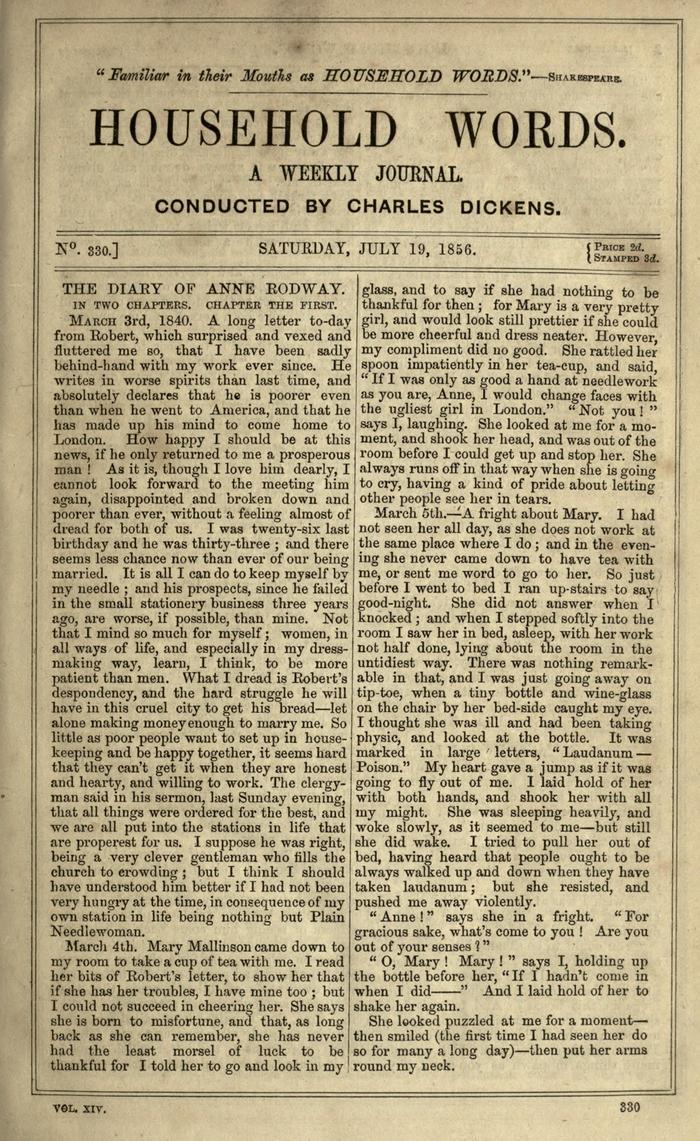
<p><a href="/tags/otd/" rel="tag">#OTD</a> in 1856.</p><p>Wilkie Collins' "Anne Rodway", a story in diary form about a needlewoman and her fiancé investigating the murder of a friend, appears in Household Words (first chapter), as the first English story to feature a woman as the main detective character.</p><p>The story is set in mid-19th century London, depicting the harsh realities of life for the working poor.</p><p><a href="https://djo.org.uk/household-words/volume-xiv/page-1.html" rel="nofollow" class="ellipsis" title="djo.org.uk/household-words/volume-xiv/page-1.html"><span class="invisible">https://</span><span class="ellipsis">djo.org.uk/household-words/vol</span><span class="invisible">ume-xiv/page-1.html</span></a></p><p><a href="/tags/books/" rel="tag">#books</a> <a href="/tags/literature/" rel="tag">#literature</a></p>
Edited 1y ago