#the true name

50 books   6 movies  

"Our effectiveness depends on our capacity to be audacious and astute, clear and appealing. I would hope that we can create a language more fearless and beautiful than that used by conformist writers to greet the twilight. In Latin America a literature is taking shape and acquiring strength, a literature that does not propose to bury our dead, but to immortalize them; that refuses to stir the ashes but rather attempts to light the fire. Perhaps it may help to preserve for the generations to come 'the true name of all things.'"

  • Eduardo Galeano (Days and Nights of Love and War)

Book

Blood in the Water
Goodreads Skybridge
Heather Ann Thompson publishing house: Pantheon 2016 - 8
The first definitive account of the infamous 1971 Attica prison uprising, the state’s violent response, and the victims' decades-long quest for justice including information never released to the public published to coincide with the forty-fifth anniversary of this historic event. On September 9, 1971, nearly 1,300 prisoners took over the Attica Correctional Facility in upstate New York to protest years of mistreatment. Holding guards and civilian employees hostage, during the four long days and nights that followed, the inmates negotiated with state officials for improved living conditions. On September 13, the state abruptly ended talks and sent hundreds of heavily armed state troopers and corrections officers to retake the prison by force. In the ensuing gunfire, thirty-nine men were killed, hostages as well as prisoners, and close to one hundred were severely injured. After the prison was secured, troopers and officers brutally retaliated against the prisoners during the weeks that followed. For decades afterward, instead of charging any state employee who had committed murder or carried out egregious human rights abuses, New York officials prosecuted only the prisoners and failed to provide necessary support to the hostage survivors or the families of any of the men who'd been killed. Heather Ann Thompson sheds new light on one of the most important civil rights stories of the last century, exploring every aspect of the uprising and its legacy from the perspectives of all of those involved in this forty-five-year fight for justice: the prisoners, the state officials, the lawyers on both sides, the state troopers and corrections officers, and the families of the slain men.


Book

Health Colonialism
Goodreads
Shiloh Krupar publishing house: University of Minnesota Press 2023 - 3
The role of American hospital expansions in health disparities and medical apartheid. Health Colonialism considers how U.S. urban development policies contribute to the uneven and unjust distribution of health care in this country. Here, Shiloh Krupar investigates the racially inequitable effects of elite U.S. hospitals on their surrounding neighborhoods and their role in consolidating frontiers of land primed for redevelopment. Naming this frontier “medical brownfields,” Krupar shows how hospitals leverage their domestic real estate empires to underwrite international prospecting for patients and overseas services and specialty clinics. Her pointed analysis reveals that decolonizing health care efforts must scrutinize the land practices of nonprofit medical institutions and the liberal foundations of medical apartheid perpetuated by globalizing American health care.

Book

How to Lose the Hounds
Goodreads
Celeste Winston publishing house: Duke University Press 2023 - 10
In How to Lose the Hounds Celeste Winston explores marronage—the practice of flight from and placemaking beyond slavery—as a guide to police abolition. She examines historically Black maroon communities in the Maryland suburbs of Washington, DC, that have been subjected to violent excesses of police power from slavery until the present day. Tracing the long and ongoing historical geography of Black freedom struggles in the face of anti-Black police violence in these communities, Winston shows how marronage provides critical lessons for reimagining public safety and community well-being. These freedom struggles take place in what Winston calls maroon geographies—sites of flight from slavery and the spaces of freedom produced in multigenerational Black communities. Maroon geographies constitute part of a Black placemaking tradition that asserts life-affirming forms of community. Winston contends that maroon geographies operate as a central method of Black flight, holding ground, and constructing places of freedom in ways that imagine and plan a world beyond policing.

Book

Settlers
Mythology of the White Proletariat: A Short Course in Understanding Babylon Goodreads NeoDB
J. Sakai publishing house: Morningstar Pres 1989
Settlers is a uniquely important book in the canon of the North American revolutionary left and anticolonial movements. First published in the 1980s by activists with decades of experience organizing in grassroots anticapitalist struggles against white supremacy, the book soon established itself as an essential reference point for revolutionary nationalists and dissident currents within the predominantly colonialist Marxist-Leninist and anarchist movements at that time. Always controversial within the establishment Left Settlers uncovers centuries of collaboration between capitalism and white workers and their organizations, as well as their neocolonial allies, showing how the United States was designed from the ground up as a parasitic and genocidal entity. Settlers exposes the fact that America’s white citizenry have never supported themselves but have always resorted to exploitation and theft, culminating in acts of genocide to maintain their culture and way of life. As recounted in painful detail by Sakai, the United States has been built on the theft of Indigenous lands and of Afrikan labor, on the robbery of the northern third of Mexico, the colonization of Puerto Rico, and the expropriation of the Asian working class, with each of these crimes being accompanied by violence.

Book

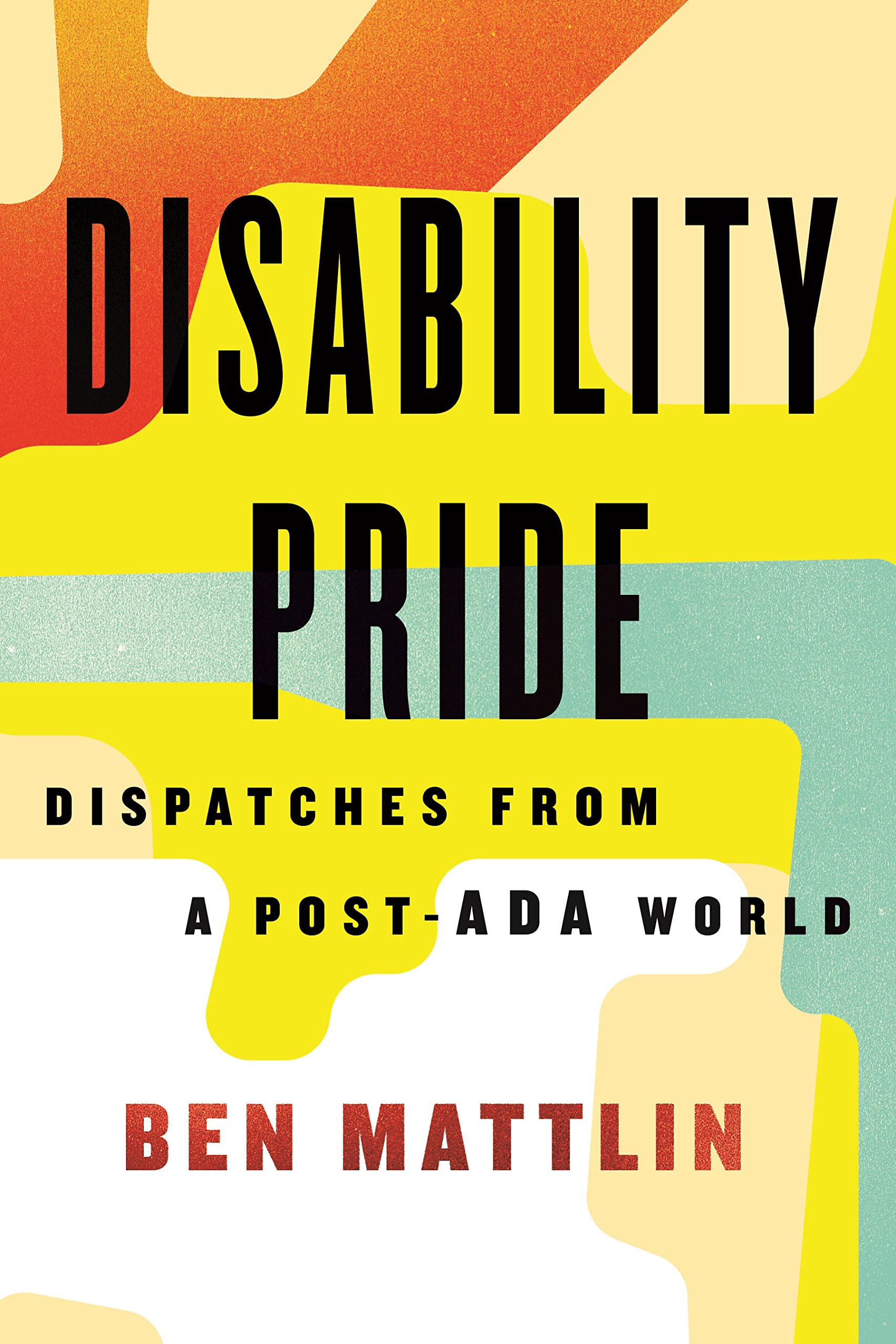
Disability Pride
Goodreads
Ben Mattlin publishing house: Beacon Press 2022 - 11
A disabled journalist documents how the “ADA Generation” has grown up, the rise of neurodiversity, impact of identity politics and representation, and the state of a disability rights and justice agenda Weaving together interviews with reportage, Disability Pride traces the evolution of societal attitudes and activist agendas around disability from a fight for civil rights to a celebration of identity and heritage. Since the American with Disabilities Act (ADA) passed over thirty years ago, changes can be seen everywhere—wheelchair ramps, braille signs and menus, public transit lifts, closed captioning on TVs, "reasonable accommodations" by employers such as flextime and telecommuting, and myriad other measures. People under 30 have not lived in a world without the expectation that disabled people should fully participate in society. Journalist Ben Mattlin demonstrates how a new generation of young people and disabled activists have made diversity and inclusiveness hallmarks of today’s social justice movements and modern media. From a giant Times Square billboard featuring disabled model Jillian Mercado to paraplegic actor and singer Ali Stroker becoming the first wheelchair-using performer ever to win a Tony, the world is ready to see, even to celebrate, nontraditional images of beauty. Mattlin explores how this new wave of disability visibility and pride is furthering the cause of disability justice. Today, activists are fighting for long-term personal-assistance services and for mental-health support systems and it's coming from a broad spectrum of disability perspectives. Although this new generation of activism may be different from the protest actions of previous generations, Disability Pride demonstrates how to fearlessly push the movement forward.

Book

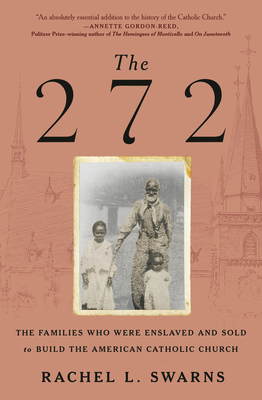
The 272
Goodreads
Rachel L. Swarns publishing house: Random House 2023 - 6
“An absolutely essential addition to the history of the Catholic Church, whose involvement in New World slavery sustained the Church and, thereby, helped to entrench enslavement in American society.”—Annette Gordon-Reed, Pulitzer Prize–winning author of The Hemingses of Monticello and On Juneteenth In 1838, a group of America’s most prominent Catholic priests sold 272 enslaved people to save their largest mission project, what is now Georgetown University. In this groundbreaking account, journalist, author, and professor Rachel L. Swarns follows one family through nearly two centuries of indentured servitude and enslavement to uncover the harrowing origin story of the Catholic Church in the United States. Through the saga of the Mahoney family, Swarns illustrates how the Church relied on slave labor and slave sales to sustain its operations and to help finance its expansion. The story begins with Ann Joice, a free Black woman and the matriarch of the Mahoney family. Joice sailed to Maryland in the late 1600s as an indentured servant, but her contract was burned and her freedom stolen. Her descendants, who were enslaved by Jesuit priests, passed down the story of that broken promise for centuries. One of those descendants, Harry Mahoney, saved lives and the church’s money in the War of 1812, but his children, including Louisa and Anna, were put up for sale in 1838. One daughter managed to escape. The other was sold and shipped to Louisiana. Their descendants would remain apart until Rachel Swarns’s reporting in The New York Times finally reunited them. They would go on to join other GU272 descendants who pressed Georgetown and the Catholic Church to make amends, prodding the institutions to break new ground in the movement for reparations and reconciliation in America. Swarns’s journalism has already started a national conversation about universities with ties to slavery. The 272 tells a bigger story, demonstrating how slavery fueled the growth of the Catholic Church in America and bringing to light the enslaved people whose forced labor helped to build the largest religious denomination in the nation.

Book

Owning the Sun
Goodreads
Alexander Zaitchik publishing house: Counterpoint 2022 - 3
An authoritative look at monopoly medicine from the dawn of patents through the race for COVID-19 vaccines and how the privatization of public science has prioritized profits over people. Owning the Sun tells the story of one of the most contentious fights in human history: the legal right to control the production of lifesaving medicines. Medical science began as a discipline geared toward the betterment of all human life, but the merging of research with intellectual property and the rise of the pharmaceutical industry warped and eventually undermined its ethical foundations. Since the Second World War, federally funded research has facilitated most major medical breakthroughs, yet these drugs are often wholly controlled by price-gouging corporations with growing international ambitions. Why does the U.S. government fund the development of medical science in the name of the public, only to relinquish exclusive rights to drug companies, and how does such a system impoverish us, weaken our responses to global crises, and, as in the case of AIDS and COVID-19, put the world at risk?   Outlining how generations of public health and science advocates have attempted to hold the line against Big Pharma and their allies in government, Alexander Zaitchik’s first-in-kind history documents the rise of medical monopoly in the United States and its subsequent globalization. From the controversial arrival of patent-wielding German drug firms in the late nineteenth century, to present-day coordination between industry and philanthropic organizations—including the influential Gates Foundation—that stymie international efforts to vaccinate the world against COVID-19, Owning the Sun tells one of the most important and least understood histories of our time.

Book

How to Hide an Empire
Goodreads Skybridge
Daniel Immerwahr publishing house: Farrar, Straus and Giroux 2019 - 2 other title: How to Hide an Empire: A History of the Greater United States
A pathbreaking history of the United States' overseas possessions and the true meaning of its empire We are familiar with maps that outline all fifty states. And we are also familiar with the idea that the United States is an "empire," exercising power around the world. But what about the actual territories — the islands, atolls, and archipelagos — this country has governed and inhabited? In How to Hide an Empire , Daniel Immerwahr tells the fascinating story of the United States outside the United States. In crackling, fast-paced prose, he reveals forgotten episodes that cast American history in a new light. We travel to the Guano Islands, where prospectors collected one of the nineteenth century's most valuable commodities, and the Philippines, site of the most destructive event on U.S. soil. In Puerto Rico, Immerwahr shows how U.S. doctors conducted grisly experiments they would never have conducted on the mainland and charts the emergence of independence fighters who would shoot up the U.S. Congress. In the years after World War II, Immerwahr notes, the United States moved away from colonialism. Instead, it put innovations in electronics, transportation, and culture to use, devising a new sort of influence that did not require the control of space. Rich with absorbing vignettes, full of surprises, and driven by an original conception of what empire and globalization mean today, How to Hide an Empire is a major and compulsively readable work of history.

Book

The Black Jacobins
Goodreads Douban NeoDB Skybridge
C.L.R. James publishing house: Vintage 1989 - 10 other title: The Black Jacobins: Toussaint L'Ouverture and the San Domingo Revolution
A powerful and impassioned historical account of the largest successful revolt by enslaved people in history: the Haitian Revolution of 1791–1803. "One of the seminal texts about the history of slavery and abolition.... Provocative and empowering." —The New York Times Book Review The Black Jacobins, by Trinidadian historian C. L. R. James, was the first major analysis of the uprising that began in the wake of the storming of the Bastille in France and became the model for liberation movements from Africa to Cuba. It is the story of the French colony of San Domingo, a place where the brutality of plantation owners toward enslaved people was horrifyingly severe. And it is the story of a charismatic and barely literate enslaved person named Toussaint L'Ouverture, who successfully led the Black people of San Domingo against successive invasions by overwhelming French, Spanish, and English forces—and in the process helped form the first independent post-colonial nation in the Caribbean. With a new introduction (2023) by Professor David Scott.

Book

Self Defense: A Philosophy of Violence
Se défendre, une philosophie de la violence Goodreads
Elsa Dorlin translator: Kieran Aarons publishing house: Verso 2022 - 9
A brilliant study of violent self-defense in the struggle for liberation by an award-winning philosopher. Is violent self-defense ethical? In the history of colonialism, racism, sexism, capitalism, there has long been a dividing line between bodies "worthy of defending" and those who have been disarmed and rendered defenseless. In 1685, for example, France's infamous "Code Noir" forbade slaves from carrying weapons, under penalty of the whip. In nineteenth-century Algeria, the colonial state outlawed the use of arms by Algerians, but granted French settlers the right to bear arms. Today, some lives are seen to be worth so little that Black teenagers can be shot in the back for appearing "threatening" while their killers are understood, by the state, to be justified. That those subject to the most violence have been forcibly made defenseless raises, for any movement of liberation, the question of using violence in the interest of self-defense. Here, philosopher Elsa Dorlin looks across the global history of the left - from slave revolts to the knitting women of the French Revolution and British suffragists' training in ju-jitsu, from the Warsaw Ghetto Uprising to the Black Panther Party, from queer neighborhood patrols to Black Lives Matter, to trace the politics, philosophy, and ethics of self defense. In this history she finds a "martial ethics of the self": a practice in which violent self defense is the only means for the oppressed to ensure survival and to build a liveable future. In this sparkling and provocative book, drawing on theorists from Thomas Hobbes to Fred Hampton, Frantz Fanon to Judith Butler, Michel Foucault to June Jordan, Dorlin has reworked the very idea of modern governance and political subjectivity.

Book

Disabled Ecologies
Goodreads
Sunaura Taylor publishing house: University of California Press 2024 - 5
A powerful analysis and call to action that reveals disability as one of the defining features of environmental devastation and the movements that resist it. Deep below the ground in Tucson, Arizona, lies an aquifer forever altered by the detritus of a postwar Superfund site. Disabled Ecologies tells the story of this contamination and its ripple effects through the largely Mexican American community living above. Drawing on her own complex relationship to this long-ago injured landscape, Sunaura Taylor takes us with her to follow the site's disabled ecology—the networks of disability, both human and wild, that are created when ecosystems are corrupted and profoundly altered. What Taylor finds is a story of entanglements that reach far beyond the Sonoran Desert. These stories tell of debilitating and sometimes life-ending injuries, but they also map out alternative modes of connection, solidarity, and resistance—an environmentalism of the injured. An original and deeply personal reflection on what disability means in an era of increasing multispecies disablement, Disabled Ecologies is a powerful call to reflect on the kinds of care, treatment, and assistance this age of disability requires.

Book

Pirate Care
Goodreads
Valeria Graziano / Marcell Mars … publishing house: Pluto Press 2025 - 1
‘A most nourishing and encouraging book’ – McKenzie Wark, author of A Hacker Manifesto In many places around the world, the freedom to simply care for one another is being attack by the powerful, and acts of solidarity are being made illegal. In a moment of struggle defined by the rollback of the social safety net, the criminalization of migration, and the right-wing clampdown on bodily autonomy, radical networks of care are fighting back. From volunteer rescue boats in the Mediterranean to underground labs preparing gender-affirming hormones, people are reclaiming the means to care for one another in defiance of a system that devalues and exploits the labor of care. Against atomized despair, Pirate Care shows that fighting back isn’t only about legal and legislative changes but also about organizing, direct action, and disobedient care.

Book

A Short History of Trans Misogyny
Goodreads Skybridge
Jules Gill-Peterson publishing house: Verso 2024 - 1
An accessible, bold new vision for the future of intersectional trans feminism, called "one of the best books in trans studies in recent years" by Susan Stryker Why are trans women the most targeted of LGBT people? Why are they in the crosshairs of a resurgent anti-trans politics around the world? And what is to be done about it by activists, organizers, and allies? A Short History of Transmisogyny is the first book-length study to answer these urgent but long overdue questions. Combining new historical analysis with political and activist accessibility, the book shows why it matters to understand trans misogyny as a specific form of violence with a documentable history. Ironically, it is through attending to the specificity of trans misogyny that trans women are no longer treated as inevitably tragic figures. They emerge instead as embattled but tenacious, locked in a struggle over the meaning and material stakes of gender, labor, race, and freedom. The book travels across bustling port cities like New York, New Orleans, London and Paris, the colonial and military districts of the British Raj, the Philippines, and Hawai'i, and the lively travesti communities of Latin America. The book shows how trans femininity has become legible as a fault line of broader global histories, including colonial government, the sex work industry, the policing of urban public space, and the line between the formal and informal economy. This transnational and intersectional approach reinforces that trans women are not isolated social subjects who appear alone; they are in fact central to the modern social world.

Book

Belly of the Beast
Goodreads
Da’Shaun Harrison publishing house: North Atlantic Books 2021 - 8
Exploring anti-fatness and anti-Blackness at the intersections of race, police violence, gender identity, fatness, and health. To live in a body both fat and Black is to intersect at the margins of a society that normalizes anti-fatness as anti-Blackness: hyper-policed by state and society, passed over for housing and jobs, and derided and misdiagnosed by medical professionals, fat Black people in the United States are subject to culturally sanctioned discrimination, abuse, and trauma. In Belly of the Beast, author Da’Shaun Harrison–a fat, Black, disabled, and non-binary writer AMAB (assigned male at birth)–offers an incisive, fresh, and precise exploration of anti-fatness as anti-Blackness. Foregrounding the state-sanctioned murder of Eric Garner in a historical analysis of the policing, disenfranchisement, and invisibilizing of fat Black men and trans and nonbinary AMAB people, Harrison discusses the pervasive, insidious ways that anti-fat anti-Blackness shows up in everyday life. Fat people can be legally fired in 49 states for being fat; they’re more likely to be houseless. Fat people die at higher rates from misdiagnosis or non-treatment; fat women are more likely to be sexually assaulted. And at the intersections of fatness, race, disability, and gender identity, these abuses are exacerbated. Taking on desirability politics, f*ckability, healthism, hyper-sexualization, invisibility, and the connections between anti-fatness and police violence, Harrison viscerally and vividly illustrates the myriad harms of anti-fat anti-Blackness–and offers strategies for dismantling denial, unlearning the cultural programming that says “fat is bad,” and moving beyond the world we have now toward one that makes space for the fat and Black.

Book

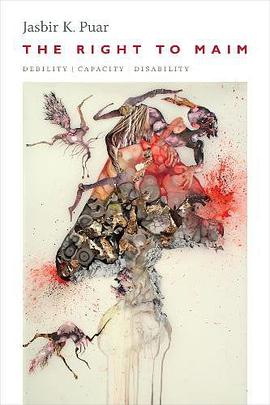
The Right to Maim
Douban NeoDB
Jasbir K. Puar publishing house: Duke University Press Books 2017 - 11
In The Right to Maim Jasbir K. Puar brings her pathbreaking work on the liberal state, sexuality, and biopolitics to bear on our understanding of disability. Drawing on a stunning array of theoretical and methodological frameworks, Puar uses the concept of “debility”—bodily injury and social exclusion brought on by economic and political factors—to disrupt the category of disability. She shows how debility, disability, and capacity together constitute an assemblage that states use to control populations. Puar's analysis culminates in an interrogation of Israel's policies toward Palestine, in which she outlines how Israel brings Palestinians into biopolitical being by designating them available for injury. Supplementing its right to kill with what Puar calls the right to maim, the Israeli state relies on liberal frameworks of disability to obscure and enable the mass debilitation of Palestinian bodies. Tracing disability's interaction with debility and capacity, Puar offers a brilliant rethinking of Foucauldian biopolitics while showing how disability functions at the intersection of imperialism and racialized capital.

Book

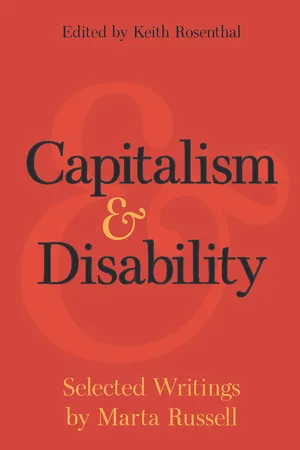
Capitalism and Disability
Google Books NeoDB
Marta Russell publishing house: Haymarket Books 2019 - 8
Spread out over many years and many different publications, the late author and activist Marta Russell wrote a number of groundbreaking and insightful essays on the nature of disability and oppression under capitalism. In this volume, Russell’s various essays are brought together in one place in order to provide a useful and expansive resource to those interested in better understanding the ways in which the modern phenomenon of disability is shaped by capitalist economic and social relations. The essays range in analysis from the theoretical to the topical, including but not limited to: the emergence of disability as a “human category” rooted in the rise of industrial capitalism and the transformation of the conditions of work, family, and society corresponding thereto; a critique of the shortcomings of a purely “civil rights approach” to addressing the persistence of disability oppression in the economic sphere, with a particular focus on the legacy of the Americans with Disabilities Act of 1990; an examination of the changing position of disabled people within the overall system of capitalist production utilizing the Marxist economic concepts of the reserve army of the unemployed, the labor theory of value, and the exploitation of wage-labor; the effects of neoliberal capitalist policies on the living conditions and social position of disabled people as it pertains to welfare, income assistance, health care, and other social security programs; imperialism and war as a factor in the further oppression and immiseration of disabled people within the United States and globally; and the need to build unity against the divisive tendencies which hide the common economic interest shared between disabled people and the often highly-exploited direct care workers who provide services to the former.
Reply Quote Dec. 29, 2025